Training BasicsHow-to
Strength Training at Home: Where a Beginner Starts
Living Room Strength ·
About this illustration
Illustration by Living Room Strength: a generated marker drawing of a room, not a photograph and not a guide to any move. It shows no people. Reuse it with credit to Living Room Strength; this site claims rights in it only as far as the law grants them.Answer first
Train the easiest version of a squat, a push and a hip hinge at least two days a week. Do 1 to 3 sets of 8 to 12 reps of each, and move to a harder version only when the Spare-Two Check says so. Add a pull once you have a band, a dumbbell or a doorway pull-up bar. Every move on this site has its own page with the versions in order, so you never start from the hardest one.
If you have a long-term health condition, or symptoms such as chest pain or pressure, dizziness or joint pain, or you are pregnant or have recently given birth, talk to a health care provider before you start. If new symptoms show up as you do more, talk to one then too. Physical Activity Guidelines for Americans, 2nd edition, chapter 7, p. 93 (Guidelines).
Floor Card
- Space
- Mat, Wall
- Noise
- Quiet
- Kit
- sturdy chair
- Version today
- The first version on each move page you use
- Sets × reps
- 1–3 × 8–12
- Rest
- 30 seconds, 30–90 seconds or 1–3 minutes, by goal (HPRC)
- Easier
- Not used here
- Stop for today if
- “Stop the exercise immediately if you feel any pain or become unwell.” If the pain does not go away, see a doctor.The quoted sentence: Information from the NHS website, as at 261126 (NHS). Seeing a doctor if the pain stays: Living Room Strength rule.
- End the set if
- The equipment moves or gives: the doorway bar shifts or creaks, the band has a nick, a cut or loose stitching, the chair or couch slides, or the step wobbles. End the set and check it against its instructions before the next one.What to look for on a band comes from the instructions that come with bands. Ending the set and checking: Living Room Strength rule.
- You can no longer do the move the way this page describes it. That set ends there.Going on only while the move meets its standard: Adapted from ATP 7-22.02, p. 13-7 (ATP 7-22.02).
What counts as strength training at home?
Strength training is any activity that makes your muscles do more work than they are used to. The U.S. Physical Activity Guidelines for Americans list lifting weights, working with resistance bands, body-weight moves such as push-ups and pull-ups, and carrying heavy loads (p. 61) [1]. At home, that usually means your own body weight, a resistance band, or a pair of dumbbells. This site's pages stop at a pair of dumbbells.
The versions and rules on this site have not been tried on anyone. They are written from the sources each page lists, and each page marks which parts are its own rules.
How many days a week?
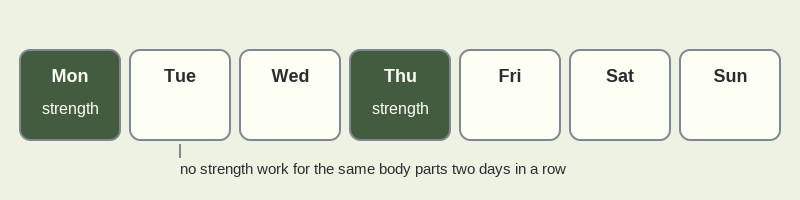
Train at least two days a week, at moderate effort or harder, and cover the legs, hips, back, chest, abdomen, shoulders and arms (pp. 56, 61) [1]. A military fitness resource, HPRC, gives 2 to 3 days a week, depending on your goals [3]. The National Institute on Aging adds one limit: don't train the same part of the body two days in a row (adapted from the National Institute on Aging, NIH) [2].
So two days with at least one day between them meets all three. Monday and Thursday is one example; the days themselves are a Living Room Strength rule. How to split the body across more days is on Workout Splits: Full Body, Upper/Lower, Push/Pull/Legs.
The guidelines set no length for a session (p. 61) [1]. This site does not give one either, and it gives no fixed number of moves.
Which moves go into one session?
The guidelines say "The improvement in, or maintenance of, muscle strength is specific to the muscles used during the activity," so you need a variety of moves to cover the whole body (p. 61) [1]. HPRC sorts strength moves into five groups and suggests using all of them: lower-body push or pull, upper-body horizontal push or pull, upper-body vertical push or pull, anti-rotation, and rotation [3].
Here is how this site's first pages fit those groups. Which move goes in which group is a Living Room Strength rule.
- Lower-body push: How to Squat at Home, From a Chair to a Goblet Squat, Reverse Lunges in a Small Room, Step-Ups on a Stair at Home
- Lower-body pull (the hip hinge): Romanian Deadlift With Dumbbells, Hip Hinge First
- Upper-body horizontal push: Push-Up Progression: From the Wall to the Floor
- Upper-body horizontal pull: Seated Resistance Band Rows on the Floor, Dumbbell Row at Home With One Hand on a Chair
- Upper-body vertical pull: Pull-Up Progression When You Can't Do One Yet, Dead Hang on a Doorway Bar: Check the Bar Before You Hang (the hang comes before the pull-up)
- Anti-rotation and rotation: this site has no pages for these yet.
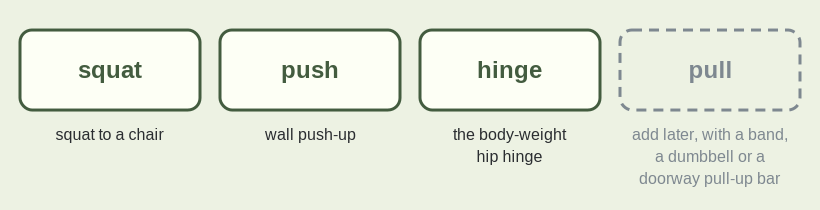
Your first session needs no kit beyond a sturdy chair: a squat to a chair, a wall push-up, and the body-weight version of the hip hinge. Use a sturdy chair with no wheels, one that won't slip or fold, with its back against a wall (a Living Room Strength rule). How to Squat at Home, From a Chair to a Goblet Squat shows the squat to a chair.
The National Institute on Aging suggests that beginners try moves without weights or resistance bands until they are comfortable with them (adapted from the National Institute on Aging, NIH) [2]. Every pull on this site needs a band, a dumbbell or a doorway pull-up bar. So your first session is a squat, a push and a hip hinge, and a pull comes later, once you have that kit (a Living Room Strength rule). None of these three is a pulling move. The guidelines' list includes the back, and a pull is the move this site adds for it. In the hip hinge, you still hold your trunk the way Romanian Deadlift With Dumbbells, Hip Hinge First describes.
An open college textbook puts moves that use several joints before moves that use one [5]. Everything in the sample session uses several joints, so any order works.
For whole sessions laid out move by move, see Bodyweight Workout at Home With No Equipment to Buy and Dumbbell Workout at Home With One Pair of Dumbbells. To find a move by the space and kit it needs, use the Exercise Names: A Home Exercise Library by Movement.
How many sets and reps?
The NHS defines the two words: "A repetition is 1 complete movement of an activity, like lifting a weight or doing 1 push-up or 1 sit-up." "Try to do 8 to 12 repetitions for each activity, which counts as 1 set." Information from the NHS website, as at 261126 (https://www.nhs.uk/live-well/exercise/how-to-improve-strength-flexibility/) [6].
The U.S. guidelines say one set of 8 to 12 reps of each move is effective, and 2 or 3 sets may be more effective (p. 61) [1]. The National Institute on Aging gives the same numbers (adapted from the National Institute on Aging, NIH) [2]. Most move pages here use that 8-to-12 band as their range. How Many Sets and Reps? Ranges, Goals and Moving Up explains how a range works.
For rest between sets, HPRC gives 30 seconds, 30 to 90 seconds, or 1 to 3 minutes, depending on the goal [3]. This site does not pick one; Rest Between Sets and Days Between Sessions sets them side by side.
How hard should each set be?
The guidelines say to work to the point where another rep would be difficult (p. 61) [1]. The National Institute on Aging gives the same point (adapted from the National Institute on Aging, NIH) [2]. Keep every form line on the move's page while you get there.
The Spare-Two Check answers a different question: whether this version is still hard enough. It is a Living Room Strength rule, not a finding from a source. At the end of the last set in a session, check three things:
- Did you reach the top of the range in every set?
- Did every rep keep the form lines?
- Could you have done about two more good reps?
If all three are yes, next session you move to the harder version and start at the bottom of the range.
The two rules sit side by side, and they can point to different places. The guidelines describe how hard a set should be. The Spare-Two Check decides when you change versions: if you reach the top of the range with about two reps to spare, the set ends at the top, and this version has become too easy for you. Moving up then is a Living Room Strength rule. If your first set on the harder version can't reach the bottom of the range, the check sends you back to the easier version next session. RPE Scale and Reps in Reserve for Home Sets explains how to guess the reps you have left, and Progressive Overload at Home With One Pair of Dumbbells has the full check.
The idea is close to two rules for adding weight. HPRC describes a "2-for-2" rule: add weight once you can do two more reps than your goal in the last set, two weeks in a row [4]. This site doesn't wait two weeks; the Spare-Two Check looks at one session. An open college textbook suggests adding 2 to 10 percent more load once you pass your target by one or two reps [5]. This site uses the same idea to change versions instead of weight, which is its own extension.
Where do you start?
If you are new, start without weights or bands until the moves feel familiar (adapted from the National Institute on Aging, NIH) [2]. The guidelines tell people who are not active to "start low and go slow" (p. 88) [1]. On this site, that means the first row of each move's version table, a Living Room Strength rule. Bodyweight Progression Finder for Progressive Overload shows which version comes next.
Use good form, move through the full range, and keep each rep under control [5]. This site takes the range of motion from each version's page. HPRC lists the ways to make training harder over time: more reps or sets, more weight, more sessions, or less rest [4]. On this site, harder mostly means the next version.
About this illustration
Illustration by Living Room Strength: a generated marker drawing of a room, not a photograph and not a guide to any move. It shows no people. Reuse it with credit to Living Room Strength; this site claims rights in it only as far as the law grants them.How do you warm up and breathe?
The guidelines say a warm-up for strength work usually means doing the same moves with less weight (p. 62) [1]. The National Institute on Aging also suggests warming up with less weight (adapted from the National Institute on Aging, NIH) [2]. If you're on the first row of a move, do one light set of that same version with fewer reps. If you're past the first row, do one light round of an easier version instead. Both are a Living Room Strength rule. Warm Up Before a Home Workout and Each Strength Move has more.
Don't hold your breath. Breathe out during the effort and in as you relax (adapted from the National Institute on Aging, NIH) [2]. The textbook also says to breathe out during the effort [5].
Does this count as cardio or stretching?
No. The guidelines list aerobic activity and strength work as separate targets (p. 56) [1], and time spent stretching counts toward neither (p. 61) [1]. For cardio without jumping, see Low-Impact Cardio at Home With No Jumping. For one stretch done three ways, see Hip Flexor Stretch: Kneeling, Standing or Lying Down.
Next session: open one squat, one push and one hip hinge page, and start each at its first version.
Source trail
- What counts as muscle-strengthening; at least 2 days a week for the legs, hips, back, chest, abdomen, shoulders and arms; no set session length; variety because strength is specific to the muscles used; work to where another rep would be difficult; 1 set of 8 to 12 effective, 2 or 3 may be more; start low and go slow; warm up with lighter weight [1]
- Same frequency and sets; avoid the same body area two days in a row; beginners start without weights or bands until the moves feel familiar; warm up with less weight; breathe out on the effort [2]
- 2 to 3 days a week; five movement categories for balance; rest between sets of 30 seconds, 30 to 90 seconds, or 1 to 3 minutes [3]
- Ways to progress; the 2-for-2 rule for adding weight [4]
- From an open college textbook: proper form, full range, controlled; multi-joint before single-joint; breathing; adding load once you pass the target reps [5]
- What a rep and a set are (quoted) [6]
Living Room Strength rule
- Which move fits which category; the sample first session (squat, push and hinge with no kit beyond a chair; a pull added once you have a band, a dumbbell or a doorway pull-up bar, since every pull here needs one) and week; a sturdy chair with no wheels, one that won't slip or fold, with its back against a wall; the warm-up set on a first row uses the same version with fewer reps, and past the first row it is one light round of an easier version; the range of motion is the one each version page gives; reaching the top of the range with about two reps to spare means the version is too easy; the Spare-Two Check looks at one session rather than two weeks; starting at the first row of each version table; the Spare-Two Check and starting the harder version at the bottom of the range
Living Room Strength set these itself. No source gives them, so read them as this site’s choice, not a finding.
Sources
Numbers in brackets point here. Anything marked Living Room Strength rule is this site’s own choice and has no source.
- U.S. Department of Health and Human Services. Physical Activity Guidelines for Americans, 2nd edition (2018) Open the source Read: Full guidelines; Chapter 4 (pages 56-62) and Chapter 7 (pages 88-93) used.
- National Institute on Aging, NIH. Three Types of Exercise Can Improve Your Health and Physical Ability (content reviewed 2025) Open the source Read: Full article; general principles only.
- Human Performance Resources by CHAMP (HPRC). Use the FITT-VP principle to plan your workouts (2025) Open the source Read: Full article and FITT-VP table.
- Human Performance Resources by CHAMP (HPRC). Guidelines to progress your physical training over time (2021) Open the source Read: Full article.
- Markell, Peterson and Johnson (Centralia College). Exercise and Nutrition, 4.3: Resistance Exercise Programming. Medicine LibreTexts Open the source Read: Section 4.3; its recommendations summarize the 2009 ACSM position stand. License: CC BY 4.0.
- NHS. How to improve your strength and flexibility Open the source Read: Full page (page last reviewed 21 July 2026).
Elsewhere in the room
Corrections
No corrections on this page yet. If a line, a number or a drawing here is wrong, tell this site.