Training BasicsReference
RPE Scale and Reps in Reserve for Home Sets
Living Room Strength ·
About this illustration
Illustration by Living Room Strength: a generated marker drawing of a room, not a photograph and not a guide to any move. It shows no people. Reuse it with credit to Living Room Strength; this site claims rights in it only as far as the law grants them.Answer first
RPE is a rating of how hard you feel you are working. Reps in reserve (RIR) is how many more good reps you think you could have done. On the RPE scale built on reps in reserve, a 10 means none left and an 8 means about two. Treat the number as a rough guess, and let the form lines decide first.
What is the RPE scale?
The letters stand for rating of perceived exertion. An open college textbook sums it up as one question, which asks how hard you feel you are working overall [1]. The first version runs from 6 to 20, where 6 is almost no effort and 20 is the most you can give. A later version runs from 1 to 10, from resting effort up to the most you can give [1].
The Physical Activity Guidelines for Americans use a similar effort scale from 0 to 10, where sitting is 0 and the hardest effort possible is 10 (p. 58) [2]. On it, moderate effort is a 5 or 6, and vigorous effort starts at a 7 or 8 [2].
| Scale | Bottom | Top | Source |
|---|---|---|---|
| RPE, 6 to 20 | 6: almost no effort | 20: the most you can give | Open college textbook [1] |
| RPE, 1 to 10 | 1: resting effort | 10: the most you can give | Open college textbook [1] |
| Effort scale, 0 to 10 | 0: sitting | 10: the hardest effort possible (moderate is 5 or 6; vigorous starts at 7 or 8) | U.S. guidelines, p. 58 [2] |
These scales ask how hard you are working overall, as on a walk or in a round of an interval workout. For a set of push-ups or squats, this site uses the scale below, built on reps in reserve.
What does reps in reserve mean?
Reps in reserve is the number of good reps you could still have done when you ended a set. If you stopped at 10 and could have done 12, you had two in reserve. It's a guess, made at the end of the set.
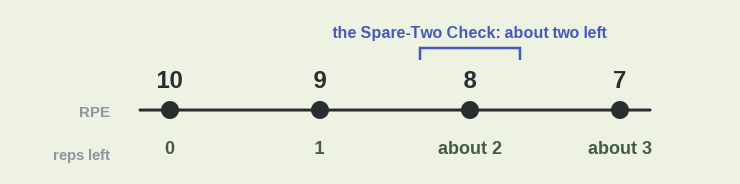
A 2016 study described an RPE scale for strength work where each number stands for reps left: 10 means none left, 9 means one left, and so on [3]. That makes an 8 about two left and a 7 about three.
| Rating on the reps-in-reserve scale | Reps you could still have done |
|---|---|
| 10 | None |
| 9 | 1 |
| 8 | About 2 |
| 7 | About 3 |
How accurate is the guess?
Only roughly. In studies, people tended to guess fewer reps in reserve than they really had, and the guess got closer the nearer they were to the end of the set; studies disagree on whether experience helps [4] [5].
So on this site the guess comes second. Every rep has to keep the form lines on the move's page, and a rep that breaks one ends the set, whatever number you had in mind. That order is a Living Room Strength rule.
How does this site use reps in reserve?
It shows up in one place: the third part of the Spare-Two Check. After the last set of a session, ask whether you could have done about two more good reps. If you could, and every set reached the top of the range with clean reps, the version has become too easy. The full check is on Progressive Overload at Home With One Pair of Dumbbells, and How Many Sets and Reps? Ranges, Goals and Moving Up explains the range.
The guidelines describe a different point: work each set until another rep would be difficult (p. 61) [2]. The National Institute on Aging says the same (adapted from the National Institute on Aging, NIH) [6]. The two sit side by side, and they can point to different places. Strength Training at Home: Where a Beginner Starts shows how they fit into one session.
Holds don't have reps, so the check uses something else. For a plank-type hold, the question is whether you could have stayed for about two more slow breaths. For a dead hang on Pull-Up Progression When You Can't Do One Yet, it is whether you could have hung on longer before either hand started to slip. Both are a Living Room Strength rule.
How do you make the guess at home?
These steps are a Living Room Strength rule:
- Decide before the last set that you will rate it, so you pay attention to the last few reps.
- When the set ends, answer with a number, not a feeling: zero, one, two, three.
- If you can't choose between two numbers, take the lower one.
- If a form line broke on the last rep, the answer is zero, whatever it felt like.
Rest the same amount each time, too. A guess after 30 seconds of rest and a guess after three minutes are not the same guess; Rest Between Sets and Days Between Sessions explains why the site keeps rest fixed.
About this illustration
Illustration by Living Room Strength: a generated marker drawing of a room, not a photograph and not a guide to any move. It shows no people. Reuse it with credit to Living Room Strength; this site claims rights in it only as far as the law grants them.Can you use RPE for cardio at home?
Yes, and a talk test works too. The guidelines' rule of thumb: at moderate effort you can talk but not sing, and at vigorous effort you can't say more than a few words without stopping for a breath (p. 60) [2]. The National Institute on Aging gives a similar test (adapted from the National Institute on Aging, NIH) [6]. The textbook adds the talk test as another way to rate effort [1].
Low-Impact Cardio at Home With No Jumping uses the talk test for a session without jumping. For work and rest rounds, see HIIT, Tabata, EMOM and AMRAP: Four Ways to Time a Workout and the Interval Workout Timer for Work, Rest and Rounds at Home.
Next session: after the last set of one move, say a number out loud for the reps you had left, and write it down next to the reps you did.
Source trail
- RPE as a rating of how hard you feel you are working; the 6-to-20 scale and the 1-to-10 scale; the talk test as another way to rate effort [1]
- A 0-to-10 effort scale (5 or 6 moderate, 7 or 8 the start of vigorous); the talk test; working to where another rep would be difficult [2]
- One sentence: an RPE scale where each number stands for reps left (10 none, 9 one, and so on) [3]
- One sentence: guesses of reps left usually come in low and get closer near the end of a set [4]
- Same sentence: studies disagree on whether experience helps [5]
- Talk test wording; working to where another rep would be difficult [6]
Living Room Strength rule
- Form lines come before the guess; about two reps left in the Spare-Two Check; about two slow breaths for holds; hands starting to slip for the dead hang; answering with a number after the last set and taking the lower number when unsure
Living Room Strength set these itself. No source gives them, so read them as this site’s choice, not a finding.
Sources
Numbers in brackets point here. Anything marked Living Room Strength rule is this site’s own choice and has no source.
- Markell, Peterson and Johnson (Centralia College). Exercise and Nutrition, 3.5: Measuring Intensity. Medicine LibreTexts Open the source Read: Section 3.5 (talk test and perceived exertion parts). License: CC BY 4.0.
- U.S. Department of Health and Human Services. Physical Activity Guidelines for Americans, 2nd edition (2018) Open the source Read: Full guidelines; Chapter 4 (pages 56-62) and Chapter 7 (pages 88-93) used.
- Zourdos MC et al. (2016). Novel Resistance Training-Specific Rating of Perceived Exertion Scale Measuring Repetitions in Reserve. Journal of Strength and Conditioning Research 30(1):267-275 Open the source Read: Abstract.
- Halperin I et al. (2022). Accuracy in Predicting Repetitions to Task Failure in Resistance Exercise: A Scoping Review and Exploratory Meta-analysis. Sports Medicine 52(2):377-390 Open the source Read: Abstract.
- Steele J et al. (2017). Ability to predict repetitions to momentary failure is not perfectly accurate, though improves with resistance training experience. PeerJ 5:e4105 Open the source Read: Abstract.
- National Institute on Aging, NIH. Three Types of Exercise Can Improve Your Health and Physical Ability (content reviewed 2025) Open the source Read: Full article; general principles only.
Elsewhere in the room
Corrections
No corrections on this page yet. If a line, a number or a drawing here is wrong, tell this site.