Push & PullMove
Dumbbell Row at Home With One Hand on a Chair
Living Room Strength ·
About this illustration
Illustration by Living Room Strength: a generated marker drawing of a room, not a photograph and not a guide to any move. It shows no people. Reuse it with credit to Living Room Strength; this site claims rights in it only as far as the law grants them.Answer first
Start with one dumbbell and your free hand on the seat of a sturdy chair. Pull until your upper arm is level with the floor, then lower the weight until your arm is straight. The order on this site is that row, then a slower lowering, then a pause at the top, then a heavier dumbbell. Move on only when the Spare-Two Check at the end of a session says so.
Floor Card
- Space
- Mat
- Noise
- Quiet
- Kit
- one dumbbell, sturdy chair
- Version today
- One-arm dumbbell row
- Sets × reps
- 2–3 × 8–12 per side
- Rest
- 30 seconds, 30–90 seconds or 1–3 minutes, by goal (HPRC)
- Spare-Two Check
- 12 reps per side
- Easier
- None on this site yet
- Stop for today if
- “Stop the exercise immediately if you feel any pain or become unwell.” If the pain does not go away, see a doctor.The quoted sentence: Information from the NHS website, as at 261126 (NHS). Seeing a doctor if the pain stays: Living Room Strength rule.
- End the set if
- The equipment moves or gives: the doorway bar shifts or creaks, the band has a nick, a cut or loose stitching, the chair or couch slides, or the step wobbles. End the set and check it against its instructions before the next one.What to look for on a band comes from the instructions that come with bands. Ending the set and checking: Living Room Strength rule.
- You can no longer keep one of the form lines. That rep ends the set.Going on only while the move meets its standard: Adapted from ATP 7-22.02, p. 13-7 (ATP 7-22.02).
Form lines
- Your free hand rests on the chair seat with the arm straight, and both feet are flat on the floor.
- Your back stays straight, with your head in line with it, and neither moves while you pull.
- You pull until your upper arm is level with the floor and your elbow points back.
- Your shoulder stays down and back as you pull.
You can film one set from the side on your phone and check each line. The video stays on your phone; this site never sees it.
The back, head and pulling lines come from the U.S. Army manual ATP 7-22.02. Its single-arm bent-over row keeps the back straight and the head in line with the spine. It pulls the weight toward the chest until the upper arm is parallel to the ground, with the elbow pointing to the rear, while the head and spine stay where they started (para 14-17, p. 14-12). Its two-handed bent-over row says the same about the elbows, head and spine (para 14-16, p. 14-11).
The shoulder line comes from HPRC, the Uniformed Services University's fitness resource. For rows, it says to keep "your shoulders down and back" (Foundational movements: Pull).
The first line is a Living Room Strength rule. ATP rests one hand and one knee on a weight bench. Here a chair takes the bench's place, and both feet stay on the floor, as the next section explains.
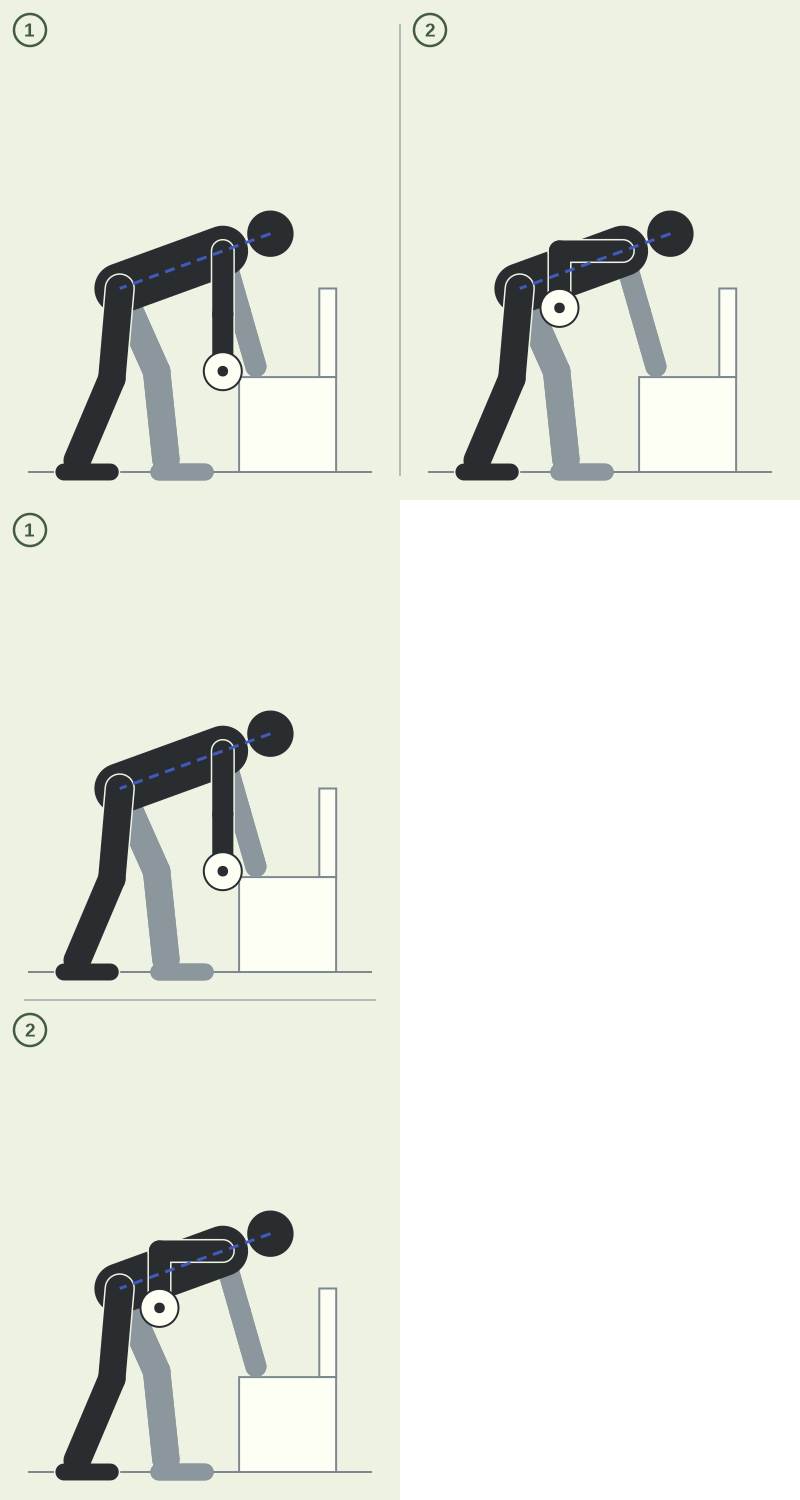
The one-arm row. Panel 1 is the start, arm straight; panel 2 is the top, upper arm level with the floor.
Dumbbell row versions, from one dumbbell to a heavier one
| Order | Version | What changes | Range | Basis |
|---|---|---|---|---|
| 1 | One-arm dumbbell row | Start | 8–12 reps per side | [1] |
| 2 | One-arm row, slow lowering | Tempo: three seconds on the way down | 8–12 reps per side | Living Room Strength rule |
| 3 | One-arm row with a pause | Pause: one second with the elbow back, with the slow lowering kept | 8–12 reps per side | Living Room Strength rule |
| 4 | One-arm row, heavier dumbbell | Load: the next heavier dumbbell, with the slow lowering and the pause kept | 8–12 reps per side | [3] |
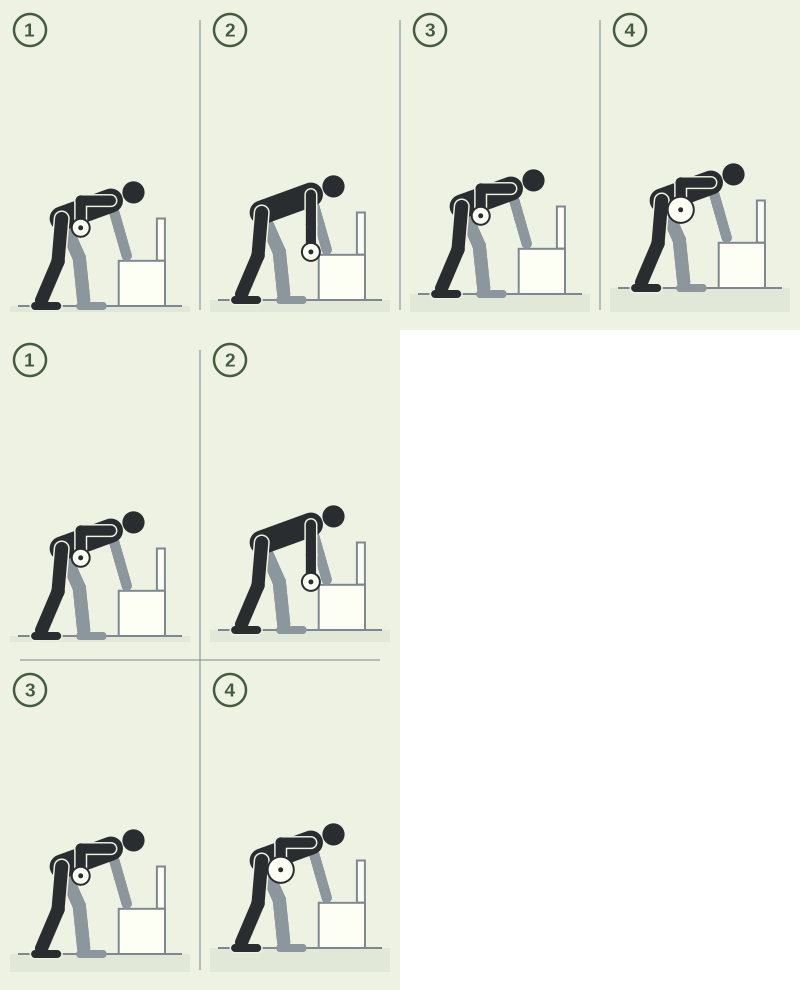
The four versions in order. Rows 2 and 3 change the timing; row 4 changes the weight.
Row 1 is ATP's single-arm row, moved from a bench to a chair. Rows 2 and 3 are this site's own steps for when you have one dumbbell: they make the same weight harder by slowing the way down and then holding the top. The three seconds and the one second are this site's choice, a Living Room Strength rule.
Each row keeps what the row before it changed. Row 3 is the slow lowering plus the pause, and row 4 keeps both and adds weight. That way each row changes one thing.
Row 4 adds weight, one of the ways HPRC lists for making strength work harder: "the weight you use" is among the things you can increase (Guidelines to progress your physical training over time). Pick a dumbbell you can control through the whole rep; ATP's row asks for a weight you can control (para 14-17, p. 14-12).
How do you set up the chair?
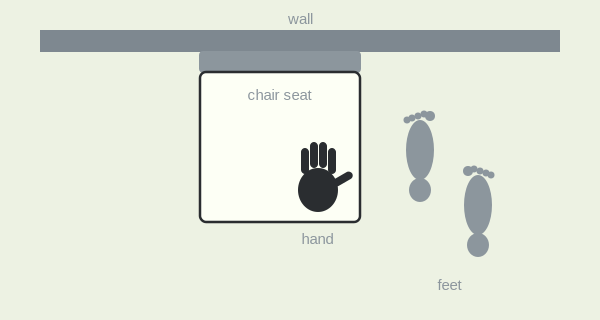
Use a chair that won't fold, and push its back against a wall so it can't slide when you lean on the seat (Living Room Strength rule). For the chair itself, the NHS advice fits, quoted as written: "choose a solid, stable chair that does not have wheels and that will not slip on the surface it is on." Information from the NHS website, as at 261126, https://www.nhs.uk/live-well/exercise/strength-exercises/.
Stand beside the chair, with the seat at your side. Bend forward and put the hand nearer the chair flat on the seat, arm straight but not locked (Adapted from the National Institute on Aging, NIH). Hold the dumbbell in the other hand. Step the foot on the dumbbell side back a little, so both feet are flat on the floor, your back can stay straight, and the dumbbell has room to pass your front leg.
ATP puts a knee on its bench as well. On a chair, keep both feet on the floor and both knees off the seat. These setup choices are a Living Room Strength rule.
Credit and license
"A chair against the wall for a one-arm row, seen from above" from Living Room Strength (https://livingroomstrength.com/push-and-pull/dumbbell-row/), licensed CC BY 4.0 (creativecommons.org/licenses/by/4.0)The setup from above. The wall keeps the chair from sliding away from your hand.
How do you hold and pull the dumbbell?
Hold the dumbbell with your palm facing in, toward your body, and your thumb wrapped around the handle. ATP's two-handed bent-over row holds its weights with a closed neutral grip like this (Adapted from ATP 7-22.02, para 13-10, p. 13-8). Chin-Up vs Pull-Up Grip and Which Way the Palms Face explains the grip names.
Start with the arm hanging straight below your shoulder. Pull the dumbbell up toward your chest until your upper arm is level with the floor and your elbow points back. Then lower it until your arm is straight again.
Breathe out as you pull and in as you lower, rather than holding your breath (Adapted from the National Institute on Aging, NIH).
Do all your reps on one side, then switch hands and do the same number on the other side (Living Room Strength rule). Set the dumbbell down on the mat between sides; don't drop it.
How many reps and sets, and how long to rest?
The Floor Card uses 2 to 3 sets of 8 to 12 reps on each side. The U.S. Physical Activity Guidelines for Americans say one set of 8 to 12 reps is effective and two or three sets may be more effective (p. 61). How Many Sets and Reps? Ranges, Goals and Moving Up explains how a range works.
For rest, HPRC gives a range for each training goal. The three that fit home strength work are 30 seconds, 30 to 90 seconds, and 1 to 3 minutes, depending on the goal. This site doesn't choose one; Rest Between Sets and Days Between Sessions puts them side by side.
About this illustration
Illustration by Living Room Strength: a generated marker drawing of a room, not a photograph and not a guide to any move. It shows no people. Reuse it with credit to Living Room Strength; this site claims rights in it only as far as the law grants them.You move to the next row with the Spare-Two Check, explained under the table and on Progressive Overload at Home With One Pair of Dumbbells. The "two left" part is a guess about reps in reserve, and the page on reps in reserve explains how to make that guess. The Bodyweight Progression Finder for Progressive Overload asks the same questions one at a time.
What does it look like when the form slips?
- Your back rounds, or your head drops or lifts out of line with it.
- Your trunk twists or rises to swing the dumbbell up.
- Your elbow drifts out to the side instead of pointing back.
- Your upper arm stops short of level with the floor.
- Your shoulder rides up toward your ear as you pull.
- In rows 2 to 4, the lowering takes less than three seconds; in rows 3 and 4, the pause gets skipped.
The Floor Card says when a set ends.
The doorway-bar moves in this part of the room are Dead Hang on a Doorway Bar: Check the Bar Before You Hang and Pull-Up Progression When You Can't Do One Yet, and Seated Resistance Band Rows on the Floor is the same pull with a band. For the push that balances it, see Push-Up Progression: From the Wall to the Floor. Romanian Deadlift With Dumbbells, Hip Hinge First uses the same straight back, bent forward. Strength Training at Home: Where a Beginner Starts shows where a pull fits in a session, Dumbbell Workout at Home With One Pair of Dumbbells puts several dumbbell moves together, and every version here is listed in the Exercise Names: A Home Exercise Library by Movement.
Next session: Push the chair against the wall, then do the one-arm row and watch one form line: your upper arm reaches level with the floor, elbow pointing back.
Source trail
- One-arm row: back straight with the head in line, pull toward the chest until the upper arm is level with the floor, elbow pointing back, head and back staying where they started; a weight you can control [1]
- Palm facing in (a neutral grip), thumb wrapped around the handle [1]
- Shoulders down and back when you row [2]
- Adding weight as one way to make strength work harder [3]
- How to choose a chair (quoted only) [4]
- Breathe out as you pull and in as you lower; don't lock the arm on the seat [5]
- 8 to 12 reps; one set is effective and two or three may be more effective [6]
- Rest between sets: three ranges listed side by side [7]
Living Room Strength rule
- A chair in place of a bench, with only the hand on it, standing beside the chair, the foot on the dumbbell side back, both feet on the floor and both knees off the seat; a chair that won't fold, back against a wall; the three-second lowering and the one-second pause; each row keeping the change before it; the same reps on each side; setting the dumbbell down between sides
Living Room Strength set these itself. No source gives them, so read them as this site’s choice, not a finding.
Sources
Numbers in brackets point here. Anything marked Living Room Strength rule is this site’s own choice and has no source.
- Headquarters, Department of the Army. ATP 7-22.02, Holistic Health and Fitness Drills and Exercises, Oct 2020 (incl. C1, Sept 2025) Open the source Read: Chapters 2, 3, 6, 13, 14, 16 and 17 (exercise descriptions only; photographs not used).
- Human Performance Resources by CHAMP (HPRC). Foundational movements: Pull (2018) Open the source Read: Full article (videos not used).
- Human Performance Resources by CHAMP (HPRC). Guidelines to progress your physical training over time (2021) Open the source Read: Full article.
- NHS. Strength exercises Open the source Read: Full page (page last reviewed 28 February 2024).
- National Institute on Aging, NIH. Three Types of Exercise Can Improve Your Health and Physical Ability (content reviewed 2025) Open the source Read: Full article; general principles only.
- U.S. Department of Health and Human Services. Physical Activity Guidelines for Americans, 2nd edition (2018) Open the source Read: Full guidelines; Chapter 4 (pages 56-62) and Chapter 7 (pages 88-93) used.
- Human Performance Resources by CHAMP (HPRC). Use the FITT-VP principle to plan your workouts (2025) Open the source Read: Full article and FITT-VP table.
Elsewhere in the room
Corrections
No corrections on this page yet. If a line, a number or a drawing here is wrong, tell this site.