Training BasicsReference
Exercise Names: A Home Exercise Library by Movement
Living Room Strength ·
About this illustration
Illustration by Living Room Strength: a generated marker drawing of a room, not a photograph and not a guide to any move. It shows no people. Reuse it with credit to Living Room Strength; this site claims rights in it only as far as the law grants them.Answer first
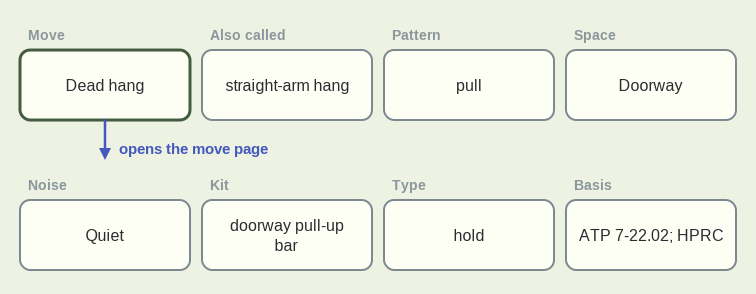
This library lists every move on this site with its other names, movement pattern, space, noise and kit. Use it to find a move that fits your room, open that move's page for its versions, or download the whole list as a CSV file. Each move has one name across the site, though the library may shorten a version's name.
What does each column tell you?
- Move is the name this site uses. It links to the page with the move's versions, easiest first.
- Also called lists other names you may see for the same move. The next sections say where they come from.
- Pattern is the kind of movement: push, pull, squat, hinge, or lunge and step. Core, carry, stretch and cardio are groups too, with no rows yet. These groups are a Living Room Strength rule.
- Space says what part of a room the move needs: Mat, Mat + reach, Doorway, Wall, Stair or Hallway. These are this site's own groups. They aren't measured, because bodies, mats and kit come in different sizes.
- Noise is Quiet, Soft thud or Jumping. Quiet means your feet stay down and nothing drops. Soft thud means a foot or a weight touches down, with no jumping. Jumping means both feet leave the floor. That's a Living Room Strength rule too.
- Kit is None or a plain name such as resistance band, one dumbbell or doorway pull-up bar. It never names a brand or a weight. A stair counts as Space, not Kit.
- Type is reps for moves you count, hold for moves you hold for a number of seconds, and stretch.
- Basis says where the move comes from: a source, or Living Room Strength rule when this site chose it. A label ending in "(link only)" means the source's own words stay off the file: the move page quotes the NHS word for word, or restates University of Illinois Extension in its own words, and links to the page.
How does this site group moves by movement?
The U.S. Physical Activity Guidelines for Americans say "The improvement in, or maintenance of, muscle strength is specific to the muscles used during the activity," so you need a variety of moves (p. 61) [5]. HPRC, a military fitness resource, sorts strength moves into five groups: lower-body push or pull, upper-body horizontal push or pull, upper-body vertical push or pull, anti-rotation, and rotation. It suggests a program include moves from all five [3].
The Pattern column is simpler. It names the movement itself, so a squat and a lunge sit in separate groups even though both fall under HPRC's lower-body push or pull group. Strength Training at Home: Where a Beginner Starts shows where each of this site's moves fits in HPRC's five groups, and which groups have no page yet.
Picking one move from each pattern that fits your room is one way to get that variety. That is a Living Room Strength rule, and the guidelines still ask for all the major parts of the body.
Why does one move have more than one name?
Sources name the same move in different ways. Here is where the names in the Also called column come from:
- A U.S. Army manual, ATP 7-22.02, calls hanging from a bar with straight arms the Straight-Arm Hang (para 6-3, p. 6-1) [1]. This site calls it the dead hang.
- The same manual has a Straight-Leg Deadlift, done with the knees slightly bent and held at that bend the whole time (para 13-4, p. 13-2) [1]. This site calls that move the Romanian deadlift, a name it chose; other sources may treat the two as different moves.
- The manual's Single-Arm Bent-Over Row rests one hand and one knee on a bench (para 14-17, p. 14-12) [1]. This site's one-arm dumbbell row uses a sturdy chair instead.
- HPRC's pull-up sheet calls the slow lowering from the top of the bar "Down Only" [2]. This site calls it slow lowering from a step, on Pull-Up Progression When You Can't Do One Yet.
- HPRC uses "goblet squat" as an example name [3]. On this site it's a squat holding one dumbbell upright against the chest; those versions are on How to Squat at Home, From a Chair to a Goblet Squat.
The move pages also mention two common names that no source this page read uses: scapular pull for the straight-arm pull, and negative pull-up for the slow lowering. Every name in the Also called column comes from a source, so those two stay off the table.
Using one name per move is a Living Room Strength rule. The Floor Card, the version table, the finder and this library all say "dead hang," never "straight-arm hang." The library may shorten a version name, though: "Step-up" here is "Step-up without holding on" in the version table.
What are compound and isolation exercises?
An open college textbook calls compound exercises "multi-joint." They use more of your body in fewer moves, and the textbook suggests choosing more of them [4]. It also says to use both single-joint and multi-joint moves, and to do the multi-joint ones first in a session [4]. "Isolation exercise" is a common name for a single-joint move; the textbook itself says single-joint.
This library doesn't sort moves into compound and isolation. Squats, push-ups, rows, lunges and step-ups all use more than one joint, so by this site's reading of the textbook's terms they're compound.
The whole library
| Move | Also called | Pattern | Space | Noise | Kit | Type | Basis |
|---|---|---|---|---|---|---|---|
| Wall push-up | Push | Wall | Quiet | None | reps | NHS website (link only) | |
| Counter push-up | Push | Mat | Quiet | kitchen counter | reps | Living Room Strength rule | |
| Knee push-up | Push | Mat | Quiet | None | reps | ATP 7-22.02, Oct 2020 (incl. C1, Sept 2025) | |
| Push-up on the floor | Push | Mat | Quiet | None | reps | ATP 7-22.02, Oct 2020 (incl. C1, Sept 2025) | |
| Dead hang | straight-arm hang | Pull | Doorway | Quiet | doorway pull-up bar | hold | ATP 7-22.02, Oct 2020 (incl. C1, Sept 2025); HPRC, Train Above the Bar: Achieving Your First Pull-up |
| Straight-arm pull | Pull | Doorway | Quiet | doorway pull-up bar | reps | ATP 7-22.02, Oct 2020 (incl. C1, Sept 2025) | |
| Slow lowering from a step | down only | Pull | Doorway | Quiet | doorway pull-up bar, step | reps | HPRC, Train Above the Bar: Achieving Your First Pull-up |
| Pull-up | Pull | Doorway | Quiet | doorway pull-up bar | reps | ATP 7-22.02, Oct 2020 (incl. C1, Sept 2025); HPRC, Train Above the Bar: Achieving Your First Pull-up | |
| One-arm dumbbell row | single-arm bent-over row | Pull | Mat | Quiet | one dumbbell, sturdy chair | reps | ATP 7-22.02, Oct 2020 (incl. C1, Sept 2025) |
| Seated band row | Pull | Mat | Quiet | resistance band | reps | Illinois Extension (link only) | |
| Squat to a chair | Squat | Mat | Quiet | sturdy chair | reps | Living Room Strength rule | |
| Bodyweight squat to 90 degrees | Squat | Mat | Quiet | None | reps | ATP 7-22.02, Oct 2020 (incl. C1, Sept 2025) | |
| Goblet squat to 90 degrees | goblet squat | Squat | Mat | Quiet | one dumbbell | reps | ATP 7-22.02, Oct 2020 (incl. C1, Sept 2025) |
| Hip hinge | Hinge | Mat | Quiet | None | reps | ATP 7-22.02, Oct 2020 (incl. C1, Sept 2025) | |
| Romanian deadlift with dumbbells | straight-leg deadlift | Hinge | Mat | Quiet | pair of dumbbells | reps | ATP 7-22.02, Oct 2020 (incl. C1, Sept 2025) |
| Step-up holding the handrail | Lunge and step | Stair | Soft thud | None | reps | Illinois Extension (link only) | |
| Step-up | Lunge and step | Stair | Soft thud | None | reps | Illinois Extension (link only) | |
| Step-up holding dumbbells | Lunge and step | Stair | Soft thud | pair of dumbbells | reps | ATP 7-22.02, Oct 2020 (incl. C1, Sept 2025) | |
| Wall-supported lunge | Lunge and step | Wall | Soft thud | None | reps | Illinois Extension (link only) | |
| Reverse lunge | Lunge and step | Mat | Soft thud | None | reps | ATP 7-22.02, Oct 2020 (incl. C1, Sept 2025) |
You can sort the table by any column. Choose a header to sort by Space, for example, and every Doorway move lines up together.
The same rows are in a file: the exercise library as a CSV file (What is in this file). Its columns are move, also_called, pattern, space, noise, kit, type, page (the address of the move's page) and basis. You may reuse it under CC BY 4.0, with credit to Living Room Strength.
A move gets a row once its page is up, so the table grows as the site does. That's also a Living Room Strength rule: every row links to a real page with its versions and Form lines.
About this illustration
Illustration by Living Room Strength: a generated marker drawing of a room, not a photograph and not a guide to any move. It shows no people. Reuse it with credit to Living Room Strength; this site claims rights in it only as far as the law grants them.How do you find a move that fits your room?
Start with the Space and Noise columns. If you have a mat and neighbors below, look for Mat and Quiet. Then read the Kit column for anything you don't own.
The Small-Space Workout Finder: Match Space, Noise and Equipment does the same thing with check boxes. You choose your space, your noise limit and your kit, and it lists the moves that fit, grouped by pattern.
Once you've picked a move, open its page and start at the first version. After a session, the Bodyweight Progression Finder for Progressive Overload tells you which version to use next.
What is not in the library?
The library doesn't list which muscles a move works. It describes only the movement, the room and the kit.
It gives no weights to use either. Each move page has a range of reps, and How Many Sets and Reps? Ranges, Goals and Moving Up explains how a range works. The Spare-Two Check on each page decides when to move to a harder version.
Moves that need a spotter, tests of the most weight you can lift, and jumping up onto a box aren't on this site, so they aren't in the library.
Next session: sort the table by Noise, pick one Quiet move from each pattern that has one, and open each at its first version.
Source trail
- Five groups of strength moves (lower-body push or pull, upper-body horizontal and vertical push or pull, anti-rotation, rotation) and including moves from all of them; goblet squat as a name [3]
- Improving or keeping muscle strength is specific to the muscles used, so a variety of moves is needed [5]
- Names used in a military manual: Straight-Arm Hang, Straight-Leg Deadlift done with the knees slightly bent, Single-Arm Bent-Over Row [1]
- Down Only as a name for the slow lowering from a step [2]
- From an open college textbook: compound means multi-joint and uses more of the body in fewer moves; use both single- and multiple-joint moves; multiple-joint moves first [4]
Living Room Strength rule
- The Pattern, Space and Noise groups; picking one move per pattern; one name per move across the site, with the library allowed to shorten a version name; Romanian deadlift as this site's name for the Straight-Leg Deadlift; the goblet squat held as one dumbbell upright against the chest; which names are listed (only names a source uses); counting squats, push-ups, rows, lunges and step-ups as multi-joint; a move gets a row once its page is up; no muscle names and no weight suggestions in the library
Living Room Strength set these itself. No source gives them, so read them as this site’s choice, not a finding.
Sources
Numbers in brackets point here. Anything marked Living Room Strength rule is this site’s own choice and has no source.
- Headquarters, Department of the Army. ATP 7-22.02, Holistic Health and Fitness Drills and Exercises, Oct 2020 (incl. C1, Sept 2025) Open the source Read: Chapters 2, 3, 6, 13, 14, 16 and 17 (exercise descriptions only; photographs not used).
- Human Performance Resources by CHAMP (HPRC), Uniformed Services University. Train Above the Bar: Achieving Your First Pull-up (2020) Open the source Read: Full 4-page program sheet (photographs not used).
- Human Performance Resources by CHAMP (HPRC). Use the FITT-VP principle to plan your workouts (2025) Open the source Read: Full article and FITT-VP table.
- Markell, Peterson and Johnson (Centralia College). Exercise and Nutrition, 4.3: Resistance Exercise Programming. Medicine LibreTexts Open the source Read: Section 4.3; its recommendations summarize the 2009 ACSM position stand. License: CC BY 4.0.
- U.S. Department of Health and Human Services. Physical Activity Guidelines for Americans, 2nd edition (2018) Open the source Read: Full guidelines; Chapter 4 (pages 56-62) and Chapter 7 (pages 88-93) used.
Elsewhere in the room
Corrections
No corrections on this page yet. If a line, a number or a drawing here is wrong, tell this site.