Training BasicsReference
Workout Splits: Full Body, Upper/Lower, Push/Pull/Legs
Living Room Strength ·
About this illustration
Illustration by Living Room Strength: a generated marker drawing of a room, not a photograph and not a guide to any move. It shows no people. Reuse it with credit to Living Room Strength; this site claims rights in it only as far as the law grants them.Answer first
A workout split is how you spread your strength moves across the week. A full-body session covers every part of the body, so two or three days a week meet the U.S. guidelines. Upper/lower needs four days to give every part two, and push/pull/legs needs six.
What is a workout split?
It's the plan for which moves go on which day. Some plans train the whole body each time. Others split the body into parts and give each part its own day.
The names below are the usual ones in gyms and online. What each name means on this page is a Living Room Strength rule, since none of the sources read for this site defines them.
- Full body: every session covers all the parts the guidelines list.
- Upper/lower: one session for the upper body (chest, back, shoulders, arms), the next for the lower body (legs and hips).
- Push/pull/legs (PPL): one session of pushing moves, one of pulling moves, and one for the legs and hips.
Where the abdomen goes is up to you, as long as it gets two days a week and never two in a row. That is also a Living Room Strength rule.
What do the guidelines ask for?
The Physical Activity Guidelines for Americans ask for strength work at least two days a week. It should cover the legs, hips, back, chest, abdomen, shoulders and arms (pp. 56, 61) [1]. The National Institute on Aging adds a limit: don't train the same part of the body two days in a row (adapted from the National Institute on Aging, NIH) [2].
HPRC, a U.S. military fitness resource, gives 2 to 3 days a week, depending on your goals [3]. An open college textbook gives 2 to 3 days a week for beginners and intermediate training, and 4 to 5 days for advanced training [5].
So this page checks every split with the same two tests, one from each source: each part of the body gets at least two days a week, and no part comes up two days in a row.
How do the three splits compare?
This table counts the days each split needs to pass both tests. The counts and example weeks are a Living Room Strength rule, worked out from the two tests above:
| Split | One session covers | Days a week for two days per part | Example week |
|---|---|---|---|
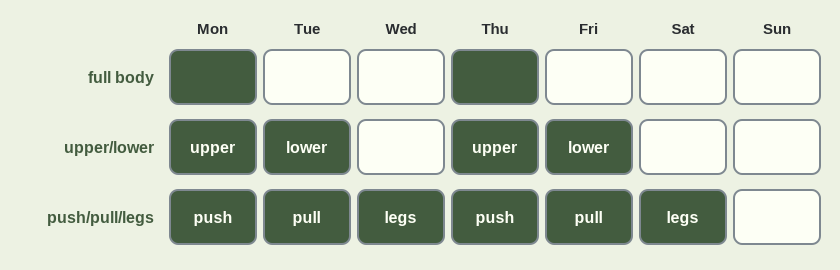
| Full body | Every part | 2 or 3 | Monday and Thursday, or Monday, Wednesday and Friday |
| Upper/lower | The upper body, or the legs and hips | 4 | Upper Monday, lower Tuesday, upper Thursday, lower Friday |
| Push/pull/legs, once through | Pushing, pulling, or legs and hips | 3 days give each part only one day | Push Monday, pull Wednesday, legs Friday |
| Push/pull/legs, twice through | Pushing, pulling, or legs and hips | 6 | Push, pull, legs, then again from Thursday to Saturday |
Why does full body fit two days a week?
Because each session already covers every part, two sessions give every part its two days. Leave at least one day between them and no part comes up two days in a row. Strength Training at Home: Where a Beginner Starts uses Monday and Thursday for exactly this reason.
A third day works the same way: Monday, Wednesday and Friday still leave a day between sessions. This is one way to lay out a 3-day workout plan. HPRC lists more sessions a week as one way to make training harder [4], so a third day is an option if you want more. Progressive Overload at Home With One Pair of Dumbbells covers the other ways.
Can upper and lower go on back-to-back days?
Yes. An upper-body day and a lower-body day train different parts of the body, so the two tests still pass. This page reads the National Institute on Aging's limit one kind of day at a time: upper, lower, push, pull or legs. That reading is a Living Room Strength rule.
The textbook uses the same idea inside a single session. Alternating upper- and lower-body moves can let one side rest while the other works [5]. A 4-day upper/lower week does this across days instead.
The cost is the count. To give each part two days, upper/lower takes four sessions a week, not two.
What about push/pull/legs?
Done once a week, PPL gives each part one day, which is below the guidelines' two. Done twice, it takes six sessions: push, pull and legs, then the same again from Thursday to Saturday.
Read one kind of day at a time, as with upper and lower, and each kind comes up twice, never two days in a row. So by this page's reading, six days pass both tests. The two tests show only that much for this layout. They don't say PPL is better or worse than the others.
If you can train only two or three days a week, full body is the one split here that passes both tests in that many days.
Which moves go on which day?
Here is how this site's first move pages fall into the three kinds of day. Which move goes where is a Living Room Strength rule:
- Push: Push-Up Progression: From the Wall to the Floor
- Pull: Dumbbell Row at Home With One Hand on a Chair, Seated Resistance Band Rows on the Floor, Pull-Up Progression When You Can't Do One Yet
- Legs and hips: How to Squat at Home, From a Chair to a Goblet Squat, Romanian Deadlift With Dumbbells, Hip Hinge First, Step-Ups on a Stair at Home, Reverse Lunges in a Small Room
For upper/lower, the push and pull lists go on the upper day. HPRC sorts strength moves into five groups and suggests using all of them [3]; Strength Training at Home: Where a Beginner Starts shows how these pages map onto those groups. Whole sessions laid out move by move are on Bodyweight Workout at Home With No Equipment to Buy and Dumbbell Workout at Home With One Pair of Dumbbells.
About this illustration
Illustration by Living Room Strength: a generated marker drawing of a room, not a photograph and not a guide to any move. It shows no people. Reuse it with credit to Living Room Strength; this site claims rights in it only as far as the law grants them.Does the split change your sets, reps or rest?
No. On this site, each move keeps its own range and sets, whichever day it lands on. How Many Sets and Reps? Ranges, Goals and Moving Up covers the numbers and Rest Between Sets and Days Between Sessions covers rest.
This page doesn't compare which split gets better results. It only compares how each one fits the week.
Next session: count the days you can train this week, then pick the split from the table that passes both tests in that many days.
Source trail
- Strength work at least 2 days a week for the legs, hips, back, chest, abdomen, shoulders and arms [1]
- Not the same part of the body two days in a row [2]
- 2 to 3 strength days a week; five movement categories [3]
- More sessions a week as one way to make training harder [4]
- From an open college textbook: 2 to 3 days a week for beginners and intermediate training, 4 to 5 for advanced training; alternating upper- and lower-body moves [5]
Living Room Strength rule
- What full body, upper/lower and push/pull/legs mean; how many days each needs to give every part two days; the example weeks; reading the National Institute on Aging's limit one kind of day at a time (upper, lower, push, pull or legs); where the abdomen goes (two days a week, not two in a row); which move goes on which day
Living Room Strength set these itself. No source gives them, so read them as this site’s choice, not a finding.
Sources
Numbers in brackets point here. Anything marked Living Room Strength rule is this site’s own choice and has no source.
- U.S. Department of Health and Human Services. Physical Activity Guidelines for Americans, 2nd edition (2018) Open the source Read: Full guidelines; Chapter 4 (pages 56-62) and Chapter 7 (pages 88-93) used.
- National Institute on Aging, NIH. Three Types of Exercise Can Improve Your Health and Physical Ability (content reviewed 2025) Open the source Read: Full article; general principles only.
- Human Performance Resources by CHAMP (HPRC). Use the FITT-VP principle to plan your workouts (2025) Open the source Read: Full article and FITT-VP table.
- Human Performance Resources by CHAMP (HPRC). Guidelines to progress your physical training over time (2021) Open the source Read: Full article.
- Markell, Peterson and Johnson (Centralia College). Exercise and Nutrition, 4.3: Resistance Exercise Programming. Medicine LibreTexts Open the source Read: Section 4.3; its recommendations summarize the 2009 ACSM position stand. License: CC BY 4.0.
Elsewhere in the room
Corrections
No corrections on this page yet. If a line, a number or a drawing here is wrong, tell this site.