Training BasicsReference
Progressive Overload at Home With One Pair of Dumbbells
Living Room Strength ·
About this illustration
Illustration by Living Room Strength: a generated marker drawing of a room, not a photograph and not a guide to any move. It shows no people. Reuse it with credit to Living Room Strength; this site claims rights in it only as far as the law grants them.Answer first
Progressive overload means asking a little more of your body over time. When your dumbbells stop at one pair, you mostly do that by moving to a harder version of the move, not a heavier weight. On this site, the Spare-Two Check at the end of a session says when to move.
What is progressive overload?
The Physical Activity Guidelines for Americans define the two halves. "Overload is the physical stress placed on the body when physical activity is greater in amount or intensity than usual" (p. 34) [1]. Progression is the step-by-step increase in how hard, how long, how often or how much you train, as your body gets used to what you do now (p. 107) [1].
HPRC, a U.S. military fitness resource, puts them together: "Progressive overload is the increase in workout volume or intensity over time." [2] A 2026 position stand from the American College of Sports Medicine concludes that healthy adults should do resistance training that progresses over time [7].
This site sets no timetable for any of it. It only says what to try next session.
What can you change to make it harder?
HPRC lists adding reps, sets, weight or sessions a week, or cutting the rest between sets, or any mix of them [2]. The U.S. guidelines name more weight and more days a week (p. 61) [1]. The National Institute on Aging names weight, sets or reps, and days a week (adapted from the National Institute on Aging, NIH) [4].
Other ways change the move itself. This table lists them with where each one comes from:
| Way to make it harder | What it looks like at home | Basis |
|---|---|---|
| More reps | One more rep per set, inside the version's range | HPRC [2]; NIA [4] |
| More sets | From 1 set up to 2 or 3 | HPRC [2]; U.S. guidelines, p. 61 [1]; NIA [4] |
| More weight | From no weight, to one dumbbell, to both dumbbells of your pair (twice the load) | HPRC [2]; U.S. guidelines, p. 61 [1]; NIA [4]; textbook [5] |
| More days a week | A second strength day, then a third | HPRC [2]; U.S. guidelines, p. 61 [1]; NIA [4] |
| Less rest | A shorter rest between sets | HPRC [2] |
| Bigger range | Lowering deeper, such as past 90 degrees in a squat | ATP 7-22.02, para 14-4 [6]; HPRC [3] |
| A harder exercise | Changing to the next exercise in a family | HPRC [3] |
| Lever | Hands lower in a push-up, from a wall to a counter to a stair step | Living Room Strength rule |
| One side | One arm or one leg doing the work | Living Room Strength rule |
| Slower lowering | Taking about three seconds on the way down | Living Room Strength rule |
| Pause | Holding still for a second at the hardest point | Living Room Strength rule |
For range, the Army's training manual says it plainly about squats: "Progress to deeper squat positions as strength improves." (ATP 7-22.02, para 14-4, p. 14-2) [6] HPRC gives the same idea for exercises in general: change to one that is harder or moves through more range, such as going from a split squat to one with the back foot raised [3].
The last four rows are this site's own way of naming the changes; no source read for this site lists them as ways to make training harder.
What if your dumbbells stop at one pair?
Then weight is the one dial you can't turn, so you use the others. On this site, the main one is the version table on each move page. Most rows change one thing, such as the lever, the range, one side, the tempo or a pause; a few rows change two, and say so. Versions come before weight here, which is a Living Room Strength rule.
About this illustration
Illustration by Living Room Strength: a generated marker drawing of a room, not a photograph and not a guide to any move. It shows no people. Reuse it with credit to Living Room Strength; this site claims rights in it only as far as the law grants them.For example, How to Squat at Home, From a Chair to a Goblet Squat goes from a squat to a chair, to a squat to 90 degrees, to holding one dumbbell, to a deeper squat with that same dumbbell. Push-Up Progression: From the Wall to the Floor needs no weight at all. The hands move lower, from a wall to a counter to a stair step, then to the floor with the knees down. Last, the knees come off the floor.
How does the Spare-Two Check work?
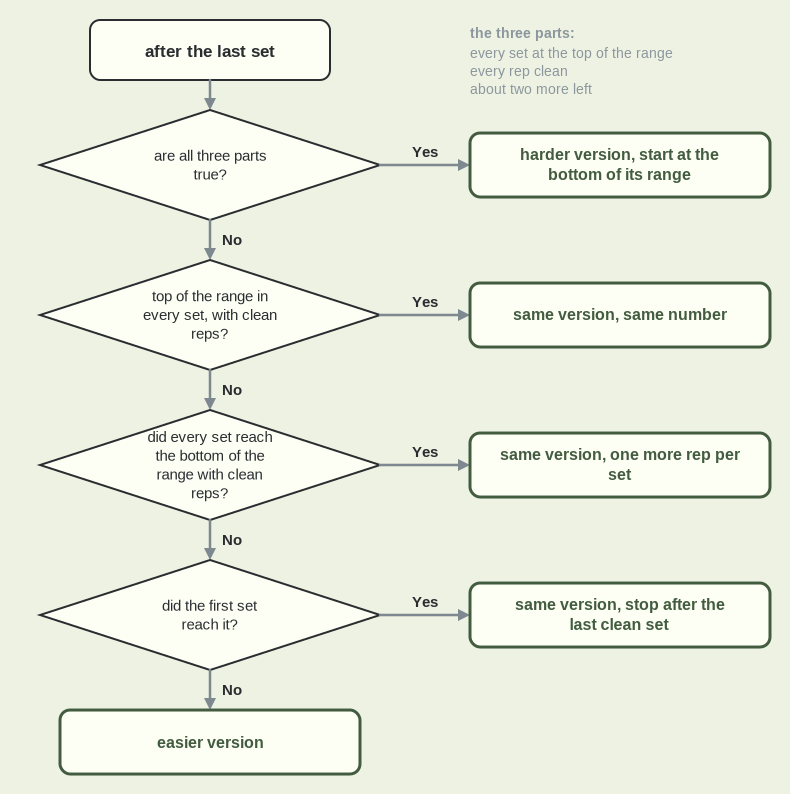
The Spare-Two Check is how this site decides when to change versions. It is a Living Room Strength rule, not a finding from a source. Judge it at the end of the last set of a session. Look at three things:
- Every set reached the top of the range.
- Every rep kept the form lines.
- After the last set, you could have done about two more reps, and kept the form lines on them too.
Then read the outcomes in this order:
- All three are true: next session, use the harder version and start at the bottom of its range.
- Top of the range and clean form, but not two to spare: next session, same version and same number, until the third one is true as well.
- Inside the range and clean form, but short of the top: next session, same version. Try one more rep in each set.
- The first set could not reach the bottom of the range without breaking a line: next session, use the easier version. If only the later sets dropped below the bottom, stay on this version and stop after the last set you could keep clean.
Holds work a little differently. For a plank-type hold, the third part is whether you could have stayed for about two more slow breaths, and the outcome inside the range is a few more seconds. For the dead hang on Dead Hang on a Doorway Bar: Check the Bar Before You Hang and Pull-Up Progression When You Can't Do One Yet, it is whether you could have stayed longer before either hand started to slip. Set the bar so you can put your feet down by straightening your knees at the end of the hang.
A few limits apply. Nothing is counted across sessions or days, and you never switch versions in the middle of a set. The check is not a fitness test.
If you are on the last row of a table, the Harder field says "None on this site yet", so you stay there. On the first row there is no easier version, so you stay there too.
How sure can you be about "two more"?
Not exactly. The guess of how many reps you had left is usually off [8] [9], which is why the check asks about the form lines before it asks about the reps left. RPE Scale and Reps in Reserve for Home Sets explains the guess and the scale behind it.
How is this different from "one more rep would be hard"?
The guidelines say to work each set to the point where another rep would be difficult (p. 61) [1]. The Spare-Two Check answers a different question: whether this version is still hard enough.
The two rules sit side by side, and they can point to different places. The guidelines describe how hard a set should be. The check decides when you change versions: if you reach the top of the range with about two reps to spare, the set ends at the top, and this version has become too easy for you.
If your first set on the harder version can't reach the bottom of the range, the check sends you back next session. Strength Training at Home: Where a Beginner Starts shows both in a first session, and How Many Sets and Reps? Ranges, Goals and Moving Up explains ranges.
Where does the check come from?
It borrows from two rules for adding weight. HPRC describes a "2-for-2" rule: add weight once you can do two more reps than your goal in the last set, two weeks in a row [2]. An open college textbook suggests adding 2 to 10 percent more load once you pass your target by one or two reps [5].
This site doesn't wait two weeks; the check looks at one session. It also uses the idea to change versions instead of weight, which is its own extension. When progress stalls, HPRC suggests changing the exercises you do [2]. On this site, the next row of the version table is that change.
To time your rest so sessions compare fairly, see Rest Between Sets and Days Between Sessions. For how many days to train, see Workout Splits: Full Body, Upper/Lower, Push/Pull/Legs. The Bodyweight Progression Finder for Progressive Overload runs the check one answer at a time.
Next session: on one move, write down the version and the reps in each set, and run the three questions after the last set.
Source trail
- What overload and progression mean; adding weight or days as ways to progress; 1 to 3 sets; working to where another rep would be difficult [1]
- Progressive overload as more volume or intensity over time; more reps, sets, weight, sessions, or less rest; the 2-for-2 rule; changing exercises when progress stalls [2]
- Changing to a harder exercise or a bigger range of motion [3]
- Gradual increases in weight, sets or reps, or days a week [4]
- From an open college textbook: adding 2 to 10 percent more load once you pass the target by one or two reps [5]
- Deeper squats as strength improves (quoted) [6]
- One sentence: healthy adults should do resistance training that progresses [7]
- Guesses of reps left are usually off [8]
- Guesses of reps left are usually off [9]
Living Room Strength rule
- The Spare-Two Check: when it is judged, its three parts, its four outcomes and their order, the hold and dead hang versions, the ends of a table, starting the harder version at the bottom of its range, no counting across days, no switching in the middle of a set; lever, one side, slower lowering and pauses as ways to make a move harder; versions before weight when the dumbbells stop at one pair; looking at one session instead of two weeks
Living Room Strength set these itself. No source gives them, so read them as this site’s choice, not a finding.
Sources
Numbers in brackets point here. Anything marked Living Room Strength rule is this site’s own choice and has no source.
- U.S. Department of Health and Human Services. Physical Activity Guidelines for Americans, 2nd edition (2018) Open the source Read: Full guidelines; Chapter 4 (pages 56-62) and Chapter 7 (pages 88-93) used.
- Human Performance Resources by CHAMP (HPRC). Guidelines to progress your physical training over time (2021) Open the source Read: Full article.
- Human Performance Resources by CHAMP (HPRC). Use the FITT-VP principle to plan your workouts (2025) Open the source Read: Full article and FITT-VP table.
- National Institute on Aging, NIH. Three Types of Exercise Can Improve Your Health and Physical Ability (content reviewed 2025) Open the source Read: Full article; general principles only.
- Markell, Peterson and Johnson (Centralia College). Exercise and Nutrition, 4.3: Resistance Exercise Programming. Medicine LibreTexts Open the source Read: Section 4.3; its recommendations summarize the 2009 ACSM position stand. License: CC BY 4.0.
- Headquarters, Department of the Army. ATP 7-22.02, Holistic Health and Fitness Drills and Exercises, Oct 2020 (incl. C1, Sept 2025) Open the source Read: Chapters 2, 3, 6, 13, 14, 16 and 17 (exercise descriptions only; photographs not used).
- Currier BS et al. (2026). American College of Sports Medicine Position Stand. Resistance Training Prescription for Muscle Function, Hypertrophy, and Physical Performance in Healthy Adults: An Overview of Reviews. Medicine & Science in Sports & Exercise 58(4):851-872 Open the source Read: Abstract.
- Halperin I et al. (2022). Accuracy in Predicting Repetitions to Task Failure in Resistance Exercise: A Scoping Review and Exploratory Meta-analysis. Sports Medicine 52(2):377-390 Open the source Read: Abstract.
- Steele J et al. (2017). Ability to predict repetitions to momentary failure is not perfectly accurate, though improves with resistance training experience. PeerJ 5:e4105 Open the source Read: Abstract.
Elsewhere in the room
Corrections
No corrections on this page yet. If a line, a number or a drawing here is wrong, tell this site.