Training BasicsReference
How Many Sets and Reps? Ranges, Goals and Moving Up
Living Room Strength ·
About this illustration
Illustration by Living Room Strength: a generated marker drawing of a room, not a photograph and not a guide to any move. It shows no people. Reuse it with credit to Living Room Strength; this site claims rights in it only as far as the law grants them.Answer first
Do 1 to 3 sets of 8 to 12 reps of each move, the numbers the U.S. guidelines give. On this site each version of a move has a range, such as 8 to 12 reps. You work up inside that range, and when the top gets too easy you change to a harder version, not to bigger numbers.
What are a rep, a set and a range?
The NHS puts the first two plainly: "A repetition is 1 complete movement of an activity, like lifting a weight or doing 1 push-up or 1 sit-up." "Try to do 8 to 12 repetitions for each activity, which counts as 1 set." Information from the NHS website, as at 261126 (https://www.nhs.uk/live-well/exercise/how-to-improve-strength-flexibility/) [3].
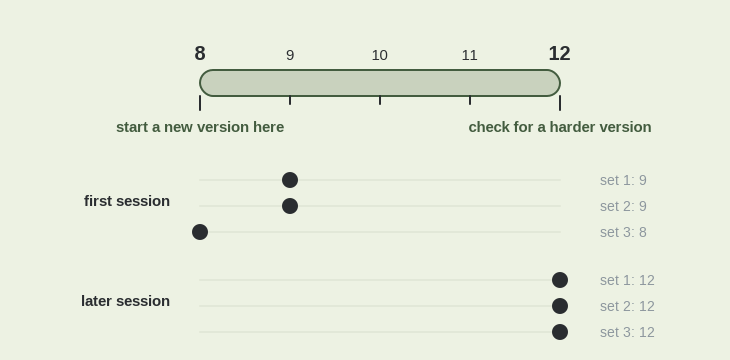
A range is the lowest and the highest count for one version of a move, written like 8–12 reps. You start a new version at the bottom number. The top number is where you check whether it is time for the next version. That meaning of "range" is a Living Room Strength rule.
Some versions are holds, so the range is in seconds instead, such as 10–30 seconds for a dead hang on Pull-Up Progression When You Can't Do One Yet. A few rows use other counts: the pull-up itself is 1–5 reps on that page. Each page says where its numbers come from, and ranges no source gives are marked as a Living Room Strength rule.
How many sets and reps do the guidelines give?
The Physical Activity Guidelines for Americans list sets and reps as one of three parts of strength work, next to how hard and how often (p. 30) [1]. For the numbers, one set of 8 to 12 reps of each exercise is effective, and 2 or 3 sets may be more effective (p. 61) [1]. The National Institute on Aging gives the same numbers (adapted from the National Institute on Aging, NIH) [2].
An open college textbook gives the same 8 to 12 reps for one set [5]. A 2026 position stand from the American College of Sports Medicine concludes that healthy adults should do resistance training that progresses over time, with a prescription that can vary in line with its findings [6].
So there is no single right number. This site uses those guideline numbers as the default: 1 to 3 sets, and 8 to 12 reps on most versions.
Do the numbers change with the goal?
They can. HPRC, a U.S. military fitness resource, gives different reps, sets and rest for different training goals [4]. This table copies three of its rows:
| Goal, as HPRC names it | Reps per set | Sets | Rest between sets |
|---|---|---|---|
| Muscular endurance | 12 | 2–4 | 30 seconds |
| Muscle mass (HPRC: hypertrophy) | 6–12 | 3–8 | 30–90 seconds |
| Muscular strength | 1–10 | 2–4 | 1–3 minutes |
HPRC pairs each row with a load as well. This site gives no loads, and its gear stops at a pair of dumbbells. So the rows show how the numbers shift with a goal; they are not a promise about what each one builds.
The guidelines' 8 to 12 overlaps all three rows. HPRC also counts volume as reps times sets, so 3 sets of 10 make 30 reps [4]. Rest Between Sets and Days Between Sessions sets the three rest times side by side.
How hard should the last rep be?
The guidelines say to work each set to the point where another rep would be difficult (p. 61) [1]. The National Institute on Aging says the same (adapted from the National Institute on Aging, NIH) [2]. The textbook says to work to the point of fatigue [5]. Every rep on the way still keeps the form lines on the move's page.
This site's Spare-Two Check answers a different question, whether this version is still hard enough. If every set reaches the top of the range, every rep is clean, and you could have done about two more good reps, the version has become too easy. Next session you move to the harder one. That is a Living Room Strength rule, and Progressive Overload at Home With One Pair of Dumbbells has all of it.
The two rules sit side by side, and they can point to different places: the guidelines describe how hard a set should be, and the check decides when you change versions. Strength Training at Home: Where a Beginner Starts puts the two together for a first session, and RPE Scale and Reps in Reserve for Home Sets explains how to guess the reps you have left.
How do you move inside a range?
Start a new version at the bottom of its range. Each session, try for one more rep in each set while every rep stays clean. When all of your sets reach the top, look at the other two parts of the check. These steps are a Living Room Strength rule.
Say a session on a new version ends with sets of 9, 9 and 8. The next goal is 10, 10 and 9, not 12 right away. If the first set can't reach the bottom of the range without breaking a form line, go back to the easier version next session.
The Bodyweight Progression Finder for Progressive Overload walks through this one answer at a time.
How many push-ups should you do?
It depends on which version you are on, not on your age or anyone else's numbers. This site gives no table of push-ups by age.
About this illustration
Illustration by Living Room Strength: a generated marker drawing of a room, not a photograph and not a guide to any move. It shows no people. Reuse it with credit to Living Room Strength; this site claims rights in it only as far as the law grants them.Start on the first row of Push-Up Progression: From the Wall to the Floor, the wall push-up, and do 1 to 3 sets of 8 to 12. Move down a row only when the Spare-Two Check says so. If the wall version won't reach 8 clean reps yet, stay on it, and end each set at the last rep that keeps the form lines. It is the first row, and this site has no easier one.
What is the Floor Card?
The Floor Card is the box at the top of every move page and how-to page. It holds today's numbers in one place, so you can read it before you start. Its fields and their order are a Living Room Strength rule:
- Space: how much room the move needs, such as a mat, a wall or a stair. Small-Space Workout Finder: Match Space, Noise and Equipment sorts moves by this field.
- Noise: Quiet, Soft thud or Jumping, so you know what the neighbors downstairs will hear.
- Kit: anything you need beyond your body. It lists the kit for every version on the page, not only today's.
- Version today: the row of the version table to use.
- Sets × reps (or Sets × seconds for holds): the number of sets, times the range for that version.
- Rest: the rest between sets, with its source.
- Spare-Two Check: the check after the last set that decides whether you change versions. Reaching the top of the range in every set is one of its three parts.
- Easier and Harder: the rows just above and below in the table. At the two ends the card says "None on this site yet".
Last come two red fields. One lists the signs to stop for today. The other lists what ends a single set, such as the form slipping or the kit moving. The card prints the same words for these on every page, so this page doesn't repeat them.
On a how-to page, some fields say "Not used here" or link to the move pages instead. To time your rest, use the Interval Workout Timer for Work, Rest and Rounds at Home.
Next session: open one move page, find the Version today on its Floor Card, and note the bottom number of that range before your first set.
Source trail
- What a rep and a set are (quoted) [3]
- One set of 8 to 12 reps is effective and 2 or 3 sets may be more effective; work to where another rep would be difficult; sets and reps as one of three parts of strength work [1]
- The same numbers and the same stopping point [2]
- From an open college textbook: one set of 8 to 12 reps [5]
- Reps per set, sets and rest for three training goals; volume as reps times sets [4]
- One sentence: healthy adults should do resistance training that progresses, with a prescription that can vary in line with its findings [6]
Living Room Strength rule
- What a range means on this site; the ranges on each version table that no source gives (holds in seconds, the pull-up rows); moving up inside a range and changing versions at the top; starting the harder version at the bottom; the Floor Card and its fields; no push-up number by age; starting push-ups on the first row and moving down only when the Spare-Two Check says so; staying on the first row when it can't reach the bottom yet
Living Room Strength set these itself. No source gives them, so read them as this site’s choice, not a finding.
Sources
Numbers in brackets point here. Anything marked Living Room Strength rule is this site’s own choice and has no source.
- U.S. Department of Health and Human Services. Physical Activity Guidelines for Americans, 2nd edition (2018) Open the source Read: Full guidelines; Chapter 4 (pages 56-62) and Chapter 7 (pages 88-93) used.
- National Institute on Aging, NIH. Three Types of Exercise Can Improve Your Health and Physical Ability (content reviewed 2025) Open the source Read: Full article; general principles only.
- NHS. How to improve your strength and flexibility Open the source Read: Full page (page last reviewed 21 July 2026).
- Human Performance Resources by CHAMP (HPRC). Use the FITT-VP principle to plan your workouts (2025) Open the source Read: Full article and FITT-VP table.
- Markell, Peterson and Johnson (Centralia College). Exercise and Nutrition, 4.3: Resistance Exercise Programming. Medicine LibreTexts Open the source Read: Section 4.3; its recommendations summarize the 2009 ACSM position stand. License: CC BY 4.0.
- Currier BS et al. (2026). American College of Sports Medicine Position Stand. Resistance Training Prescription for Muscle Function, Hypertrophy, and Physical Performance in Healthy Adults: An Overview of Reviews. Medicine & Science in Sports & Exercise 58(4):851-872 Open the source Read: Abstract.
Elsewhere in the room
Corrections
No corrections on this page yet. If a line, a number or a drawing here is wrong, tell this site.