Training BasicsReference
Rest Between Sets and Days Between Sessions
Living Room Strength ·
About this illustration
Illustration by Living Room Strength: a generated marker drawing of a room, not a photograph and not a guide to any move. It shows no people. Reuse it with credit to Living Room Strength; this site claims rights in it only as far as the law grants them.Answer first
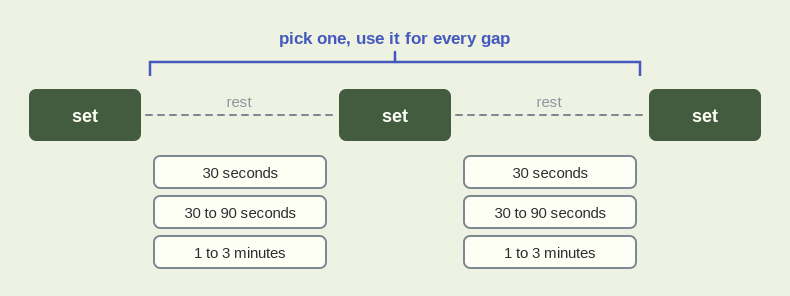
Rest 30 seconds, 30 to 90 seconds, or 1 to 3 minutes between sets, as HPRC gives for different goals. Between sessions, cover the major parts of the body on at least two days a week, but not the same part two days in a row. Pick one rest time and keep it while you stay on a version.
How long should you rest between sets?
HPRC, a U.S. military fitness resource, ties a rest time to each training goal: 30 seconds, 30 to 90 seconds, or 1 to 3 minutes [1]. In its words, this is the rest "after a set of reps" [1]. How Many Sets and Reps? Ranges, Goals and Moving Up shows which goal HPRC pairs with which time, next to its reps and sets.
This site doesn't pick one of the three for you. Most Floor Cards on the move pages list all three in their Rest field. Pull-Up Progression When You Can't Do One Yet and Dead Hang on a Doorway Bar: Check the Bar Before You Hang are the exceptions: they use the 60 to 90 seconds from HPRC's own pull-up program [7].
Why keep the rest the same each time?
Keeping the rest the same makes your sets easier to compare from one session to the next. Ten reps after 30 seconds of rest is a different set from ten reps after three minutes. So pick one of HPRC's three times, use it for every gap in a session, and keep it for as long as you stay on that version. This is a Living Room Strength rule.
The Spare-Two Check on Progressive Overload at Home With One Pair of Dumbbells asks whether every set reached the top of the range. Sets taken after the same rest make that answer fair from one session to the next.
How do you time rest at home?
Start the rest when the last rep of a set ends. When the rest runs out, start the next set. That's a Living Room Strength rule. Any clock works.
The Interval Workout Timer for Work, Rest and Rounds at Home on this site can do it for you: set the rest time you picked, and it beeps when the rest is over. For the work part, use a time long enough to finish your reps.
Does less rest make training harder?
It can. HPRC lists less rest between sets as one way to make training harder, next to adding reps, sets, weight and sessions [4]. The Army's training manual adds that, in its strength circuit, rest can go either way: "The amount of weight and the length of rest intervals can be increased or decreased to target other components of physical fitness." (ATP 7-22.02, para 13-1, p. 13-1) [5]
This site keeps the rest fixed and changes the version instead. When the Spare-Two Check says a version is too easy, you move to the harder one on the same page. That is a Living Room Strength rule. Changing the rest and the version at the same time would make your sets hard to compare.
How many days should you leave between sessions?
The Physical Activity Guidelines for Americans ask for strength work at least two days a week. It should cover the legs, hips, back, chest, abdomen, shoulders and arms (pp. 56, 61) [2]. HPRC gives 2 to 3 days a week, depending on your goals [1]. The National Institute on Aging adds a limit: don't train the same part of the body two days in a row (adapted from the National Institute on Aging, NIH) [3].
So a full-body session needs at least one day before the next one. Monday and Thursday is one example, a Living Room Strength rule that Strength Training at Home: Where a Beginner Starts also uses.
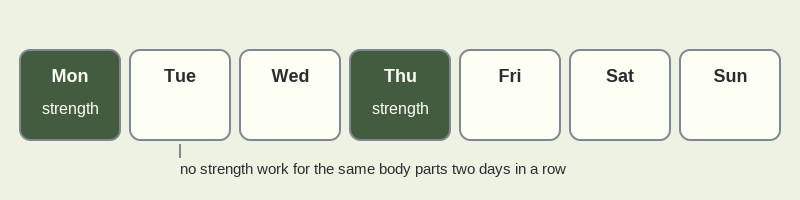
If you train on more days, the work has to be split so that no part of the body comes up two days running. Workout Splits: Full Body, Upper/Lower, Push/Pull/Legs compares the usual ways to do that.
What is a rest day?
On this site, a rest day means a day with no strength work for a given part of the body. That meaning is a Living Room Strength rule. After an upper-body day, for example, the next day can be a rest day for the upper body and a training day for the legs.
About this illustration
Illustration by Living Room Strength: a generated marker drawing of a room, not a photograph and not a guide to any move. It shows no people. Reuse it with credit to Living Room Strength; this site claims rights in it only as far as the law grants them.The guidelines set aerobic activity and strength work as two separate weekly targets (p. 56) [2]. So a day without strength work can still hold a walk or a round of Low-Impact Cardio at Home With No Jumping. Whether it does is up to you. This site sets no rule for it.
What is a deload week?
A deload week is a week where you lower both the amount of training and how hard it is, on purpose. An open college textbook describes the idea inside a plan built from blocks [6]. In its example, the amount and effort change over weeks 1 to 3. In week 4, both drop on purpose for a planned rest week, and then the pattern repeats [6].
This site's version tables don't count weeks, and the Spare-Two Check looks at one session at a time. So the site doesn't schedule a deload week. That is a Living Room Strength rule, not a claim that a planned rest week is wrong. If you follow a plan that has one, the textbook's example shows what one can look like.
What if your later sets fall short?
Rest and effort are two separate things. The guidelines say to work each set to the point where another rep would be difficult (p. 61) [2]. RPE Scale and Reps in Reserve for Home Sets explains how to judge how close you are to that point.
Say your first set reaches the range and a later set drops below the bottom of it. Keep the same rest and the same version. Next session, stop after the last set you could keep clean. That comes from the Spare-Two Check, a Living Room Strength rule, which sits under the version table on Push-Up Progression: From the Wall to the Floor and every other move page.
Next session: choose one of the three rest times before you start, set the timer to it, and use it for every gap between sets.
Source trail
- Rest between sets of 30 seconds, 30 to 90 seconds, or 1 to 3 minutes, depending on the goal; rest is the time after a set; 2 to 3 strength days a week [1]
- At least 2 days a week for the legs, hips, back, chest, abdomen, shoulders and arms; aerobic and strength work as separate targets [2]
- Not the same part of the body two days in a row [3]
- Less rest between sets as one way to make training harder [4]
- The length of rest can go up or down (quoted) [5]
- Training in blocks, with a planned rest week where volume and intensity drop [6]
- The pull-up and dead hang pages use 60 to 90 seconds between sets [7]
Living Room Strength rule
- Picking one of the three rest times and keeping it while you stay on a version; counting rest from the end of the last rep; changing versions instead of cutting rest; what a rest day means here; no deload week in this site's tables; Monday and Thursday as an example; when later sets fall short, keep the rest and version and stop after the last clean set (Spare-Two Check)
Living Room Strength set these itself. No source gives them, so read them as this site’s choice, not a finding.
Sources
Numbers in brackets point here. Anything marked Living Room Strength rule is this site’s own choice and has no source.
- Human Performance Resources by CHAMP (HPRC). Use the FITT-VP principle to plan your workouts (2025) Open the source Read: Full article and FITT-VP table.
- U.S. Department of Health and Human Services. Physical Activity Guidelines for Americans, 2nd edition (2018) Open the source Read: Full guidelines; Chapter 4 (pages 56-62) and Chapter 7 (pages 88-93) used.
- National Institute on Aging, NIH. Three Types of Exercise Can Improve Your Health and Physical Ability (content reviewed 2025) Open the source Read: Full article; general principles only.
- Human Performance Resources by CHAMP (HPRC). Guidelines to progress your physical training over time (2021) Open the source Read: Full article.
- Headquarters, Department of the Army. ATP 7-22.02, Holistic Health and Fitness Drills and Exercises, Oct 2020 (incl. C1, Sept 2025) Open the source Read: Chapters 2, 3, 6, 13, 14, 16 and 17 (exercise descriptions only; photographs not used).
- Markell, Peterson and Johnson (Centralia College). Exercise and Nutrition, 2.7: Rest, Recovery and Periodization. Medicine LibreTexts Open the source Read: Section 2.7. License: CC BY 4.0.
- Human Performance Resources by CHAMP (HPRC), Uniformed Services University. Train Above the Bar: Achieving Your First Pull-up (2020) Open the source Read: Full 4-page program sheet (photographs not used).
Elsewhere in the room
Corrections
No corrections on this page yet. If a line, a number or a drawing here is wrong, tell this site.