Push & PullMove
Pull-Up Progression When You Can't Do One Yet
Living Room Strength ·
About this illustration
Illustration by Living Room Strength: a generated marker drawing of a room, not a photograph and not a guide to any move. It shows no people. Reuse it with credit to Living Room Strength; this site claims rights in it only as far as the law grants them.Answer first
Start with a dead hang from a doorway bar, arms straight and knees bent. From there the order is the straight-arm pull, the slow lowering from a step, and then the pull-up. Move to the next one only when the Spare-Two Check at the end of a session says so.
If you have a long-term health condition, or symptoms such as chest pain or pressure, dizziness or joint pain, or you are pregnant or have recently given birth, talk to a health care provider before you start. If new symptoms show up as you do more, talk to one then too. Physical Activity Guidelines for Americans, 2nd edition, chapter 7, p. 93 (Guidelines).
Floor Card
- Space
- Doorway
- Noise
- Quiet
- Kit
- doorway pull-up bar, step
- Version today
- Dead hang
- Sets × seconds
- 2–3 × 10–30
- Rest
- 60–90 seconds (HPRC)
- Spare-Two Check
- 30 seconds
- Easier
- None on this site yet
- Harder
- Straight-arm pull
- Stop for today if
- “Stop the exercise immediately if you feel any pain or become unwell.” If the pain does not go away, see a doctor.The quoted sentence: Information from the NHS website, as at 261126 (NHS). Seeing a doctor if the pain stays: Living Room Strength rule.
- End the set if
- The equipment moves or gives: the doorway bar shifts or creaks, the band has a nick, a cut or loose stitching, the chair or couch slides, or the step wobbles. End the set and check it against its instructions before the next one.What to look for on a band comes from the instructions that come with bands. Ending the set and checking: Living Room Strength rule.
- You can no longer keep one of the form lines. That rep ends the set.Going on only while the move meets its standard: Adapted from ATP 7-22.02, p. 13-7 (ATP 7-22.02).
Form lines
- Your hands hold the bar with the palms facing away from you, and your thumbs wrap around the bar.
- Your legs stay still under you; they don't swing or kick to help.
- Every rep ends at the bottom with your arms fully straight.
- In the straight-arm pull, your elbows stay straight the whole time.
- In the slow lowering, your shoulders draw down and back during the pause at the bottom.
- In the pull-up, every rep reaches the same top, the one you picked before the set: head above the bar or chest to the bar.
You can film one set from the side on your phone and check each line. The video stays on your phone; this site never sees it.
These lines come from two government sources. The U.S. Army manual ATP 7-22.02 starts each bar exercise from a "Straight-Arm Hang using the closed overhand grip," with the thumb wrapped around the bar the other way from the fingers (paras 2-14 and 6-3, pp. 2-5 and 6-1). ATP describes the pull-up as pulling up "without using the legs" (para 6-5, p. 6-3), and the straight-arm pull as a move where you "keep the arms straight" (para 6-3, p. 6-1).
HPRC, the Uniformed Services University's fitness resource, writes "palms facing away from you" and "Keep your legs still" in its pull-up sheet, Train Above the Bar. For the pause at the bottom of the lowering, and only there, it adds "shoulders down and back."
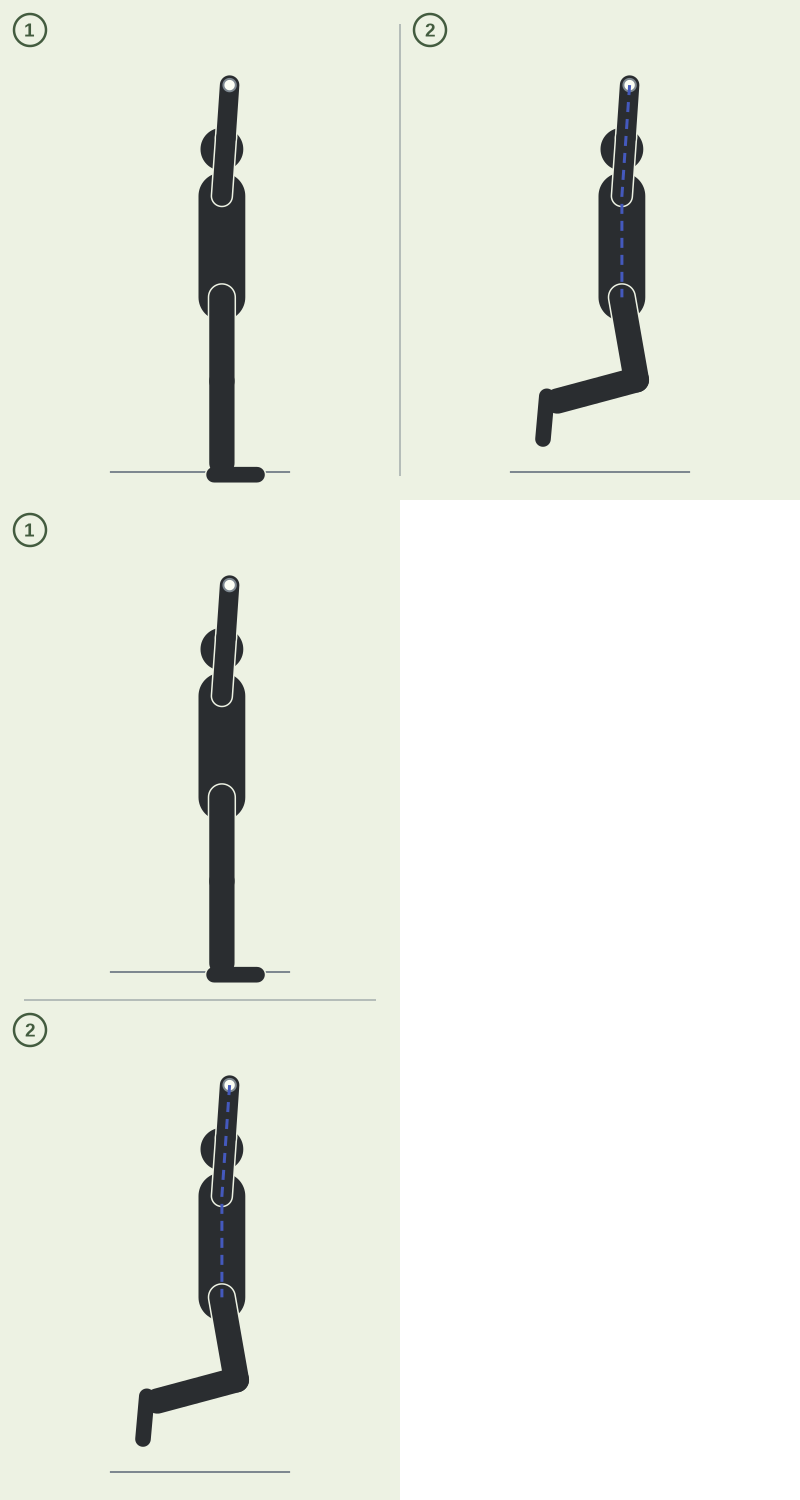
The dead hang. In panel 2 the knees bend to lift the feet; straightening them puts the feet back on the floor.
Pull-up versions, from hanging to pulling up
| Order | Version | What changes | Range | Basis |
|---|---|---|---|---|
| 1 | Dead hang | Start | 10–30 seconds | Living Room Strength rule |
| 2 | Straight-arm pull | New move: arms stay straight while the chest rises a little toward the bar | 5–10 reps | [1] |
| 3 | Slow lowering from a step | New move: start at the top from a step and lower for 5 to 10 seconds | 3–5 reps | [2] |
| 4 | Pull-up | New move: pull from a straight-arm hang up to the top | 1–5 reps | Living Room Strength rule |
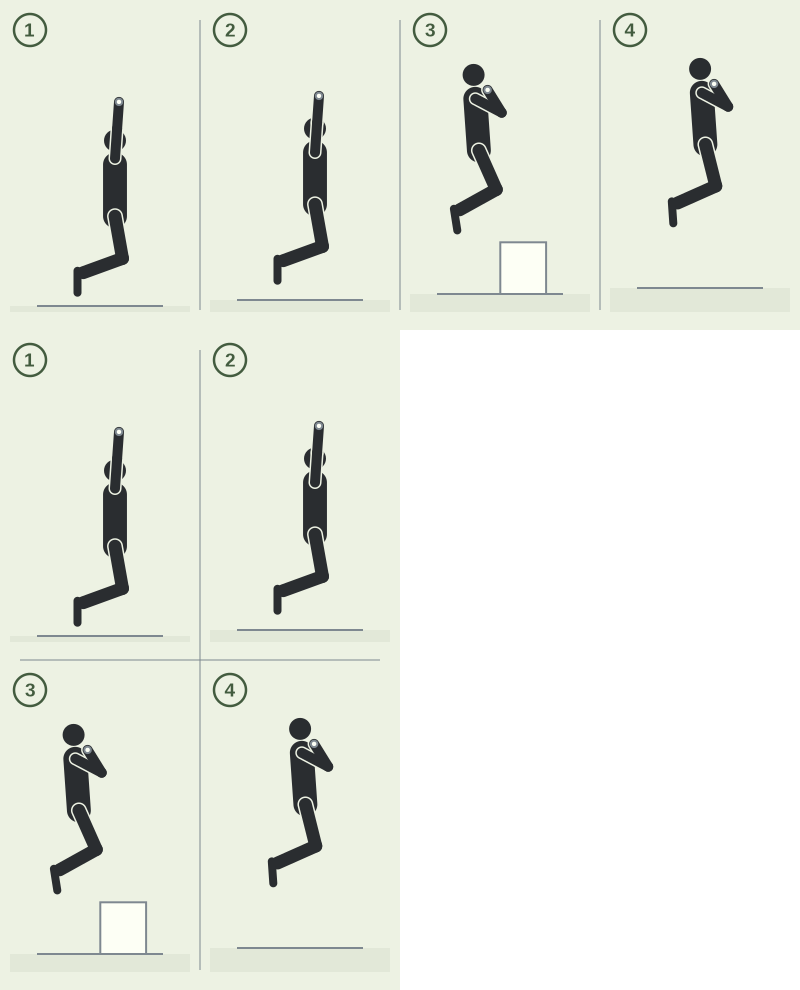
The four versions in order. Every one starts from or ends at a straight-arm hang.
ATP's strength circuit uses the straight-arm pull for anyone who can't complete the pull-ups, which puts it before the pull-up (para 13-7, p. 13-6). HPRC's sheet uses the "Down Only" lowering as one of the steps before trying a pull-up. Putting the lowering after the straight-arm pull, rather than before it, is a Living Room Strength rule; neither source places the two side by side.
The straight-arm pull range is ATP's own: "Repeat the exercise 5–10 times" (para 6-3, p. 6-1). For the pull-up, ATP also uses 5 to 10 reps (para 6-5, p. 6-3). This site starts the pull-up row at 1 to 5 so a first pull-up counts, which is a Living Room Strength rule. The hang and the lowering have no rep or time range in the sources this site read, so those ranges are a Living Room Strength rule too.
This page has no band-assisted version. The site has not found a band-assisted pull-up method from a public agency, so it doesn't list one.
How do you do each version?
Dead hang. Stand under the bar, take hold, then bend your knees until your feet leave the floor. Hang with straight arms and still legs. Straighten your legs to stand when the time is up. Dead Hang on a Doorway Bar: Check the Bar Before You Hang covers this version on its own page.
Straight-arm pull. This is sometimes called a scapular pull. From the hang, keep your arms straight and pull your body up a little, then lower back to the hang. Your elbows do not bend.
ATP describes the move as "raising the head between the arms. The chest will move up toward the bar and the shoulder blades will move together" (para 6-3, p. 6-1).
Slow lowering. This version is often called a negative pull-up. HPRC calls it "Down Only," and the site writes it the way the sheet does.
Step up on a sturdy step, hold the bar with your palms facing away, and begin at the top. Bend your knees so your feet just leave the step, and start counting from there (Living Room Strength rule). Keep your legs still and "take 5–10 seconds to slowly lower until your arms are fully extended." Pause briefly with your shoulders down and back.
After the pause, straighten your knees to stand on the floor, and let go only once you're standing (Living Room Strength rule). Your feet don't go back to the step. It's the same way you come down from the dead hang.
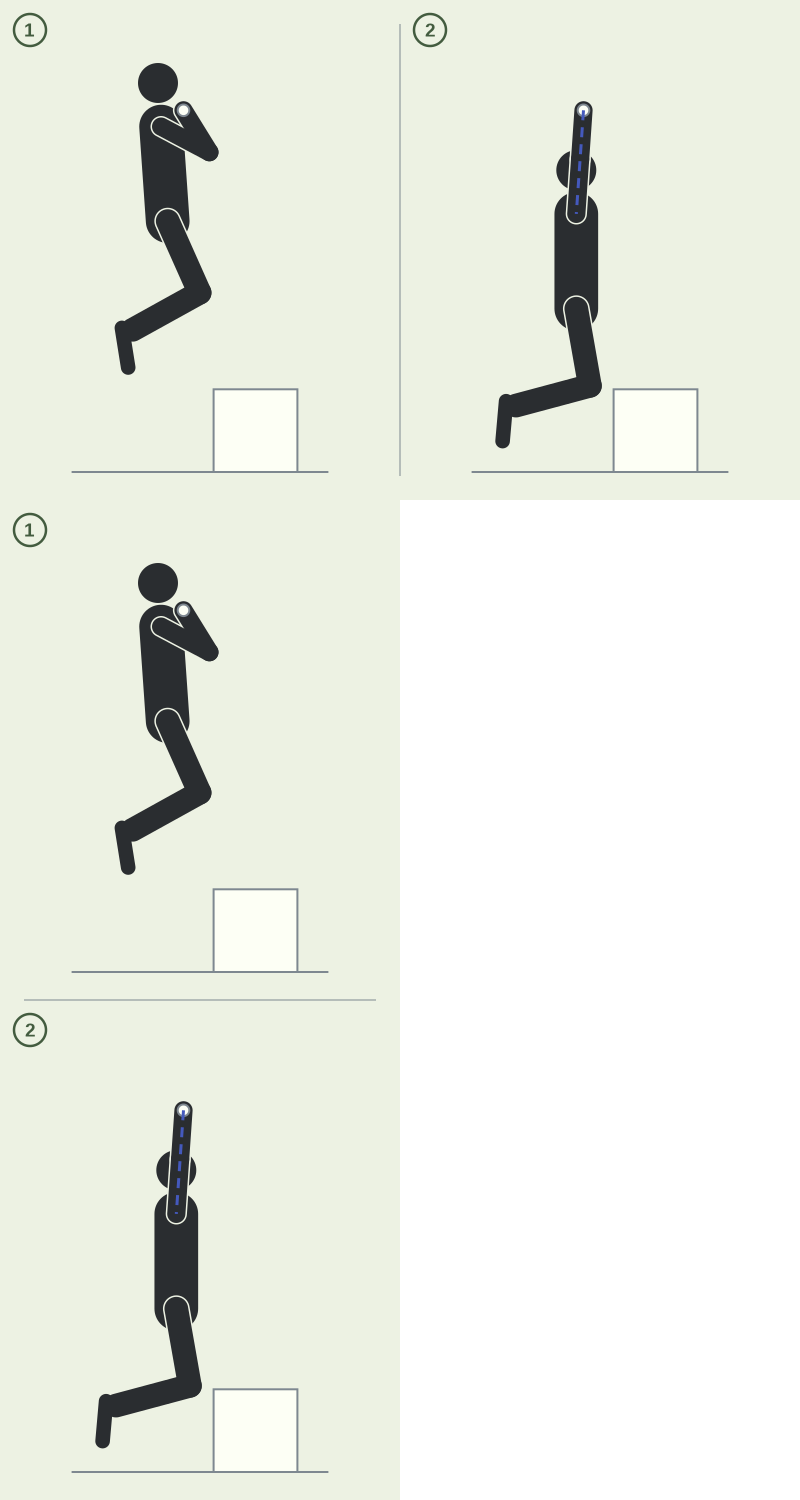
Slow lowering. Panel 1 is the top, with the feet just off the step; panel 2 is the bottom, after 5 to 10 seconds. From there you straighten your knees and stand on the floor before you let go.
Pull-up. From a straight-arm hang, bend your elbows and pull up, with your legs still. Pause, then lower until your arms are fully straight.
The two sources end the rep in different places. ATP raises the body "until the head is above the bar" (para 6-5, p. 6-3). HPRC writes "pull your chest to the bar." Either one counts. Pick one before the set and keep it for every rep of that set (Living Room Strength rule).
What should you check on a doorway bar before you hang?
Install your bar the way its instructions say, and check it before every session. At least one doorway bar has been recalled. Check yours on the U.S. Consumer Product Safety Commission's recall list at https://www.cpsc.gov/Recalls.
This site's order for the check, a Living Room Strength rule:
- Look at the door frame for cracks or loose trim where the bar sits.
- Look at both ends of the bar. They should sit tight against the frame.
- Pull down on the bar hard with your hands while your feet stay on the floor.
- Only then hang your full weight.
The Floor Card says when a set ends.
How high should the bar be, and what do you stand on?
The line under the version table gives the bar height. The lowering and the pull-up both take your head above the bar. Before either one, check that your head has room there without touching the top of the frame. If you skip the lowering because the step won't fit, still do this check before the pull-up (Living Room Strength rule).
For the slow lowering, use something built to be stepped on, like the sturdy step from Step-Ups on a Stair at Home. The step is only for getting to the top. Put it where you can reach the top with bent arms, but not on the spot where your feet come down at the bottom (Living Room Strength rule). If there's no spot where the step can sit like that, leave the lowering out for now (Living Room Strength rule). Don't use a chair, and don't jump to reach the bar. Whether your doorway bar is meant to take a lowering rep is a question for its instructions.
How many sets, and how long to rest?
The Floor Card uses 2 to 3 sets. The U.S. Physical Activity Guidelines for Americans say one set of a strength exercise is effective and two or three may be more effective (p. 61), and they count pull-ups as a strength exercise. For rest, HPRC's pull-up sheet uses 60 to 90 seconds between sets. Rest Between Sets and Days Between Sessions has the other ranges.
About this illustration
Illustration by Living Room Strength: a generated marker drawing of a room, not a photograph and not a guide to any move. It shows no people. Reuse it with credit to Living Room Strength; this site claims rights in it only as far as the law grants them.HPRC's sheet follows a set number of weeks before it has you try a pull-up. This site doesn't promise a pull-up by any date.
You move from one row to the next with the Spare-Two Check, explained under the table and on Progressive Overload at Home With One Pair of Dumbbells. For today's dead hang, the third thing to look at is whether you could have stayed longer with neither hand starting to slip. From the straight-arm pull on, the "two left" part is a guess about reps in reserve, and the page on reps in reserve explains how to make that guess. The Bodyweight Progression Finder for Progressive Overload asks the same questions one at a time.
What does it look like when the form slips?
- Your legs swing or kick to get you higher.
- Your elbows bend during a straight-arm pull.
- Your shoulders ride up by your ears during the pause at the bottom of the lowering.
- The lowering takes less than 5 seconds; you drop instead of lowering.
- A pull-up or a straight-arm pull ends with your elbows still bent, or the lowering stops before your arms are fully straight.
- Your pull-ups stop at a lower point than the top you picked for the set.
On this page you hold the bar with the palms facing away. Chin-Up vs Pull-Up Grip and Which Way the Palms Face explains the other grip and which way the palms face. For pulling without a bar, see Dumbbell Row at Home With One Hand on a Chair; for the pushing side, Push-Up Progression: From the Wall to the Floor. Strength Training at Home: Where a Beginner Starts shows how a pull fits into a full session, and every version here is listed in the Exercise Names: A Home Exercise Library by Movement.
Next session: Before you hang, run the four bar checks in order, then start with the dead hang.
Source trail
- Every version starts from a straight-arm hang with a closed overhand grip, thumb wrapped around the bar [1]
- Straight-arm pull: arms straight, chest moves up toward the bar, shoulder blades move together; 5 to 10 reps [1]
- Order hang, straight-arm pull, pull-up (the straight-arm pull is the alternate when pull-ups can't be completed) [1]
- Pull-up: flex the elbows until the head is above the bar; ATP's range of 5 to 10 reps, listed beside this site's 1 to 5 [1]
- Lowering only: step up, begin at the top, take 5 to 10 seconds to lower until the arms are fully extended, pause with the shoulders down and back [2]
- Straight-arm pull keeps the arms straight [1]
- Palms facing away from you; legs still; pull-up ends with the chest to the bar; 60 to 90 seconds between sets [2]
- Check whether your bar has been recalled [4]
Living Room Strength rule
- Lowering: feet just off the step before counting; at the bottom, pause, straighten the knees to stand on the floor, then let go; the step is only for getting to the top and sits outside the spot where the feet come down; leave the lowering out if the step can't sit like that; pick one pull-up top and keep it for the set
- Seconds for the dead hang; rep ranges for the lowering and the pull-up; the lowering placed after the straight-arm pull
- Bar checks in order; the bar set low enough that straightening the knees at the end of a hang puts the feet on the floor; head room above the bar without touching the top of the frame, checked before the lowering and before the pull-up; the step within reach of the top but outside the spot where the feet come down; no chair as a step
Living Room Strength set these itself. No source gives them, so read them as this site’s choice, not a finding.
Sources
Numbers in brackets point here. Anything marked Living Room Strength rule is this site’s own choice and has no source.
- Headquarters, Department of the Army. ATP 7-22.02, Holistic Health and Fitness Drills and Exercises, Oct 2020 (incl. C1, Sept 2025) Open the source Read: Chapters 2, 3, 6, 13, 14, 16 and 17 (exercise descriptions only; photographs not used).
- Human Performance Resources by CHAMP (HPRC), Uniformed Services University. Train Above the Bar: Achieving Your First Pull-up (2020) Open the source Read: Full 4-page program sheet (photographs not used).
- U.S. Department of Health and Human Services. Physical Activity Guidelines for Americans, 2nd edition (2018) Open the source Read: Full guidelines; Chapter 4 (pages 56-62) and Chapter 7 (pages 88-93) used.
- U.S. Consumer Product Safety Commission. Recall of doorway pull-up bar handles (2011) Open the source Read: Recall notice from 2011; the recalls search page is linked.
Elsewhere in the room
Corrections
No corrections on this page yet. If a line, a number or a drawing here is wrong, tell this site.