Legs & HipsMove
How to Squat at Home, From a Chair to a Goblet Squat
Living Room Strength ·
About this illustration
Illustration by Living Room Strength: a generated marker drawing of a room, not a photograph and not a guide to any move. It shows no people. Reuse it with credit to Living Room Strength; this site claims rights in it only as far as the law grants them.Answer first
Start by squatting back to a sturdy chair until you just touch the seat, then stand up. The order on this site is the chair, a bodyweight squat to 90 degrees, a goblet squat with one dumbbell to the same depth, and then a deeper goblet squat. Move on only when the Spare-Two Check at the end of a session says so.
If you have a long-term health condition, or symptoms such as chest pain or pressure, dizziness or joint pain, or you are pregnant or have recently given birth, talk to a health care provider before you start. If new symptoms show up as you do more, talk to one then too. Physical Activity Guidelines for Americans, 2nd edition, chapter 7, p. 93 (Guidelines).
Floor Card
- Space
- Mat
- Noise
- Quiet
- Kit
- sturdy chair, one dumbbell
- Version today
- Squat to a chair
- Sets × reps
- 2–3 × 8–12
- Rest
- 30 seconds, 30–90 seconds or 1–3 minutes, by goal (HPRC)
- Spare-Two Check
- 12 reps
- Easier
- None on this site yet
- Stop for today if
- “Stop the exercise immediately if you feel any pain or become unwell.” If the pain does not go away, see a doctor.The quoted sentence: Information from the NHS website, as at 261126 (NHS). Seeing a doctor if the pain stays: Living Room Strength rule.
- End the set if
- The equipment moves or gives: the doorway bar shifts or creaks, the band has a nick, a cut or loose stitching, the chair or couch slides, or the step wobbles. End the set and check it against its instructions before the next one.What to look for on a band comes from the instructions that come with bands. Ending the set and checking: Living Room Strength rule.
- You can no longer keep one of the form lines. That rep ends the set.Going on only while the move meets its standard: Adapted from ATP 7-22.02, p. 13-7 (ATP 7-22.02).
Form lines
- Your feet stay flat, and your heels stay on the floor.
- Your knees stay in line over your feet; they don't fall in toward each other.
- Your upper back stays straight, not rounded, and your head and neck stay in line with it.
- Your lower back keeps the natural arch it had when you started; it doesn't round.
- In the goblet squats, the dumbbell stays upright against your chest.
- At the top you stand tall, with your knees straight but not locked.
You can film one set from the side on your phone and check each line. The video stays on your phone; this site never sees it.
The heel, knee and upper-back lines come from the caution notes for the squat in the U.S. Army manual ATP 7-22.02: "Do not round out the upper back," and "The knees stay aligned over the feet and the heels stay on the ground" (para 14-4, p. 14-2). The lower-back line and the head and neck come from a later paragraph of the same manual: "Maintain a natural arch in the lower back with the head and neck staying in alignment" (para 14-6, p. 14-3). The NHS mini-squat also asks for the knees "facing forwards" and the back straight, in the words quoted further down. Not locking the knees at the top comes from the National Institute on Aging (Adapted from the National Institute on Aging, NIH). The dumbbell line is a Living Room Strength rule, explained with the goblet squat below.
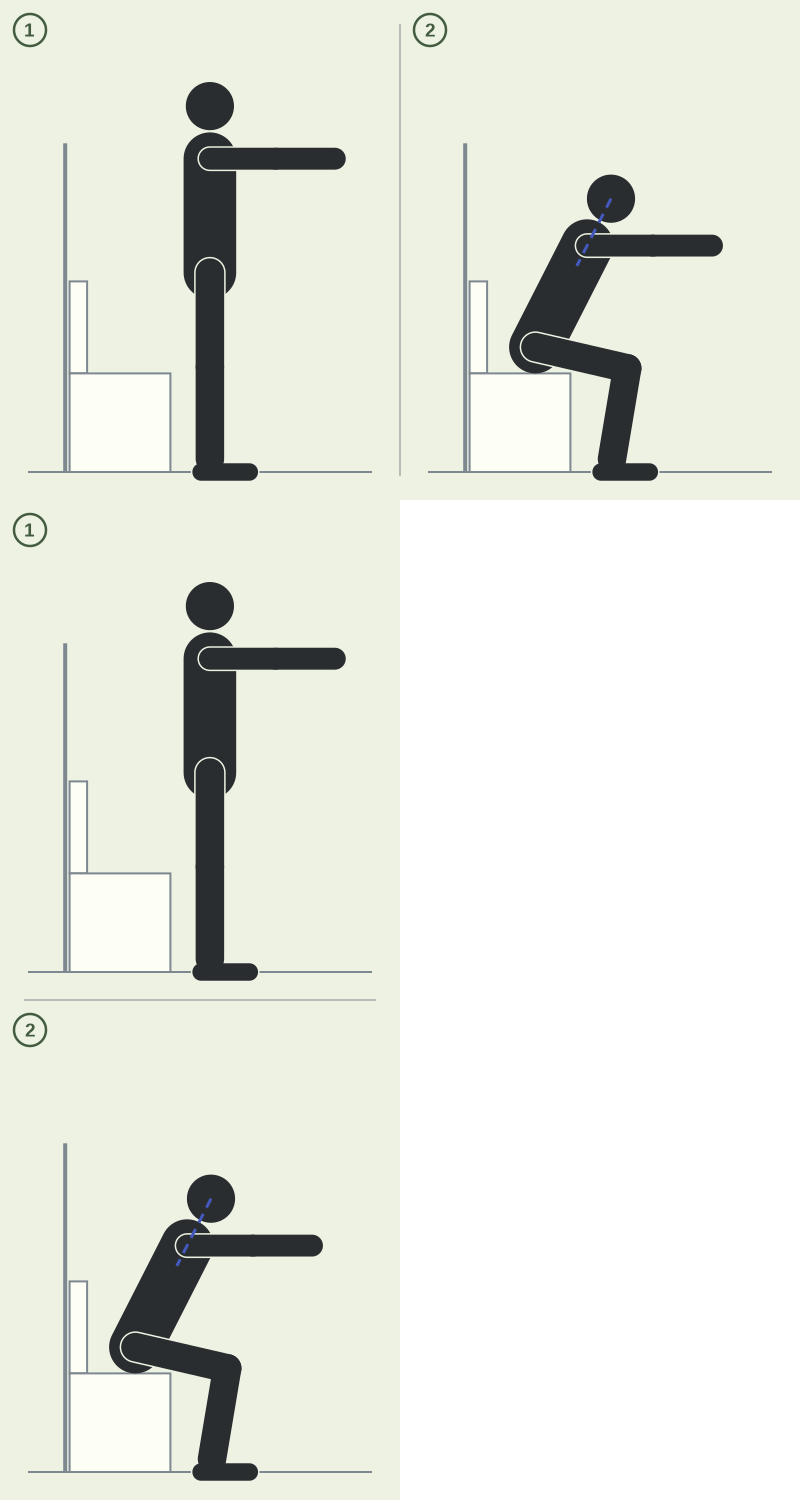
Squat to a chair. In panel 2 the seat is only touched, not sat on.
Squat versions, from the chair to the goblet squat
| Order | Version | What changes | Range | Basis |
|---|---|---|---|---|
| 1 | Squat to a chair | Start | 8–12 reps | Living Room Strength rule |
| 2 | Bodyweight squat to 90 degrees | Assistance: no chair behind you, and the depth becomes a 90-degree angle between the upper and lower leg; at that angle your hips may be higher or lower than your chair seat was Two changes on this row | 8–12 reps | [1] |
| 3 | Goblet squat to 90 degrees | Load: one dumbbell held upright against the chest with both hands | 8–12 reps | [1] |
| 4 | Deeper goblet squat | Range: lower past 90 degrees, only as far as the form lines hold | 8–12 reps | [1] |
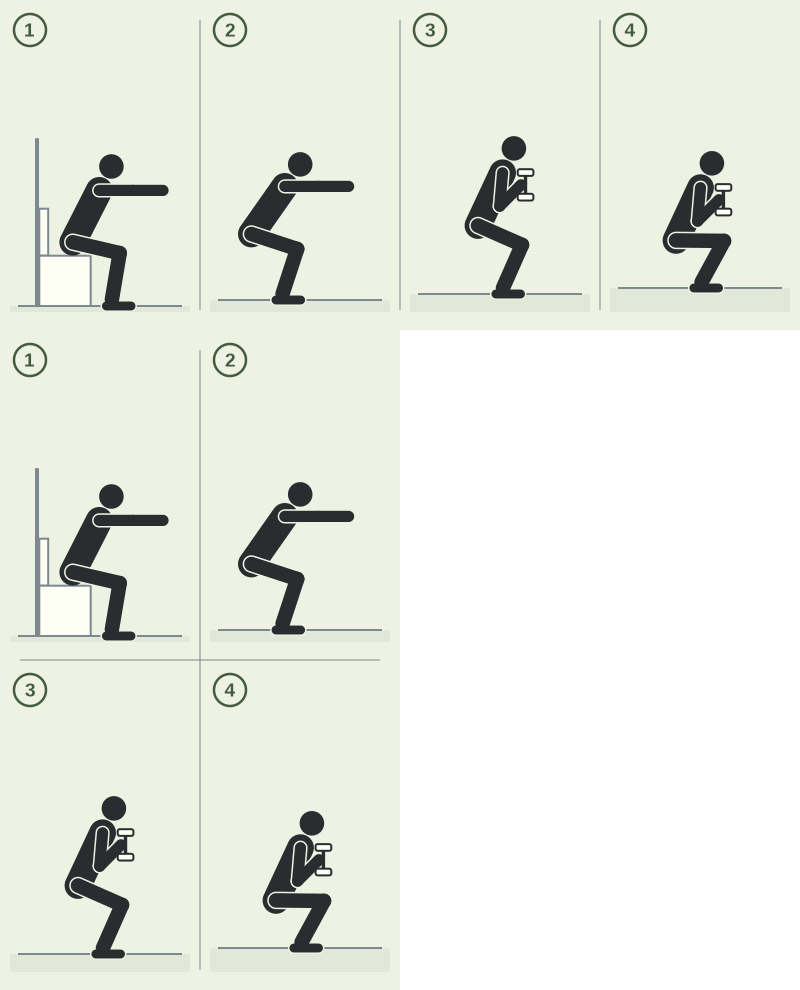
The four versions in order: the chair goes, then a weight comes, then depth.
ATP is the source for rows 2 to 4. Its squat starts by lowering "until there is a 90-degree angle between the upper and lower leg," and it says, "Initially do not squat deeper than 90 degrees. Progress to deeper positions as strength improves" (para 14-6, p. 14-3). ATP writes that line for squats with a weight, so on this page the dumbbell comes in at 90 degrees and the extra depth comes after it. Row 4 has no set depth: you go only as low as every form line holds, the lower-back line included. That is a Living Room Strength rule.
Row 1, the chair, is this site's own first step. No source read for this page describes it, so it is marked as a Living Room Strength rule.
In row 2, two things change at once. The chair goes, and your depth becomes ATP's 90-degree angle. When your knees reach 90 degrees, your hips may be a little higher or lower than the chair seat was. Go by the right angle between your thigh and shin, not by the seat.
How do you squat to a chair?
Stand in front of the chair with its seat behind your heels, and raise both arms in front of you, level with the floor. Lean slightly forward, and keep the natural arch your lower back has when you stand tall. Your head stays in line with your upper back. ATP's squat bender uses this forward lean and arm position (para 3-8, p. 3-5); the lower-back arch comes from para 14-6. Push your hips back and down until the seat just touches, then stand straight back up.
Touch the seat; don't sit down and rest on it. That keeps each rep a squat rather than a sit-and-stand, and it is a Living Room Strength rule.
For the chair itself, the NHS advice fits, quoted as written: "choose a solid, stable chair that does not have wheels and that will not slip on the surface it is on." The next line is for choosing the chair's height, not for how deep you squat: "You should be able to sit with your feet flat on the floor and your knees bent at right angles." Information from the NHS website, as at 261126, https://www.nhs.uk/live-well/exercise/strength-exercises/.
This site adds two things. Use a chair that won't fold, and push it back against a wall so it can't slide when you touch it (Living Room Strength rule).
Can your knees go past your toes?
The two sources on this point describe the knees differently, so both are here.
The NHS mini-squat says, quoted as written: "Slowly bend your knees as far as is comfortable, keeping them facing forwards. Aim to get them over your big toe. Keep your back straight at all times." Information from the NHS website, as at 261126, https://www.nhs.uk/live-well/exercise/strength-exercises/.
ATP says the knees "stay aligned over the feet," with the heels on the ground. One talks about how far forward the knees go; the other talks about keeping them lined up with the feet. This site doesn't add a rule of its own on top of these.
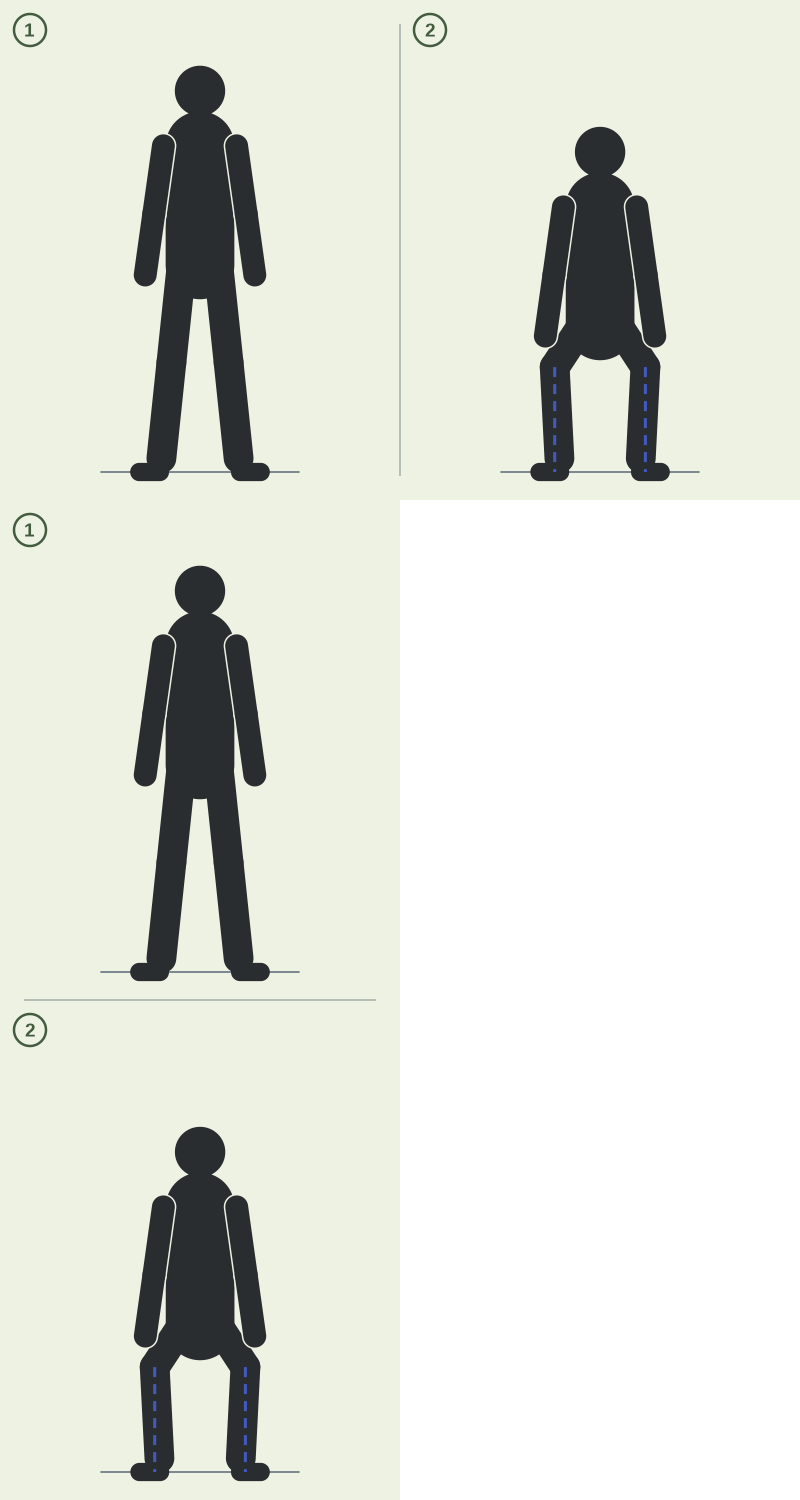
From the front, each knee tracks over its own foot in panel 2. A front view shows only the side-to-side line; it doesn't show how far forward the knees go.
How wide should your feet be?
The sources differ here too. ATP's standing position puts the feet shoulder-width apart (para 2-5, p. 2-3), and its squats turn the toes slightly out: "toes pointed slightly outward" (paras 14-4 and 14-6). The NHS mini-squat sets the feet "hip-width apart" and keeps the knees "facing forwards," quoted as written. Information from the NHS website, as at 261126, https://www.nhs.uk/live-well/exercise/strength-exercises/.
Pick one stance and keep it for the whole set, so the knee line has something fixed to follow (Living Room Strength rule). Whichever you choose, the second form line still applies: knees in line over the feet.
How do you hold the dumbbell for a goblet squat?
Hold one dumbbell upright against your chest with both hands, and squat to 90 degrees, the same depth as row 2; only row 4 goes deeper. Holding it upright against your chest is a Living Room Strength rule; ATP's sumo squat holds a single weight "with both hands in front of the body" (para 13-3, p. 13-1). This page doesn't use the sumo squat's wide stance; keep the stance you picked. ATP also says to "Always lift a weight that can be controlled throughout the range of motion" (p. 14-2).
The National Institute on Aging suggests trying moves without weights until you are comfortable with them (Adapted from the National Institute on Aging, NIH). On this site, that is why the dumbbell comes after the two bodyweight versions. If you have a pair, Dumbbell Workout at Home With One Pair of Dumbbells shows other ways to use them.
About this illustration
Illustration by Living Room Strength: a generated marker drawing of a room, not a photograph and not a guide to any move. It shows no people. Reuse it with credit to Living Room Strength; this site claims rights in it only as far as the law grants them.How many reps and sets, and how long to rest?
The Floor Card uses 2 to 3 sets of 8 to 12 reps. The U.S. Physical Activity Guidelines for Americans say one set of 8 to 12 reps is effective, two or three sets may be more effective, and each set goes to the point where another rep would be hard (p. 61). The National Institute on Aging gives the same numbers (Adapted from the National Institute on Aging, NIH).
How that fits with stopping about two reps short is on Strength Training at Home: Where a Beginner Starts. How Many Sets and Reps? Ranges, Goals and Moving Up explains the words.
For rest, HPRC, the Uniformed Services University's fitness resource, gives a range for each training goal. The three that fit home strength work are 30 seconds, 30 to 90 seconds, and 1 to 3 minutes, depending on the goal. This site doesn't choose one; Rest Between Sets and Days Between Sessions puts them side by side.
You move to the next row with the Spare-Two Check, explained under the table and on Progressive Overload at Home With One Pair of Dumbbells. The "two left" part is a guess about reps in reserve, and the page on reps in reserve explains how to make that guess. The Bodyweight Progression Finder for Progressive Overload asks the same questions one at a time.
What does it look like when the form slips?
- Your heels lift off the floor at the bottom.
- Your knees fall in toward each other.
- Your upper back rounds forward, or your head tips back or drops out of line with it.
- Your lower back rounds at the bottom.
- You sit down on the chair and rock to get up.
- In the goblet squat, the dumbbell drifts away from your chest.
The Floor Card says when a set ends.
The other pages in this part of the room build on the same stance. Step-Ups on a Stair at Home uses one leg at a time on a stair, Reverse Lunges in a Small Room moves one foot behind you into a split stance, and Romanian Deadlift With Dumbbells, Hip Hinge First bends at the hips instead of the knees. To fit squats into a full session with a push such as the Push-Up Progression: From the Wall to the Floor, start at Strength Training at Home: Where a Beginner Starts. Every version here is also listed in the Exercise Names: A Home Exercise Library by Movement.
Next session: Squat to the chair and watch one form line on every rep: your heels stay on the floor.
Source trail
- Heels stay on the ground, knees aligned over the feet, upper back not rounded, a natural arch in the lower back, head and neck in line [1]
- Lower until there is a 90-degree angle between the upper and lower leg; with a weight, stay at 90 degrees at first and go deeper as strength improves; lift only a weight you can control [1]
- Lean slightly forward with the arms out in front; hold a single weight in front of the body with both hands; feet shoulder-width apart, toes slightly outward in the squats [1]
- Knees facing forwards and over the big toe, back straight, feet hip-width apart, how to choose a chair, and a chair that lets you sit with the knees bent at right angles (quoted only) [2]
- Knees straight but not locked at the top; try moves without weights first [3]
- 8 to 12 reps, one set is effective and two or three may be more effective [4]
- Rest between sets: three ranges listed side by side [5]
Living Room Strength rule
- The squat-to-a-chair version, touching the seat without sitting, a chair that won't fold, and the chair against a wall
- Holding the dumbbell upright against the chest in the goblet versions; the deeper version goes only as low as every form line holds, the lower-back line included; pick one stance and keep it for the whole set
Living Room Strength set these itself. No source gives them, so read them as this site’s choice, not a finding.
Sources
Numbers in brackets point here. Anything marked Living Room Strength rule is this site’s own choice and has no source.
- Headquarters, Department of the Army. ATP 7-22.02, Holistic Health and Fitness Drills and Exercises, Oct 2020 (incl. C1, Sept 2025) Open the source Read: Chapters 2, 3, 6, 13, 14, 16 and 17 (exercise descriptions only; photographs not used).
- NHS. Strength exercises Open the source Read: Full page (page last reviewed 28 February 2024).
- National Institute on Aging, NIH. Three Types of Exercise Can Improve Your Health and Physical Ability (content reviewed 2025) Open the source Read: Full article; general principles only.
- U.S. Department of Health and Human Services. Physical Activity Guidelines for Americans, 2nd edition (2018) Open the source Read: Full guidelines; Chapter 4 (pages 56-62) and Chapter 7 (pages 88-93) used.
- Human Performance Resources by CHAMP (HPRC). Use the FITT-VP principle to plan your workouts (2025) Open the source Read: Full article and FITT-VP table.
Elsewhere in the room
Corrections
No corrections on this page yet. If a line, a number or a drawing here is wrong, tell this site.