Training BasicsTool
Bodyweight Progression Finder for Progressive Overload
Living Room Strength ·
About this illustration
Illustration by Living Room Strength: a generated marker drawing of a room, not a photograph and not a guide to any move. It shows no people. Reuse it with credit to Living Room Strength; this site claims rights in it only as far as the law grants them.Answer first
Pick a move, the version you did last session, and how that session went, judged after its last set. The finder tells you which version to use next session, where in its range to start, and that version's Form lines. It follows the Spare-Two Check, a Living Room Strength rule, and links to the row in the move's version table.
Use it here
Everything you pick here stays on this page in your browser. Nothing is saved, put in the address bar or sent anywhere, and it all resets when you reload.
Pick how the last session went.
The rule, without the tool
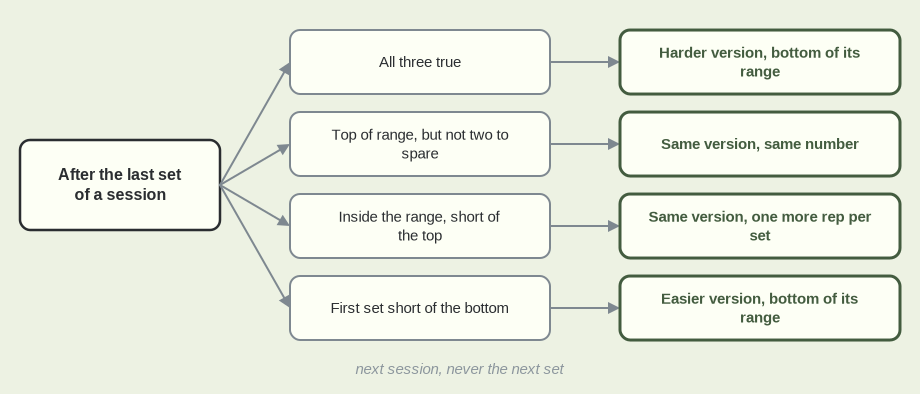
Judge this at the end of the last set of a session. Look at three things:
- Every set reached the top of the range.
- Every rep kept the form lines.
- After the last set, you could have done about two more reps, and kept the form lines on them too.
For a hold the third one is about two more slow breaths; for a dead hang it is staying longer with neither hand starting to slip.
- All three are true
- Next session, use the harder version and start at the bottom of its range.
- Top of the range and clean form, but not two to spare
- Next session, same version and same number, until the third one is true as well.
- Inside the range and clean form, but short of the top
- Next session, same version. Try one more rep in each set.
- The first set could not reach the bottom of the range without breaking a line
- Next session, use the easier version. If only the later sets dropped below the bottom, stay on this version and stop after the last set you could keep clean.
This is how this site decides when to change versions. It is not a fitness test, and nothing is counted across sessions or days. You never switch versions in the middle of a set.
Every version table
Push-Up Progression: From the Wall to the Floor
| Order | Version | What changes | Range | Basis |
|---|---|---|---|---|
| 1 | Wall push-up | Start | 8–12 reps | NHS website (link only) |
| 2 | Counter push-up | Lever: hands on a kitchen counter | 8–12 reps | Living Room Strength rule |
| 3 | Step push-up | Lever: hands on a stair step, or on the seat of a sturdy chair that won't fold, set against a wall | 8–12 reps | Living Room Strength rule |
| 4 | Knee push-up on the floor | Lever: hands on the floor, and the knees take the place of the feet as the point you pivot on Two changes on this row | 8–12 reps | ATP 7-22.02, Oct 2020 (incl. C1, Sept 2025) |
| 5 | Push-up on the floor | Lever: up on the toes instead of the knees | 8–12 reps | ATP 7-22.02, Oct 2020 (incl. C1, Sept 2025) |
Form lines:
- Your hands are flat: at chest level on the wall; about shoulder-width apart on the edge of a counter or step, where your straight arms meet your body at a right angle at the shoulders at the top; and directly under your shoulders, fingers spread, on the floor.
- Your body makes one straight line from your head to your heels, or to your knees in the knee version, and your hips do not sag toward the floor.
- You lower until your upper arms are parallel to the ground on the floor, until your chest is just short of the edge on a counter or step, without touching it or bouncing, and until you have closed the gap as far as you can at the wall.
- At the wall, your elbows stay close to your sides as they bend.
- At the top your arms are straight, but your elbows are not locked.
Pull-Up Progression When You Can't Do One Yet
| Order | Version | What changes | Range | Basis |
|---|---|---|---|---|
| 1 | Dead hang | Start | 10–30 seconds | Living Room Strength rule |
| 2 | Straight-arm pull | New move: arms stay straight while the chest rises a little toward the bar | 5–10 reps | ATP 7-22.02, Oct 2020 (incl. C1, Sept 2025) |
| 3 | Slow lowering from a step | New move: start at the top from a step and lower for 5 to 10 seconds | 3–5 reps | HPRC, Train Above the Bar: Achieving Your First Pull-up |
| 4 | Pull-up | New move: pull from a straight-arm hang up to the top | 1–5 reps | Living Room Strength rule |
Form lines:
- Your hands hold the bar with the palms facing away from you, and your thumbs wrap around the bar.
- Your legs stay still under you; they don't swing or kick to help.
- Every rep ends at the bottom with your arms fully straight.
- In the straight-arm pull, your elbows stay straight the whole time.
- In the slow lowering, your shoulders draw down and back during the pause at the bottom.
- In the pull-up, every rep reaches the same top, the one you picked before the set: head above the bar or chest to the bar.
Dead Hang on a Doorway Bar: Check the Bar Before You Hang
| Order | Version | What changes | Range | Basis |
|---|---|---|---|---|
| 1 | Dead hang | Start | 10–30 seconds | Living Room Strength rule |
| 2 | Straight-arm pull | New move: arms stay straight while the chest rises a little toward the bar | 5–10 reps | ATP 7-22.02, Oct 2020 (incl. C1, Sept 2025) |
Form lines:
- Your hands hold the bar with the palms facing away from you, and your thumbs wrap around the bar.
- Your arms stay fully straight.
- Your legs stay still under you; they don't swing or kick to help.
Dumbbell Row at Home With One Hand on a Chair
| Order | Version | What changes | Range | Basis |
|---|---|---|---|---|
| 1 | One-arm dumbbell row | Start | 8–12 reps per side | ATP 7-22.02, Oct 2020 (incl. C1, Sept 2025) |
| 2 | One-arm row, slow lowering | Tempo: three seconds on the way down | 8–12 reps per side | Living Room Strength rule |
| 3 | One-arm row with a pause | Pause: one second with the elbow back, with the slow lowering kept | 8–12 reps per side | Living Room Strength rule |
| 4 | One-arm row, heavier dumbbell | Load: the next heavier dumbbell, with the slow lowering and the pause kept | 8–12 reps per side | HPRC, Guidelines to progress your physical training over time |
Form lines:
- Your free hand rests on the chair seat with the arm straight, and both feet are flat on the floor.
- Your back stays straight, with your head in line with it, and neither moves while you pull.
- You pull until your upper arm is level with the floor and your elbow points back.
- Your shoulder stays down and back as you pull.
Seated Resistance Band Rows on the Floor
| Order | Version | What changes | Range | Basis |
|---|---|---|---|---|
| 1 | Seated band row | Start | 8–12 reps | Illinois Extension (link only) |
| 2 | Seated band row with a pause | Pause: two seconds with the elbows back | 8–12 reps | Living Room Strength rule |
| 3 | Seated band row, stronger band | Load: a band that is harder to stretch, with the pause kept | 8–12 reps | Living Room Strength rule |
Form lines:
- You sit tall with your legs straight out in front.
- Your elbows go straight back as you pull toward your belly.
- Your trunk and head stay still while your arms move.
- Your shoulders stay down and back as you pull.
How to Squat at Home, From a Chair to a Goblet Squat
| Order | Version | What changes | Range | Basis |
|---|---|---|---|---|
| 1 | Squat to a chair | Start | 8–12 reps | Living Room Strength rule |
| 2 | Bodyweight squat to 90 degrees | Assistance: no chair behind you, and the depth becomes a 90-degree angle between the upper and lower leg; at that angle your hips may be higher or lower than your chair seat was Two changes on this row | 8–12 reps | ATP 7-22.02, Oct 2020 (incl. C1, Sept 2025) |
| 3 | Goblet squat to 90 degrees | Load: one dumbbell held upright against the chest with both hands | 8–12 reps | ATP 7-22.02, Oct 2020 (incl. C1, Sept 2025) |
| 4 | Deeper goblet squat | Range: lower past 90 degrees, only as far as the form lines hold | 8–12 reps | ATP 7-22.02, Oct 2020 (incl. C1, Sept 2025) |
Form lines:
- Your feet stay flat, and your heels stay on the floor.
- Your knees stay in line over your feet; they don't fall in toward each other.
- Your upper back stays straight, not rounded, and your head and neck stay in line with it.
- Your lower back keeps the natural arch it had when you started; it doesn't round.
- In the goblet squats, the dumbbell stays upright against your chest.
- At the top you stand tall, with your knees straight but not locked.
Romanian Deadlift With Dumbbells, Hip Hinge First
| Order | Version | What changes | Range | Basis |
|---|---|---|---|---|
| 1 | Hip hinge | Start | 8–12 reps | ATP 7-22.02, Oct 2020 (incl. C1, Sept 2025) |
| 2 | Romanian deadlift with dumbbells | Load: a dumbbell in each hand | 8–12 reps | ATP 7-22.02, Oct 2020 (incl. C1, Sept 2025) |
Form lines:
- Your knees stay slightly bent, at the same angle all the way down and up.
- You bend forward with your back straight, head in line with it.
- You lower until your back is about level with the floor, or until you feel a stretch in the back of your thighs, whichever comes first.
Step-Ups on a Stair at Home
| Order | Version | What changes | Range | Basis |
|---|---|---|---|---|
| 1 | Step-up holding the handrail | Start | 8–12 reps per side | Illinois Extension (link only) |
| 2 | Step-up without holding on | Assistance: both hands off the handrail | 8–12 reps per side | Illinois Extension (link only) |
| 3 | Step-up holding dumbbells | Load: a dumbbell in each hand | 8–12 reps per side | ATP 7-22.02, Oct 2020 (incl. C1, Sept 2025) |
Form lines:
- Your whole foot is on the stair before you step up.
- You stand all the way up on the stair before stepping down.
- You step down one foot at a time.
- In the dumbbell version, the dumbbells stay at your sides.
Reverse Lunges in a Small Room
| Order | Version | What changes | Range | Basis |
|---|---|---|---|---|
| 1 | Wall-supported lunge | Start | 8–12 reps per side | Illinois Extension (link only) |
| 2 | Reverse lunge, part way down | New move | 8–12 reps per side | ATP 7-22.02, Oct 2020 (incl. C1, Sept 2025) |
| 3 | Reverse lunge, full depth | Range: down until the front thigh is level with the floor | 8–12 reps per side | ATP 7-22.02, Oct 2020 (incl. C1, Sept 2025) |
Form lines for Wall-supported lunge:
- In the wall-supported lunge, one hand rests on the wall beside you the whole time.
- Your front knee stays over your ankle, not in front of it.
- Your chest and back stay upright, and your eyes look forward.
Form lines for Reverse lunge, part way down to Reverse lunge, full depth:
- In the reverse-lunge rows, your hands rest on your hips.
- In the reverse-lunge rows, your back foot lands on the ball of the foot first.
- Your front knee stays over your ankle, not in front of it.
- Your chest and back stay upright, and your eyes look forward.
How do you use the finder?
Use it once a session is over, not between sets. Choose three things:
- The move. Every move page with a version table is in the list.
- The version you did. Each one shows its range, such as 8–12 reps or 10–30 seconds.
- How the session went, judged after its last set. There are four choices. They follow the four branches of the Spare-Two Check, and the full rule is printed under the tool and on Progressive Overload at Home With One Pair of Dumbbells.
For a hold, the third part of the check is about two more slow breaths. For a dead hang, it's staying longer with neither hand starting to slip. The choices change their wording to match.
What does the result tell you?
The result names the version for next session and where to start:
- All three parts true: the harder version, starting at the bottom of its range.
- Top of the range with clean form, but not two to spare: the same version at the same number of reps or seconds.
- Inside the range with clean form, but short of the top: the same version, with one more rep in each set. For a hold, try a few more seconds.
- The first set couldn't reach the bottom of the range: the easier version, starting at the bottom of its range.
If only the later sets dropped below the bottom, that isn't one of the four choices: stay on the same version and stop after the last set you kept clean. The finder prints this under the choices.
The Spare-Two Check says when to go back to the easier version but not where to start in it. The finder starts at the bottom of the range, which is a Living Room Strength rule.
At the ends of a table, there's nowhere to move. On the last version, the finder keeps you there at the top of the range. On the first one, it keeps you there and tells you to end each set when a form line slips.
Some rows switch to a different move. The result says so, lists the Form lines for that version, and tells you whether they are new or the same as before. Some rows change two things at once, and the result asks you to read both before the first rep.
Why judge only after the last set?
The Spare-Two Check looks at one whole session. You never switch versions in the middle of a set. Nor does the check count anything across sessions or days. It's this site's rule for changing versions, not a fitness test.
The finder keeps no record either. It forgets your choices when you reload, so it can't track sessions for you.
To guess how many reps you had left, see RPE Scale and Reps in Reserve for Home Sets. For how a range works, see How Many Sets and Reps? Ranges, Goals and Moving Up.
How does this work as progressive overload?
HPRC, a military fitness resource, lists ways to make training harder over time: more reps or sets, more weight, more sessions, or less rest [1]. The U.S. Physical Activity Guidelines for Americans name more weight and more days a week as ways to progress (p. 61) [2]. The National Institute on Aging also describes gradual increases in weight, sets, reps or days (adapted from the National Institute on Aging, NIH) [3].
With body weight, there's often no weight to add, so this site moves you to a harder version instead.
HPRC's "2-for-2" rule adds weight once you beat your rep goal by two in the last set, two weeks in a row [1]. This site doesn't wait two weeks; the Spare-Two Check looks at one session. An open college textbook adds load once you pass your target by one or two reps [4]. Using the same idea to change versions is this site's own extension.
About this illustration
Illustration by Living Room Strength: a generated marker drawing of a room, not a photograph and not a guide to any move. It shows no people. Reuse it with credit to Living Room Strength; this site claims rights in it only as far as the law grants them.Which moves are in it?
Every version table on the site: Push-Up Progression: From the Wall to the Floor, Pull-Up Progression When You Can't Do One Yet, Dead Hang on a Doorway Bar: Check the Bar Before You Hang, Dumbbell Row at Home With One Hand on a Chair, Seated Resistance Band Rows on the Floor, How to Squat at Home, From a Chair to a Goblet Squat, Romanian Deadlift With Dumbbells, Hip Hinge First, Step-Ups on a Stair at Home and Reverse Lunges in a Small Room. Despite the name, a few tables add a dumbbell or a resistance band. A move joins once its page is up; the Exercise Names: A Home Exercise Library by Movement lists them all.
The tables are also a file: every version table as a CSV file (What is in this file), one row per version, easiest first.
Next session: after your last set, choose the move, the version and how the whole session went, then read the Form lines for next time.
Source trail
- Ways to make training harder over time: more reps or sets, more weight, more sessions, or less rest; the 2-for-2 rule for adding weight [1]
- More weight or more days a week as ways to progress [2]
- Gradual increases in weight, sets or reps, or days a week [3]
- From an open college textbook: add load once you pass the target by one or two reps [4]
Living Room Strength rule
- The Spare-Two Check and its four results; starting at the bottom of the range after moving to a harder or an easier version; what happens at either end of a version table; judging only after the last set and never switching mid-set; looking at one session rather than waiting two weeks; using the add-weight rules to change versions instead
Living Room Strength set these itself. No source gives them, so read them as this site’s choice, not a finding.
Sources
Numbers in brackets point here. Anything marked Living Room Strength rule is this site’s own choice and has no source.
- Human Performance Resources by CHAMP (HPRC). Guidelines to progress your physical training over time (2021) Open the source Read: Full article.
- U.S. Department of Health and Human Services. Physical Activity Guidelines for Americans, 2nd edition (2018) Open the source Read: Full guidelines; Chapter 4 (pages 56-62) and Chapter 7 (pages 88-93) used.
- National Institute on Aging, NIH. Three Types of Exercise Can Improve Your Health and Physical Ability (content reviewed 2025) Open the source Read: Full article; general principles only.
- Markell, Peterson and Johnson (Centralia College). Exercise and Nutrition, 4.3: Resistance Exercise Programming. Medicine LibreTexts Open the source Read: Section 4.3; its recommendations summarize the 2009 ACSM position stand. License: CC BY 4.0.
Elsewhere in the room
Corrections
No corrections on this page yet. If a line, a number or a drawing here is wrong, tell this site.