Cardio IndoorsHow-to
Low-Impact Cardio at Home With No Jumping
Living Room Strength ·

About this illustration
Illustration by Living Room Strength: a generated marker drawing of a room, not a photograph and not a guide to any move. It shows no people. Reuse it with credit to Living Room Strength; this site claims rights in it only as far as the law grants them.Answer first
March in place, then add heel digs, knee lifts, shoulder rolls and small knee bends, with no jumping. Go through the five again and again at a pace where you can talk but not sing. The moves come from an NHS warm-up; using them as a longer cardio session is a Living Room Strength rule.
If you have a long-term health condition, or symptoms such as chest pain or pressure, dizziness or joint pain, or you are pregnant or have recently given birth, talk to a health care provider before you start. If new symptoms show up as you do more, talk to one then too. Physical Activity Guidelines for Americans, 2nd edition, chapter 7, p. 93 (Guidelines).
Floor Card
- Space
- Mat + reach
- Noise
- Soft thud
- Kit
- None
- Version today
- Five no-jump moves, repeated in passes
- Sets × reps
- Not used here
- Rest
- No clear source
- Spare-Two Check
- Not used here
- Easier
- Not used here
- Harder
- Not used here
- Stop for today if
- “Stop the exercise immediately if you feel any pain or become unwell.” If the pain does not go away, see a doctor.The quoted sentence: Information from the NHS website, as at 261126 (NHS). Seeing a doctor if the pain stays: Living Room Strength rule.
- Chest pain or pressure, or dizziness. Stop, and talk to a doctor.The warning signs: Physical Activity Guidelines for Americans, 2nd edition, p. 93, and the National Heart, Lung, and Blood Institute (Guidelines, NHLBI).
- End the set if
- You can no longer do the move the way this page describes it. That set ends there.Going on only while the move meets its standard: Adapted from ATP 7-22.02, p. 13-7 (ATP 7-22.02).
What do low impact and quiet mean here?
On this site, low impact means at least one foot is on the floor at all times. Nobody jumps. That is a Living Room Strength rule, not a medical term, and this page does not claim that it is better or worse for you than any other kind of cardio.
Quiet is one of three noise labels this site gives every move, also a Living Room Strength rule:
- Quiet: your feet never leave the floor.
- Soft thud: a foot lifts and comes back down, but you never jump.
- Jumping: both feet leave the floor.
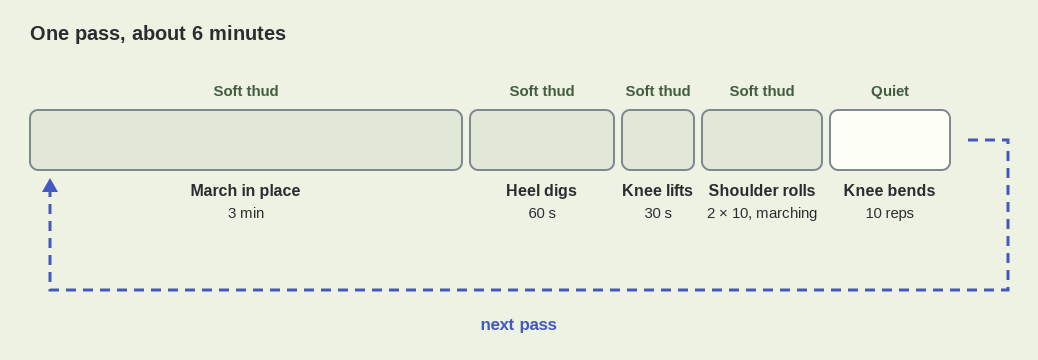
Marching, heel digs and knee lifts put a foot down with each step, so they are Soft thud. The quoted steps below have you keep marching during the shoulder rolls, so they are Soft thud too. Only the knee bends keep both feet down, so they are Quiet.
That is why the Floor Card says Soft thud. Set each foot down instead of stamping it (a Living Room Strength rule). Small-Space Workout Finder: Match Space, Noise and Equipment sorts moves by these same labels.
Which five moves do you use?
All five come from the NHS warm-up page. The words below are the NHS's own:
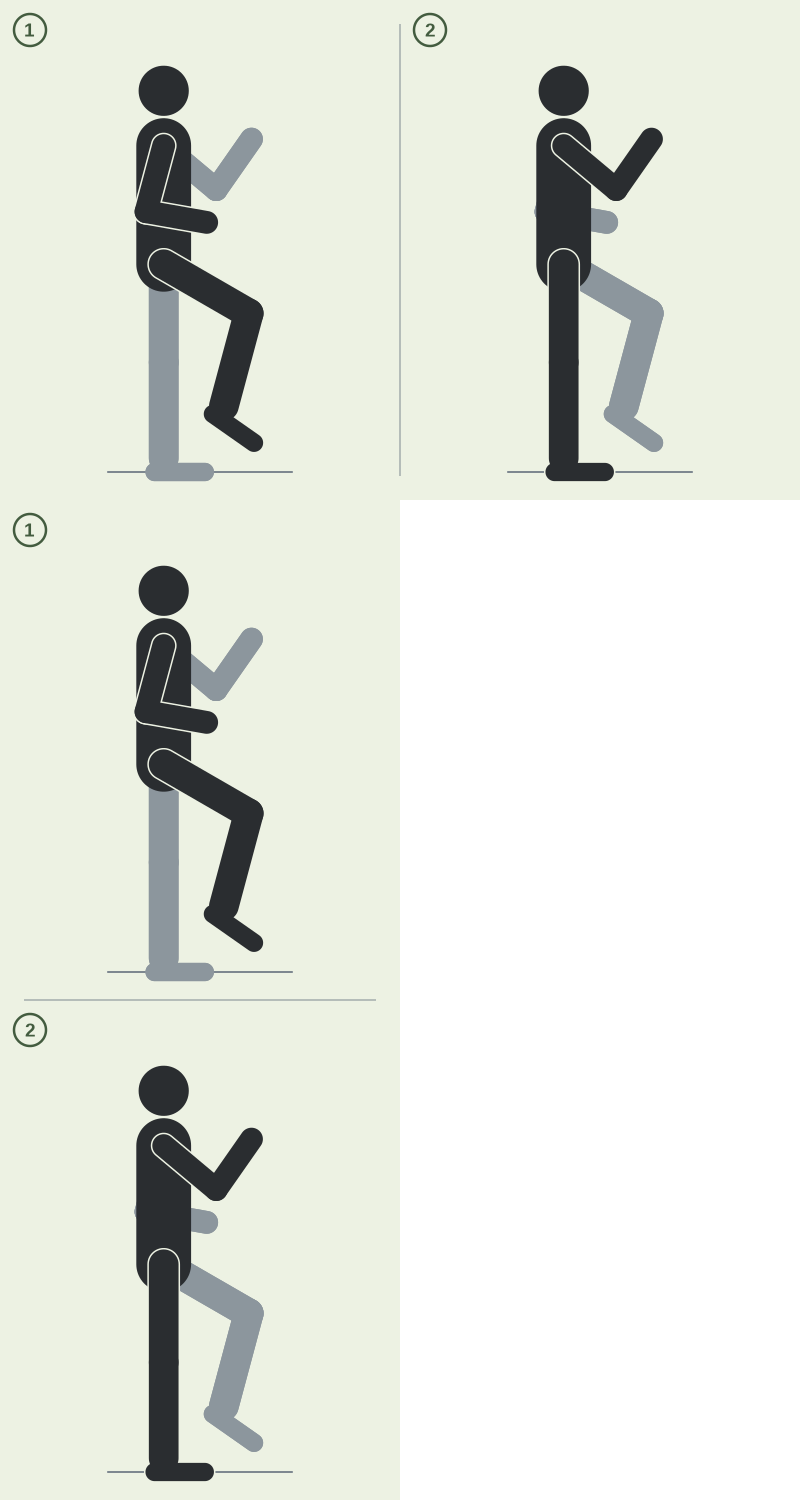
- March in place. "Start off marching on the spot and then march forwards and backwards. Pump your arms up and down in rhythm with your steps, keeping the elbows bent and the fists soft." (panel 1 and panel 2 of the first figure)
- Heel digs. "For heel digs, place alternate heels to the front, keeping the front foot pointing up, and punch out with each heel dig. Keep a slight bend in the supporting leg."
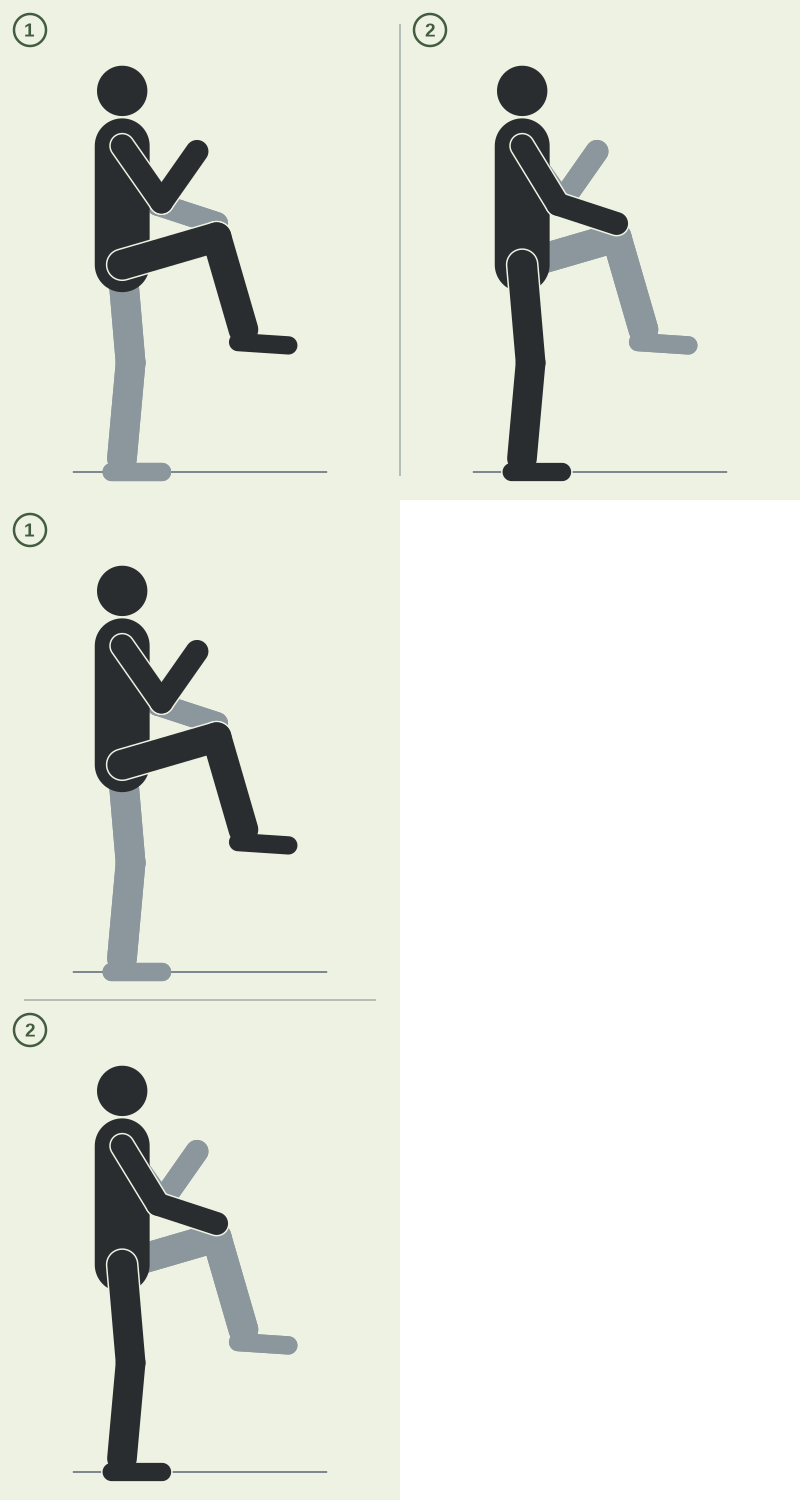
- Knee lifts. "To do knee lifts, stand tall and bring up alternate knees to touch the opposite hand." "Keep a slight bend in the supporting leg."
- Shoulder rolls. "For shoulder rolls, keep marching on the spot. Roll your shoulders forwards 5 times and backwards 5 times. Let your arms hang loose by your sides."
- Knee bends. "To do knee bends, stand with your feet shoulder-width apart and your hands stretched out. Lower yourself no more than 10cm by bending your knees. Come up and repeat."
Information from the NHS website, as at 261126 (https://www.nhs.uk/live-well/exercise/how-to-warm-up-before-exercising/) [1]. The 10 cm in the last move is about 4 in. The quoted steps describe each move. The Floor Card says when a set ends.
If your room is too small to march forward and back, march in place only (a Living Room Strength rule).
How hard should it feel?
Use the talk test. The U.S. Physical Activity Guidelines put it this way: at moderate effort you can talk, but not sing. At vigorous effort you cannot say more than a few words without stopping for a breath (p. 60) [2].
The National Institute on Aging says much the same: breathing hard but still able to hold a conversation is moderate, and only a few words between breaths is vigorous (adapted from the National Institute on Aging, NIH) [3]. A college textbook adds the light end: if you can speak in full sentences without getting winded, the effort is very light [4]. This page goes by the guidelines' marker, talk but not sing; the textbook's line describes the lighter end below it.
The guidelines also give a 0 to 10 scale, where sitting is 0 and your hardest effort is 10. Moderate is a 5 or 6, and vigorous starts at 7 or 8 (p. 58) [2]. RPE Scale and Reps in Reserve for Home Sets covers effort ratings like this one.
To raise the effort, march faster or lift your knees higher. To lower it, slow down. Both are Living Room Strength rules, not from the sources.
How long, and how often?
Done once, at the NHS amounts, the five moves make up what the NHS calls a warm-up. The amounts are the NHS's own:
| Move | NHS amount (quoted) |
|---|---|
| March in place | "keep going for 3 minutes" |
| Heel digs | "aim for 60 heel digs in 60 seconds" |
| Knee lifts | "aim for 30 knee lifts in 30 seconds" |
| Shoulder rolls | "2 sets of 10 repetitions" |
| Knee bends | "10 repetitions" |
The NHS says "This warm-up routine should take at least 6 minutes." Information from the NHS website, as at 261126 (https://www.nhs.uk/live-well/exercise/how-to-warm-up-before-exercising/) [1]. For a cardio session, go straight into another pass, and another, for as long as you planned. The table's NHS amounts are for a warm-up. When you use the moves as cardio, the talk test sets your pace, not the counts in the table (a Living Room Strength rule).
Repeating the passes is a Living Room Strength rule. A workout timer can call out each move's time so you don't have to watch a clock.
For the week, the guidelines suggest 150 to 300 minutes of moderate aerobic activity, or 75 to 150 minutes of vigorous activity, spread through the week (p. 56) [2]. You can split that into shorter bouts across the day or week (p. 58) [2]. If you are building up, add minutes per session and days per week first, and raise the effort later if you want to (p. 90) [2].
How do you start and finish a session?
The guidelines say a warm-up and cool-down usually mean doing the same activity at a slower speed or lower effort (p. 62) [2]. The National Institute on Aging suggests a little light activity, such as gentle walking, before and after (adapted from the National Institute on Aging, NIH) [3]. So make your first pass and your last pass slow (a Living Room Strength rule). For a warm-up before strength work, see Warm Up Before a Home Workout and Each Strength Move.
What about jumping, intervals and strength work?
This page leaves out jumping on purpose. The guidelines list jumping rope and high-intensity interval training among vigorous activities (p. 59) [2]. If you want timed work and rest rounds, HIIT, Tabata, EMOM and AMRAP: Four Ways to Time a Workout sets out four interval formats. Stairs have their own page, Step-Ups on a Stair at Home.

About this illustration
Illustration by Living Room Strength: a generated marker drawing of a room, not a photograph and not a guide to any move. It shows no people. Reuse it with credit to Living Room Strength; this site claims rights in it only as far as the law grants them.The guidelines count aerobic activity and muscle-strengthening work separately (p. 56) [2]. This session covers the first; for the second, start at Strength Training at Home: Where a Beginner Starts.
Next session: do your first pass slowly, then check the talk test before you start the second.
Source trail
- The five moves and their amounts: march in place, heel digs, knee lifts, shoulder rolls, knee bends; at least 6 minutes (quoted) [1]
- Talk test, the 0 to 10 effort scale, weekly amounts, short bouts count, adding minutes and days before intensity, warm-up and cool-down at a slower pace [2]
- Talk test as breathing hard but still able to hold a conversation; light activity before and after [3]
- Talk test: short phrases means high intensity, full sentences without getting winded means very light [4]
Living Room Strength rule
- Low impact and quiet as defined on this site; doing the warm-up moves as a longer cardio session in repeated passes; slow first and last pass; changing effort by pace and knee height; setting each foot down instead of stamping it; when the moves are used as cardio, the talk test sets the pace rather than the NHS warm-up counts
Living Room Strength set these itself. No source gives them, so read them as this site’s choice, not a finding.
Sources
Numbers in brackets point here. Anything marked Living Room Strength rule is this site’s own choice and has no source.
- NHS. How to warm up before exercising Open the source Read: Full page and its exercise video safety information (page last reviewed 24 June 2026).
- U.S. Department of Health and Human Services. Physical Activity Guidelines for Americans, 2nd edition (2018) Open the source Read: Full guidelines; Chapter 4 (pages 56-62) and Chapter 7 (pages 88-93) used.
- National Institute on Aging, NIH. Three Types of Exercise Can Improve Your Health and Physical Ability (content reviewed 2025) Open the source Read: Full article; general principles only.
- Markell, Peterson and Johnson (Centralia College). Exercise and Nutrition, 3.5: Measuring Intensity. Medicine LibreTexts Open the source Read: Section 3.5 (talk test and perceived exertion parts). License: CC BY 4.0.
Elsewhere in the room
Corrections
No corrections on this page yet. If a line, a number or a drawing here is wrong, tell this site.