Training BasicsHow-to
Warm Up Before a Home Workout and Each Strength Move
Living Room Strength ·
About this illustration
Illustration by Living Room Strength: a generated marker drawing of a room, not a photograph and not a guide to any move. It shows no people. Reuse it with credit to Living Room Strength; this site claims rights in it only as far as the law grants them.Answer first
Start with a few minutes of easy whole-body movement, such as marching in place. Then, before the first real set of each strength move, do one lighter set of it. When you finish, slow down for the last few minutes before you stop.
Floor Card
- Space
- Mat + reach
- Noise
- Soft thud
- Kit
- None
- Version today
- A few minutes of easy movement, then one lighter set per move
- Sets × reps
- Not used here
- Rest
- Not used here
- Spare-Two Check
- Not used here
- Easier
- Not used here
- Harder
- Not used here
- Stop for today if
- “Stop the exercise immediately if you feel any pain or become unwell.” If the pain does not go away, see a doctor.The quoted sentence: Information from the NHS website, as at 261126 (NHS). Seeing a doctor if the pain stays: Living Room Strength rule.
- Chest pain or pressure, or dizziness. Stop, and talk to a doctor.The warning signs: Physical Activity Guidelines for Americans, 2nd edition, p. 93, and the National Heart, Lung, and Blood Institute (Guidelines, NHLBI).
- End the set if
- You can no longer do the move the way this page describes it. That set ends there.Going on only while the move meets its standard: Adapted from ATP 7-22.02, p. 13-7 (ATP 7-22.02).
What does a warm-up do in a home workout?
A warm-up is the start of the session done slower or lighter. The U.S. Physical Activity Guidelines for Americans say warm-ups and cool-downs commonly mean doing an activity at a slower speed or lower effort. For strength work, they add, a warm-up commonly means doing the moves with lighter weight (p. 62).
The National Institute on Aging says much the same. Before and after aerobic activity, do a little light activity such as easy walking. Before strength work, warm up with less weight (Adapted from the National Institute on Aging, NIH).
This site splits a warm-up into two parts: a general part, where you move your whole body gently, and a specific part, where you do a lighter set of the move you're about to train. Doing both, the general part first, is a Living Room Strength rule.

One session from start to finish. The NHS routine below fills the first part; the lighter set comes before each move, not only before the first one.
What warm-up exercises can you do at home?
The NHS gives a warm-up routine that fits in a living room. The moves and amounts below, and the line after the table, are quoted from the NHS:
| Move | NHS amount (quoted) |
|---|---|
| March on the spot | "keep going for 3 minutes" |
| Heel digs | "aim for 60 heel digs in 60 seconds" |
| Knee lifts | "aim for 30 knee lifts in 30 seconds" |
| Shoulder rolls | "2 sets of 10 repetitions" |
| Knee bends | "10 repetitions" |
"This warm-up routine should take at least 6 minutes. Warm up for longer if you feel the need." Information from the NHS website, as at 261126 (https://www.nhs.uk/live-well/exercise/how-to-warm-up-before-exercising/).
The NHS's step-by-step wording for each move is quoted on Low-Impact Cardio at Home With No Jumping, which uses the same five moves as a longer cardio session. The NHS march also moves forward and back; if your room is too small for that, march in place (a Living Room Strength rule).
Four of the five moves lift a foot and put it down, so they are Soft thud on this site's noise labels. Only the knee bends keep both feet down, so they are Quiet. The Small-Space Workout Finder: Match Space, Noise and Equipment uses the same labels. A workout timer can time the 3-minute march for you.
How do you warm up for strength work?
Do a lighter set of each move just before its first working set. That follows the guidelines' "lighter weight" (p. 62). At home you often have no lighter weight to pick up, so this site turns "lighter" into a version or a rep count, as a Living Room Strength rule:
- On the first version of a move: do one set of that same version with fewer reps.
- Past the first version: do one light round of the easier version just before yours.
For the light set, check the page of the version you do. Set up the kit it needs, and keep its form lines and stop lines.
Say your squat is at the goblet squat with one dumbbell. Your light set before it is the bodyweight squat to 90 degrees, the version just before it on How to Squat at Home, From a Chair to a Goblet Squat. Say your push-up is still at the wall. Your light set is a few wall push-ups, fewer than your working sets.
Strength Training at Home: Where a Beginner Starts uses the same rule for the first version and the ones after it.
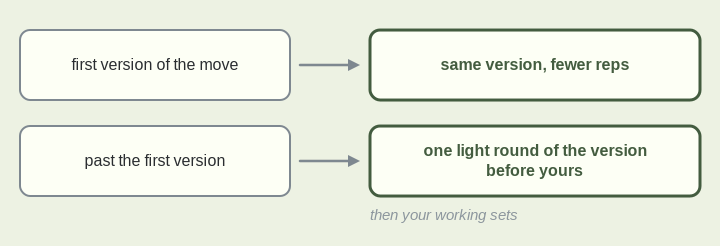
How "lighter" works at home: fewer reps, or the version before yours.
How do you use the warm-up set to check your form?
The lighter set is a good place to look at form. Before you start the working sets, read the move's form lines and check each one during the light set. This use of the light set is a Living Room Strength rule.
On the squat page, for example, watch that your heels stay down. On Push-Up Progression: From the Wall to the Floor, watch the line of your body.
If you want to look more closely, film the light set on your phone from the side and compare it with the form lines. The video stays on your phone.
How long should a warm-up take?
The NHS routine takes at least 6 minutes, as quoted above. The guidelines and the National Institute on Aging give no length. This site doesn't add a number of its own for the general part. The lighter set before each move takes as long as one set.
About this illustration
Illustration by Living Room Strength: a generated marker drawing of a room, not a photograph and not a guide to any move. It shows no people. Reuse it with credit to Living Room Strength; this site claims rights in it only as far as the law grants them.Should you stretch before a workout?
The sources differ on where stretching goes in a session, and Static vs Dynamic Stretching: Where Each Fits sets them side by side. The National Institute on Aging suggests stretching once your muscles are warmed up, after endurance or strength work (Adapted from the National Institute on Aging, NIH). This page doesn't pick one answer for you.
How do you cool down after a home workout?
Slow down. The guidelines say a cool-down, like a warm-up, usually means doing an activity at a slower speed or lower effort (p. 62). The National Institute on Aging suggests a little light activity, such as easy walking, after aerobic activity (Adapted from the National Institute on Aging, NIH). For a home session, make the last few minutes slower and lighter (a Living Room Strength rule).
If you stretch at the end, the NHS cool-down stretches are short: "These gentle stretches should take about 5 minutes." Information from the NHS website, as at 261126 (https://www.nhs.uk/live-well/exercise/how-to-stretch-after-exercising/). For stretches with their positions written out, see Hip Flexor Stretch: Kneeling, Standing or Lying Down, Hamstring Stretch Lying Down, Seated or Standing and Full-Body Stretching Routine: Five Standing, Five on the Mat.
The warm-up and cool-down fit around any session on this site, including Bodyweight Workout at Home With No Equipment to Buy and Dumbbell Workout at Home With One Pair of Dumbbells.
Next session: March in place for the first few minutes, then do one lighter set of your first move and check its form lines.
Source trail
- Warm-up and cool-down usually mean the same activity at a slower speed or lower effort; a warm-up for strength work usually means lighter weight [1]
- Light activity such as easy walking before and after aerobic activity; warm up for strength work with less weight; stretch once the muscles are warm and after endurance or strength work (adapted) [2]
- The NHS warm-up moves and amounts; at least 6 minutes (quoted) [3]
- Cool-down stretches take about 5 minutes (quoted) [4]
Living Room Strength rule
- Doing both parts, general first; one light set before each move's first working set; the same version with fewer reps on a first row, or one light round of an easier version past it; using the light set to check the form lines; marching in place when the room is small; slowing the last minutes as a cool-down; no length of its own for the general part
Living Room Strength set these itself. No source gives them, so read them as this site’s choice, not a finding.
Sources
Numbers in brackets point here. Anything marked Living Room Strength rule is this site’s own choice and has no source.
- U.S. Department of Health and Human Services. Physical Activity Guidelines for Americans, 2nd edition (2018) Open the source Read: Full guidelines; Chapter 4 (pages 56-62) and Chapter 7 (pages 88-93) used.
- National Institute on Aging, NIH. Three Types of Exercise Can Improve Your Health and Physical Ability (content reviewed 2025) Open the source Read: Full article; general principles only.
- NHS. How to warm up before exercising Open the source Read: Full page and its exercise video safety information (page last reviewed 24 June 2026).
- NHS. How to stretch after exercising Open the source Read: Full page (page last reviewed 16 March 2026).
Elsewhere in the room
Corrections
No corrections on this page yet. If a line, a number or a drawing here is wrong, tell this site.