Training BasicsHow-to
Dumbbell Workout at Home With One Pair of Dumbbells
Living Room Strength ·
About this illustration
Illustration by Living Room Strength: a generated marker drawing of a room, not a photograph and not a guide to any move. It shows no people. Reuse it with credit to Living Room Strength; this site claims rights in it only as far as the law grants them.Answer first
With one pair of dumbbells, do four moves that use them and two that don't. The four are a goblet squat, a Romanian deadlift, a one-arm row with a hand on a chair, and step-ups with a dumbbell in each hand; the two are push-ups and reverse lunges. Use the dumbbell versions once each move page's Spare-Two Check brings you there, and pick a weight you can control on every rep.
Floor Card
- Space
- Mat, Wall, Stair
- Noise
- Soft thud
- Kit
- pair of dumbbells, sturdy chair
- Version today
- Six moves, four of them with one pair of dumbbells
- Sets × reps
- 2–3 × 8–12 for each move
- Rest
- 30 seconds, 30–90 seconds or 1–3 minutes, by goal (HPRC)
- Stop for today if
- “Stop the exercise immediately if you feel any pain or become unwell.” If the pain does not go away, see a doctor.The quoted sentence: Information from the NHS website, as at 261126 (NHS). Seeing a doctor if the pain stays: Living Room Strength rule.
- End the set if
- The equipment moves or gives: the doorway bar shifts or creaks, the band has a nick, a cut or loose stitching, the chair or couch slides, or the step wobbles. End the set and check it against its instructions before the next one.What to look for on a band comes from the instructions that come with bands. Ending the set and checking: Living Room Strength rule.
- You can no longer do the move the way this page describes it. That set ends there.Going on only while the move meets its standard: Adapted from ATP 7-22.02, p. 13-7 (ATP 7-22.02).
Which moves use the dumbbells?
Six moves, one per line. Each links to its own page, where the form lines, the version table and the Floor Card live. This page doesn't repeat them.
| Move | Version with dumbbells | Dumbbells | Sets × reps |
|---|---|---|---|
| Squat | Goblet squat to 90 degrees | one, held at the chest | 2–3 × 8–12 |
| Hip hinge | Romanian deadlift with dumbbells | one in each hand | 2–3 × 8–12 |
| Row | One-arm dumbbell row | one, plus a sturdy chair | 2–3 × 8–12 per side |
| Step-up | Step-up holding dumbbells | one in each hand | 2–3 × 8–12 per side |
| Push-up | your current version | none | 2–3 × 8–12 |
| Lunge | your current version | none | 2–3 × 8–12 per side |
The six moves, and which of them carry the dumbbells, are Living Room Strength rules. The push-up and the lunge have no dumbbell version on this site yet, so they stay as bodyweight moves.
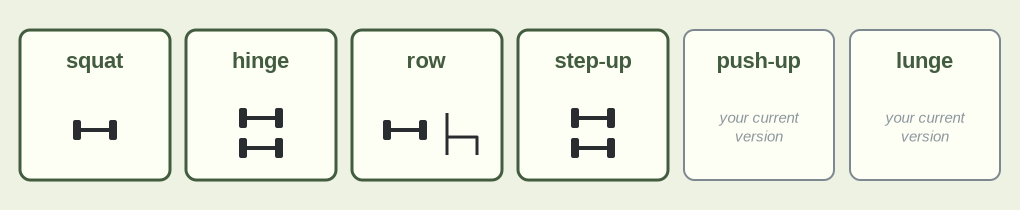
Four moves carry the dumbbells; two use body weight only.
Where do you start if you're new to dumbbells?
Start without them. The National Institute on Aging suggests that beginners try moves without weights or bands until they are comfortable with them (Adapted from the National Institute on Aging, NIH). If you haven't done the moves yet, begin with Bodyweight Workout at Home With No Equipment to Buy.
Three of the dumbbell versions above come later on their move pages: the goblet squat is the third version on How to Squat at Home, From a Chair to a Goblet Squat, the Romanian deadlift is the second on Romanian Deadlift With Dumbbells, Hip Hinge First, and the step-up with dumbbells is the third on Step-Ups on a Stair at Home. Use each one when that page's Spare-Two Check moves you to it (a Living Room Strength rule). The one-arm row is the first version on Dumbbell Row at Home With One Hand on a Chair, so you can use it from your first dumbbell session. Rest your free hand on a sturdy chair with no wheels, one that won't slip or fold, set against a wall (a Living Room Strength rule); the row page shows where the hand goes.
How heavy should the dumbbells be?
This site gives no table of pounds. The U.S. Army manual ATP 7-22.02 puts it this way in its squat notes: "Always lift a weight that can be controlled throughout the range of motion" (p. 14-2). Use that as the test. Every rep keeps the form lines, from the top to the bottom and back.
With one pair, you use the same weight for every dumbbell move. It may suit one move and not another. The Spare-Two Check sorts that out move by move, as a Living Room Strength rule:
- If your first set can't reach the bottom of the range with every form line, go back to that move's easier version next session. On a move's first version, stay there and end each set when a form line slips.
- If you reach the top of the range in every set, keep every form line, and have about two good reps to spare, that move goes to its next version.
- Anywhere in between, stay on the same version with the same pair. The full check on Progressive Overload at Home With One Pair of Dumbbells says how many reps to aim for next time.
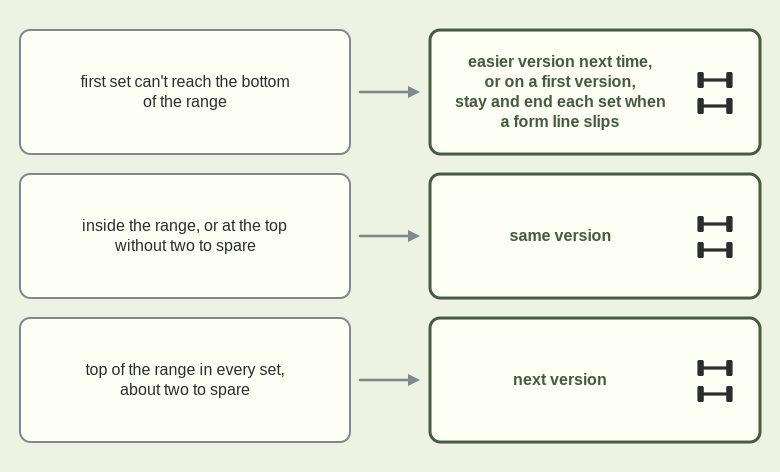
The weight doesn't change; the version does.
What do you do when the pair gets too light?
HPRC, the Uniformed Services University's fitness resource, lists more reps or sets, more weight, more sessions, or less rest. The National Institute on Aging names gradual increases in weight, sets, reps or days (Adapted from the National Institute on Aging, NIH). An open college textbook suggests adding 2 to 10 percent more load once you pass your target by one or two reps.
With one pair, you can't add weight. So on this site, a move that gets too easy goes to the next version on its page instead, a Living Room Strength rule. The row is the one exception: the last version on Dumbbell Row at Home With One Hand on a Chair needs the next heavier dumbbell, so with only one pair, stay on the version before it.
Progressive Overload at Home With One Pair of Dumbbells covers this in full, and the Bodyweight Progression Finder for Progressive Overload shows which version comes next. The "two to spare" part is a guess about reps in reserve; RPE Scale and Reps in Reserve for Home Sets explains how to make it.
How many sets, reps and days?
The U.S. Physical Activity Guidelines for Americans say one set of 8 to 12 reps of each exercise is effective, and 2 or 3 sets may be more effective, with each set going to the point where another rep would be hard (p. 61). The National Institute on Aging gives the same numbers (Adapted from the National Institute on Aging, NIH). The move pages use 2 to 3 sets, so this page does too.
How Many Sets and Reps? Ranges, Goals and Moving Up explains the range, and Strength Training at Home: Where a Beginner Starts shows how that effort sits beside the Spare-Two Check.
Train at least two days a week (p. 56), and don't work the same parts of your body two days in a row (Adapted from the National Institute on Aging, NIH). HPRC gives 2 to 3 days a week. For rest between sets, HPRC gives 30 seconds, 30 to 90 seconds, or 1 to 3 minutes, depending on the goal; Rest Between Sets and Days Between Sessions puts them side by side, and an interval timer can count it for you.
You can do the six moves as straight sets or as a circuit, the same as on Bodyweight Workout at Home With No Equipment to Buy. Pick one way and keep it for the session (a Living Room Strength rule). The open college textbook puts moves that use several joints before moves that use one; all six here use several joints, so this site leaves the order to you (a Living Room Strength rule).
About this illustration
Illustration by Living Room Strength: a generated marker drawing of a room, not a photograph and not a guide to any move. It shows no people. Reuse it with credit to Living Room Strength; this site claims rights in it only as far as the law grants them.How do you keep a dumbbell session quiet?
Put the dumbbells down under control; don't drop them. ATP's deadlift returns the weight under control and doesn't drop it (para 14-8, p. 14-4). On a living room floor, that also keeps the noise down.
The step-up and the lunge are Soft thud moves; the other four keep your feet on the floor. The Small-Space Workout Finder: Match Space, Noise and Equipment sorts every move by space and noise, and the Exercise Names: A Home Exercise Library by Movement lists the versions with the kit each one needs. Warm up first with Warm Up Before a Home Workout and Each Strength Move, and see Strength Training at Home: Where a Beginner Starts for how a week fits together.
Next session: Before your first set, check which version each move page puts you on, and use the dumbbells only where that page says so.
Source trail
- At least 2 days a week; 1 set of 8 to 12 effective, 2 or 3 may be more; work to where another rep would be difficult [1]
- Beginners start without weights or bands; gradual increases in weight, sets, reps or days; avoid the same body area two days in a row (adapted) [2]
- 2 to 3 days a week; rest between sets of 30 seconds, 30 to 90 seconds, or 1 to 3 minutes [3]
- Ways to make training harder: more reps or sets, more weight, more sessions, less rest [4]
- Lift a weight you can control through the whole range; set the weight down under control, don't drop it [5]
- From an open college textbook: add load once you pass the target reps by one or two [6]
Living Room Strength rule
- Which six moves go in the session and which use the dumbbells; doing the bodyweight session first if you are new; waiting for the Spare-Two Check before using a dumbbell version; one weight for every dumbbell move; a pair that is too light means the next version, and too heavy means the easier one, or on a first version, staying and ending the set when a form line slips; with one pair, stopping the row at the version before the heavier-dumbbell row; 2 to 3 sets to match the move pages; choosing straight sets or a circuit; leaving the order of the six to you
Living Room Strength set these itself. No source gives them, so read them as this site’s choice, not a finding.
Sources
Numbers in brackets point here. Anything marked Living Room Strength rule is this site’s own choice and has no source.
- U.S. Department of Health and Human Services. Physical Activity Guidelines for Americans, 2nd edition (2018) Open the source Read: Full guidelines; Chapter 4 (pages 56-62) and Chapter 7 (pages 88-93) used.
- National Institute on Aging, NIH. Three Types of Exercise Can Improve Your Health and Physical Ability (content reviewed 2025) Open the source Read: Full article; general principles only.
- Human Performance Resources by CHAMP (HPRC). Use the FITT-VP principle to plan your workouts (2025) Open the source Read: Full article and FITT-VP table.
- Human Performance Resources by CHAMP (HPRC). Guidelines to progress your physical training over time (2021) Open the source Read: Full article.
- Headquarters, Department of the Army. ATP 7-22.02, Holistic Health and Fitness Drills and Exercises, Oct 2020 (incl. C1, Sept 2025) Open the source Read: Chapters 2, 3, 6, 13, 14, 16 and 17 (exercise descriptions only; photographs not used).
- Markell, Peterson and Johnson (Centralia College). Exercise and Nutrition, 4.3: Resistance Exercise Programming. Medicine LibreTexts Open the source Read: Section 4.3; its recommendations summarize the 2009 ACSM position stand. License: CC BY 4.0.
Elsewhere in the room
Corrections
No corrections on this page yet. If a line, a number or a drawing here is wrong, tell this site.