Legs & HipsMove
Step-Ups on a Stair at Home
Living Room Strength ·
About this illustration
Illustration by Living Room Strength: a generated marker drawing of a room, not a photograph and not a guide to any move. It shows no people. Reuse it with credit to Living Room Strength; this site claims rights in it only as far as the law grants them.Answer first
Start on the bottom stair with one hand on the handrail. Step up until both feet are on the stair, then step down one foot at a time. Next, let go of the rail, and only after that hold a dumbbell in each hand. Move on only when the Spare-Two Check at the end of a session says so.
Floor Card
- Space
- Stair
- Noise
- Soft thud
- Kit
- pair of dumbbells
- Version today
- Step-up holding the handrail
- Sets × reps
- 2–3 × 8–12 per side
- Rest
- 30 seconds, 30–90 seconds or 1–3 minutes, by goal (HPRC)
- Spare-Two Check
- 12 reps per side
- Easier
- None on this site yet
- Stop for today if
- “Stop the exercise immediately if you feel any pain or become unwell.” If the pain does not go away, see a doctor.The quoted sentence: Information from the NHS website, as at 261126 (NHS). Seeing a doctor if the pain stays: Living Room Strength rule.
- End the set if
- The equipment moves or gives: the doorway bar shifts or creaks, the band has a nick, a cut or loose stitching, the chair or couch slides, or the step wobbles. End the set and check it against its instructions before the next one.What to look for on a band comes from the instructions that come with bands. Ending the set and checking: Living Room Strength rule.
- You can no longer keep one of the form lines. That rep ends the set.Going on only while the move meets its standard: Adapted from ATP 7-22.02, p. 13-7 (ATP 7-22.02).
Form lines
- Your whole foot is on the stair before you step up.
- You stand all the way up on the stair before stepping down.
- You step down one foot at a time.
- In the dumbbell version, the dumbbells stay at your sides.
You can film one set from the side on your phone and check each line. The video stays on your phone; this site never sees it.
The second and third lines come from two sources that agree. Illinois Extension's Step-Ups has you step up with one foot, bring the other foot up, and come down one foot at a time. The U.S. Army manual ATP 7-22.02 counts its step-up the same way: one foot up, the other foot up, one foot down, the other foot down (para 13-6).
The dumbbell line is ATP's. Its step-up is done "keeping the kettlebells at the sides of the body" (para 13-6, p. 13-4).
The first line is a Living Room Strength rule. Neither source says where on the step your foot goes. Look down before each rep: if your heel hangs off the back edge, move your foot.
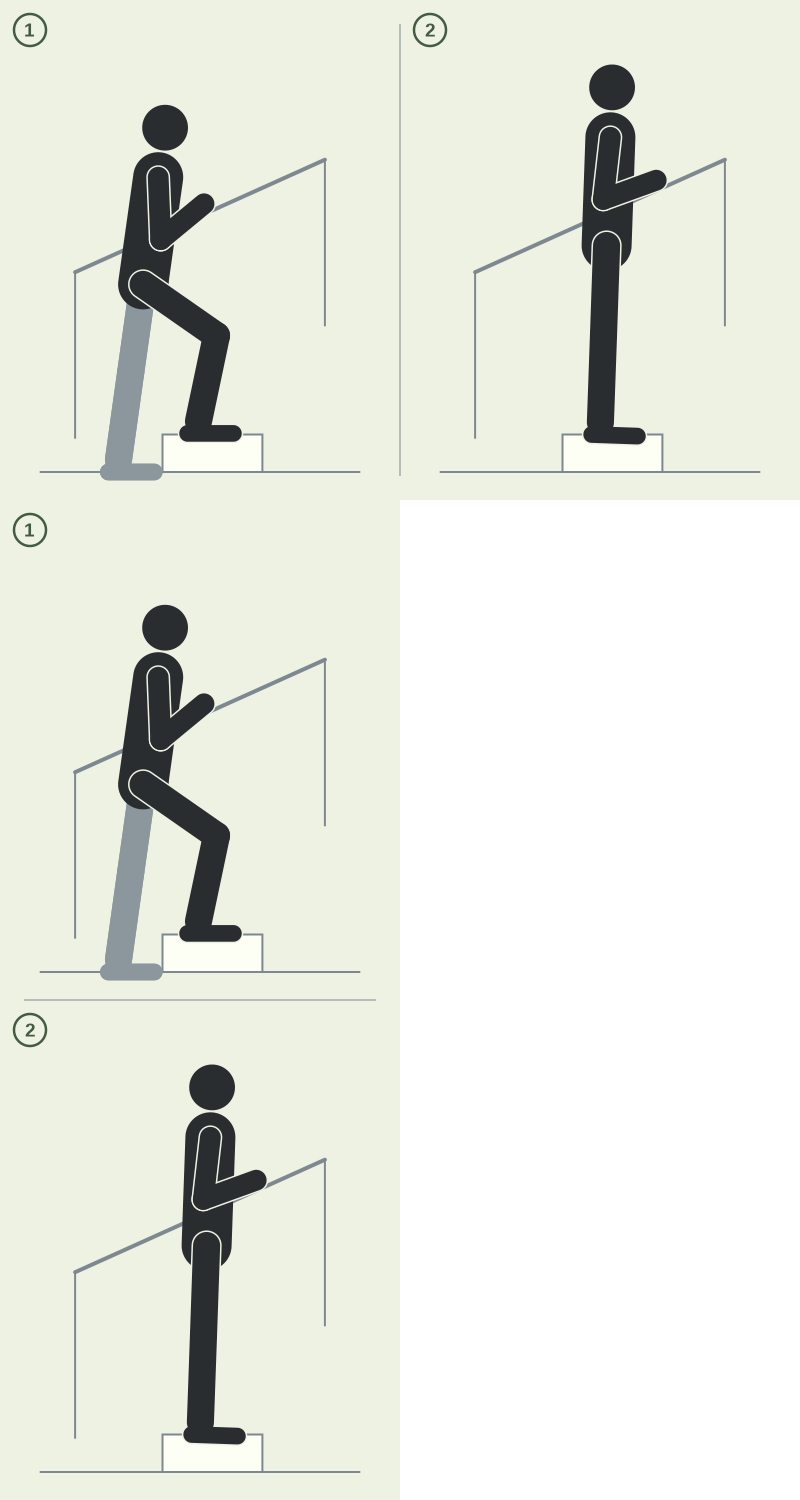
Step-up holding the handrail. In panel 2 both feet are on the stair before either one comes down.
Step-up versions, from the handrail to dumbbells
| Order | Version | What changes | Range | Basis |
|---|---|---|---|---|
| 1 | Step-up holding the handrail | Start | 8–12 reps per side | [1] |
| 2 | Step-up without holding on | Assistance: both hands off the handrail | 8–12 reps per side | [1] |
| 3 | Step-up holding dumbbells | Load: a dumbbell in each hand | 8–12 reps per side | [2] |
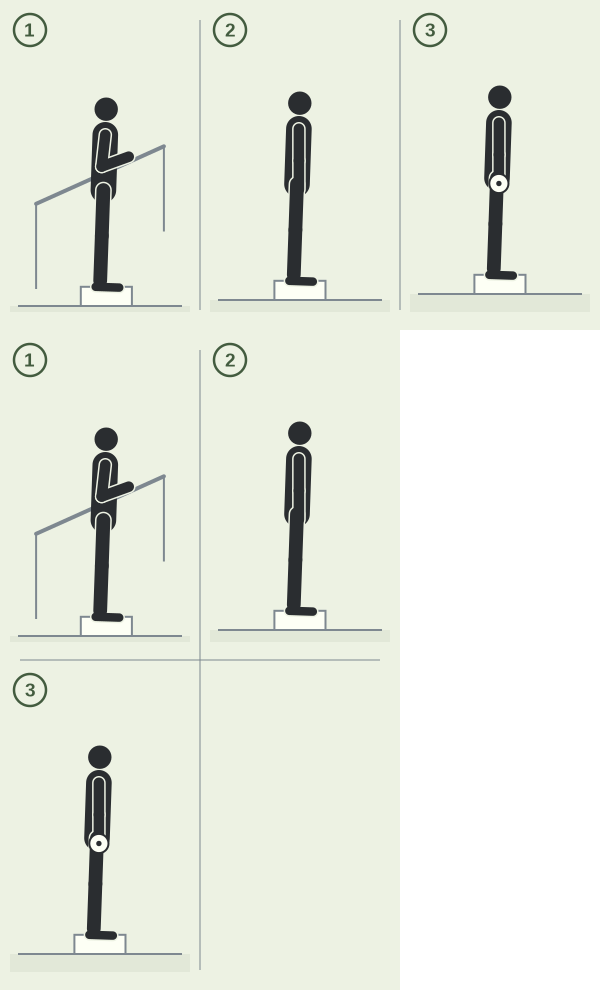
The three versions in order: the hand leaves the rail first, then the dumbbells come in.
Rows 1 and 2 come from Illinois Extension. Its step-up ends by noting that the move gets harder when you don't hold onto anything. So holding on is the easier way, and letting go is the harder one. The National Institute on Aging also suggests having something sturdy nearby to hold for support in balance moves (Adapted from the National Institute on Aging, NIH).
Row 3 comes from ATP, which carries a weight in each hand at the sides. ATP uses kettlebells; this page uses the dumbbells you have. Your hands are full in row 3, so you can't hold the rail. That is why it comes after the row where you have already let go.
About this illustration
Illustration by Living Room Strength: a generated marker drawing of a room, not a photograph and not a guide to any move. It shows no people. Reuse it with credit to Living Room Strength; this site claims rights in it only as far as the law grants them.On the stair, hold the rail for balance, not to pull yourself up. If your stair has no rail, rest a hand on the wall beside it instead. Both are Living Room Strength rules.
How high is your bottom stair?
Measure it. ATP's step-up uses "a 12- to 18-inch step" (30 to 46 cm) (para 13-6, p. 13-4). This site has no source for how high a home stair is or should be, so it doesn't give you a height to aim for.
Use the bottom stair only, not a higher one, and not a chair or a stack of books. A sturdy step or box is the other choice Illinois gives, but this page is written for the stair. Turn the light on and clear anything off the stair and the floor in front of it. These are Living Room Strength rules.
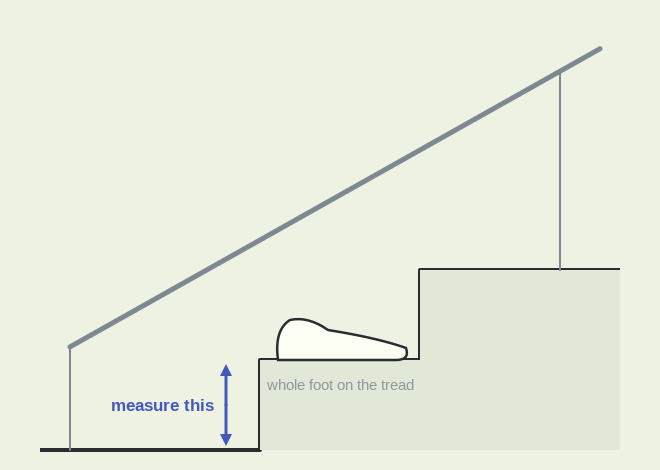
The stair check: measure the bottom step, keep your whole foot on the tread, and keep the rail within reach.
How do you do a step-up on a stair?
Stand facing the stair, close enough that one foot can land on the tread without a long reach. Put one hand on the rail.
Place your whole first foot on the stair. Then bring the other foot up, so you stand tall on the stair with both feet. Step down with the first foot, and then the second, back to where you started. That is one rep for the foot that led.
Set each foot down instead of stamping it (a Living Room Strength rule). This site has not found a quiet version of this move. Each step down is a soft thud, so check the Small-Space Workout Finder: Match Space, Noise and Equipment if noise matters where you live.
Which foot leads?
The two sources count the sides differently, so both are here. ATP switches the leading foot after each full round (para 13-6). Illinois Extension asks for 10 reps on each side.
This site accepts either one. Pick one pattern before the set and keep it for the whole set, so you can count each side (a Living Room Strength rule). The range on the Floor Card is per side.
How many reps and sets, and how long to rest?
The Floor Card uses 2 to 3 sets of 8 to 12 reps per side. The U.S. Physical Activity Guidelines for Americans say one set of 8 to 12 reps is effective, two or three sets may be more effective, and each set goes to the point where another rep would be hard (p. 61). The National Institute on Aging gives the same numbers (Adapted from the National Institute on Aging, NIH). Illinois's 10 per side sits inside that range.
How Many Sets and Reps? Ranges, Goals and Moving Up explains how a range works. For how that point sits beside the Spare-Two Check, see Strength Training at Home: Where a Beginner Starts.
For rest, HPRC, the Uniformed Services University's fitness resource, gives 30 seconds, 30 to 90 seconds, or 1 to 3 minutes, depending on the goal. This site doesn't choose one; Rest Between Sets and Days Between Sessions puts them side by side.
You move to the next row with the Spare-Two Check, explained under the table and on Progressive Overload at Home With One Pair of Dumbbells. The "two left" part is a guess about reps in reserve, and the page on reps in reserve explains how to make that guess. The Bodyweight Progression Finder for Progressive Overload asks the same questions one at a time.
What does it look like when the form slips?
- Your heel hangs off the back edge of the stair.
- You start down before your second foot is on the stair.
- Both feet come down at once, or you drop down instead of stepping.
- In row 1, your arm pulls on the rail to get you up.
- In row 3, the dumbbells swing out from your sides.
The Floor Card says when a set ends.
Step-ups sit with the other leg moves in this part of the room. How to Squat at Home, From a Chair to a Goblet Squat keeps both feet on the floor, Reverse Lunges in a Small Room moves one foot behind you, and Romanian Deadlift With Dumbbells, Hip Hinge First bends forward with a straight back. To carry your dumbbells into a whole session, see Dumbbell Workout at Home With One Pair of Dumbbells.
The stair also appears on Low-Impact Cardio at Home With No Jumping as a no-jump option. Every version here is listed in the Exercise Names: A Home Exercise Library by Movement.
Next session: Hold the rail, and check one form line on every rep: your whole foot is on the stair before you step up.
Source trail
- Step up with one foot, bring the other foot up, step down one foot at a time; 10 per side; holding on first, then without holding onto anything to make it harder [1]
- ATP's step is 12 to 18 inches (named for comparison; this page sets no target height); weights at the sides of the body; both feet up, then both down; the other foot leads the next round [2]
- Something sturdy nearby to hold for support (adapted) [3]
- 8 to 12 reps, one set is effective and two or three may be more effective [4]
- Rest between sets: three ranges listed side by side [5]
Living Room Strength rule
- Using the bottom stair rather than a box or chair; light on and nothing on the stair; the rail is for balance, not for pulling; a hand on the wall if there is no rail; the whole foot on the stair; what counts as one rep; one leading pattern per set; standing close enough to the stair to reach the tread without a long reach; setting each foot down instead of stamping it; no target stair height
Living Room Strength set these itself. No source gives them, so read them as this site’s choice, not a finding.
Sources
Numbers in brackets point here. Anything marked Living Room Strength rule is this site’s own choice and has no source.
- University of Illinois Extension, Eat.Move.Save. Movement Library: Step-Ups Open the source Read: Full exercise page (steps).
- Headquarters, Department of the Army. ATP 7-22.02, Holistic Health and Fitness Drills and Exercises, Oct 2020 (incl. C1, Sept 2025) Open the source Read: Chapters 2, 3, 6, 13, 14, 16 and 17 (exercise descriptions only; photographs not used).
- National Institute on Aging, NIH. Three Types of Exercise Can Improve Your Health and Physical Ability (content reviewed 2025) Open the source Read: Full article; general principles only.
- U.S. Department of Health and Human Services. Physical Activity Guidelines for Americans, 2nd edition (2018) Open the source Read: Full guidelines; Chapter 4 (pages 56-62) and Chapter 7 (pages 88-93) used.
- Human Performance Resources by CHAMP (HPRC). Use the FITT-VP principle to plan your workouts (2025) Open the source Read: Full article and FITT-VP table.
Elsewhere in the room
Corrections
No corrections on this page yet. If a line, a number or a drawing here is wrong, tell this site.