Training BasicsTool
Small-Space Workout Finder: Match Space, Noise and Equipment
Living Room Strength ·
About this illustration
Illustration by Living Room Strength: a generated marker drawing of a room, not a photograph and not a guide to any move. It shows no people. Reuse it with credit to Living Room Strength; this site claims rights in it only as far as the law grants them.Answer first
Check the space you have, how much noise you can make and the kit you own. The finder lists every move on this site that fits, grouped by movement, and each one links to its page. Open a page and start at the first version.
Use it here
Everything you pick here stays on this page in your browser. Nothing is saved, put in the address bar or sent anywhere, and it all resets when you reload.
4 of 20 moves fit.
Push
- Knee push-upSpace: Mat. Noise: Quiet. Kit: None.
- Push-up on the floorSpace: Mat. Noise: Quiet. Kit: None.
Squat
- Bodyweight squat to 90 degreesSpace: Mat. Noise: Quiet. Kit: None.
Hinge
- Hip hingeSpace: Mat. Noise: Quiet. Kit: None.
The whole library
Each move lists the space it needs, how much noise it makes and the kit it uses. The space and noise groups are this site’s own, so read them as a guide. Without the tool, go down the Space, Noise and Kit columns and keep the rows that match your room.
| Move | Also called | Pattern | Space | Noise | Kit | Type | Basis |
|---|---|---|---|---|---|---|---|
| Wall push-up | Push | Wall | Quiet | None | reps | NHS website (link only) | |
| Counter push-up | Push | Mat | Quiet | kitchen counter | reps | Living Room Strength rule | |
| Knee push-up | Push | Mat | Quiet | None | reps | ATP 7-22.02, Oct 2020 (incl. C1, Sept 2025) | |
| Push-up on the floor | Push | Mat | Quiet | None | reps | ATP 7-22.02, Oct 2020 (incl. C1, Sept 2025) | |
| Dead hang | straight-arm hang | Pull | Doorway | Quiet | doorway pull-up bar | hold | ATP 7-22.02, Oct 2020 (incl. C1, Sept 2025); HPRC, Train Above the Bar: Achieving Your First Pull-up |
| Straight-arm pull | Pull | Doorway | Quiet | doorway pull-up bar | reps | ATP 7-22.02, Oct 2020 (incl. C1, Sept 2025) | |
| Slow lowering from a step | down only | Pull | Doorway | Quiet | doorway pull-up bar, step | reps | HPRC, Train Above the Bar: Achieving Your First Pull-up |
| Pull-up | Pull | Doorway | Quiet | doorway pull-up bar | reps | ATP 7-22.02, Oct 2020 (incl. C1, Sept 2025); HPRC, Train Above the Bar: Achieving Your First Pull-up | |
| One-arm dumbbell row | single-arm bent-over row | Pull | Mat | Quiet | one dumbbell, sturdy chair | reps | ATP 7-22.02, Oct 2020 (incl. C1, Sept 2025) |
| Seated band row | Pull | Mat | Quiet | resistance band | reps | Illinois Extension (link only) | |
| Squat to a chair | Squat | Mat | Quiet | sturdy chair | reps | Living Room Strength rule | |
| Bodyweight squat to 90 degrees | Squat | Mat | Quiet | None | reps | ATP 7-22.02, Oct 2020 (incl. C1, Sept 2025) | |
| Goblet squat to 90 degrees | goblet squat | Squat | Mat | Quiet | one dumbbell | reps | ATP 7-22.02, Oct 2020 (incl. C1, Sept 2025) |
| Hip hinge | Hinge | Mat | Quiet | None | reps | ATP 7-22.02, Oct 2020 (incl. C1, Sept 2025) | |
| Romanian deadlift with dumbbells | straight-leg deadlift | Hinge | Mat | Quiet | pair of dumbbells | reps | ATP 7-22.02, Oct 2020 (incl. C1, Sept 2025) |
| Step-up holding the handrail | Lunge and step | Stair | Soft thud | None | reps | Illinois Extension (link only) | |
| Step-up | Lunge and step | Stair | Soft thud | None | reps | Illinois Extension (link only) | |
| Step-up holding dumbbells | Lunge and step | Stair | Soft thud | pair of dumbbells | reps | ATP 7-22.02, Oct 2020 (incl. C1, Sept 2025) | |
| Wall-supported lunge | Lunge and step | Wall | Soft thud | None | reps | Illinois Extension (link only) | |
| Reverse lunge | Lunge and step | Mat | Soft thud | None | reps | ATP 7-22.02, Oct 2020 (incl. C1, Sept 2025) |
How does the finder decide a move fits?
A move fits when three things are true. You checked every space it needs. Its noise is no louder than your limit. And you own every piece of kit it uses.
It opens with a mat, quiet only and no kit, which means body weight only. Those starting choices are a Living Room Strength rule. Each result shows the move's space, noise and kit, so you can see why it made the list.
Three choices work in ways you might not expect:
- A pair of dumbbells also counts as one dumbbell.
- A stair is a space, not kit. To see moves like Step-Ups on a Stair at Home, check Stair under space and choose "A soft thud is fine."
- A doorway pull-up bar needs Doorway checked under space too. Without it, the hanging moves stay off the list.
What do the space and noise choices mean?
The space and noise groups are this site's own, so read them as a guide, not a measurement. They give no sizes, because people, mats and kit differ.
About this illustration
Illustration by Living Room Strength: a generated marker drawing of a room, not a photograph and not a guide to any move. It shows no people. Reuse it with credit to Living Room Strength; this site claims rights in it only as far as the law grants them.Mat + reach adds room to lift or spread your arms. Before any move with your arms overhead, check the ceiling, any light fitting and any ceiling fan. Turn the fan off and wait for it to stop. That check is a Living Room Strength rule.
Doorway means a door frame or a door. For a doorway pull-up bar, check the bar before each session the way its instructions say; Pull-Up Progression When You Can't Do One Yet gives this site's order for that check.
Stair means only the bottom two or three stairs, with the rail within reach and the light on (a Living Room Strength rule). Wall means a clear stretch of wall, and Hallway a few steps of floor to walk forward.
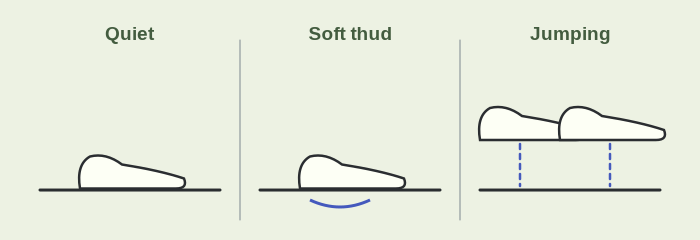
For noise, Quiet only means your feet stay down and nothing drops. A soft thud is fine adds moves where a foot or a weight touches down, with no jumping. Jumping is fine adds moves where both feet leave the floor. The library has no Jumping moves yet, so for now the third choice lists the same moves as the second.
Cardio without jumping has its own page: Low-Impact Cardio at Home With No Jumping.
Does the finder build a workout?
No. It lists moves that fit. It doesn't pick an order, sets, reps or days.
The U.S. Physical Activity Guidelines for Americans ask for strength work that covers all the major parts of the body, at least two days a week (p. 56) [1]. HPRC, a military fitness resource, sorts strength moves into five groups and suggests a program use all of them [2]. One way to get there from the finder is to take one move from each movement group in your results. That is a Living Room Strength rule.
For a first session laid out for you, see Strength Training at Home: Where a Beginner Starts. Whole sessions, move by move, are on Bodyweight Workout at Home With No Equipment to Buy and Dumbbell Workout at Home With One Pair of Dumbbells.
Where does the list come from?
The finder reads the Exercise Names: A Home Exercise Library by Movement, the same table that page shows in full. A move is listed once its page is up. You can also get the rows as a file: the exercise library as a CSV file (What is in this file).
After a session, the Bodyweight Progression Finder for Progressive Overload tells you which version of a move to use next.
Next session: check only what you have in the room today, then open the first move in each group at its first version.
Source trail
Living Room Strength rule
- The space, noise and pattern groups; the starting choices (a mat, quiet only, no kit); a pair of dumbbells also counting as one dumbbell; a stair counting as space; checking the ceiling, light fittings and a ceiling fan before moves with the arms overhead; using only the bottom two or three stairs; picking one move from each pattern
Living Room Strength set these itself. No source gives them, so read them as this site’s choice, not a finding.
Sources
Numbers in brackets point here. Anything marked Living Room Strength rule is this site’s own choice and has no source.
- U.S. Department of Health and Human Services. Physical Activity Guidelines for Americans, 2nd edition (2018) Open the source Read: Full guidelines; Chapter 4 (pages 56-62) and Chapter 7 (pages 88-93) used.
- Human Performance Resources by CHAMP (HPRC). Use the FITT-VP principle to plan your workouts (2025) Open the source Read: Full article and FITT-VP table.
Elsewhere in the room
Corrections
No corrections on this page yet. If a line, a number or a drawing here is wrong, tell this site.