Training BasicsTool
Interval Workout Timer for Work, Rest and Rounds at Home
Living Room Strength ·
About this illustration
Illustration by Living Room Strength: a generated marker drawing of a room, not a photograph and not a guide to any move. It shows no people. Reuse it with credit to Living Room Strength; this site claims rights in it only as far as the law grants them.Answer first
Set the work seconds, rest seconds and rounds, then press Start. The timer counts down each part and stops after the last work part. It beeps as each work and rest part starts, in the last three seconds of each part, and once at the finish. It counts time only; it doesn't count reps, rate your effort or keep a record.
Use it here
Everything you pick here stays on this page in your browser. Nothing is saved, put in the address bar or sent anywhere, and it all resets when you reload.
Ready
00:30
8 rounds
Without this timer
Pick a row in the table, then run it on any timer that beeps: set the work seconds, the rest seconds and the number of rounds, or set one long countdown for a time cap. This timer does the same, nothing more.
| Format | Work | Rest | Rounds or time cap | How you count | On this timer | Basis |
|---|---|---|---|---|---|---|
| HIIT | Short, hard work bouts; no one fixed length | Easier recovery between bouts | No fixed number | Count the work bouts | 30 s work / 30 s rest × 8 (7 min 30 s) | Physical Activity Guidelines for Americans, 2nd edition |
| Tabata | 20 seconds | 10 seconds | 8 rounds | The timer counts the rounds | 20 s work / 10 s rest × 8 (3 min 50 s) | Tabata et al. 1996, Medicine and Science in Sports and Exercise 28:1327 |
| EMOM | A set number of reps, started at the top of every minute | Whatever is left of that minute | A set number of minutes | Count the minutes | 1 min rounds × 10, back to back (10 min) | Living Room Strength rule |
| AMRAP | A short list of moves, repeated | Only when you choose to | A time cap | Count the rounds you finish | One 10 min block (10 min) | Living Room Strength rule |
How does one round run?
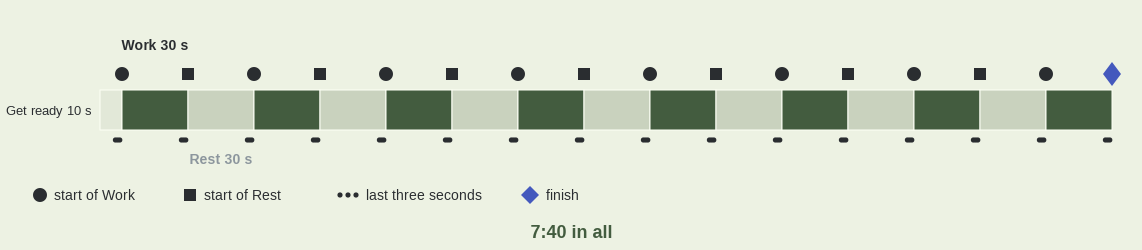
A run starts with a short get-ready countdown of 0, 5, 10 or 15 seconds. Then it goes work, rest, work, rest, and so on. The last round ends with work: there is no rest after it.
The timer opens at 30 seconds of work, 30 seconds of rest and 8 rounds, with 10 seconds to get ready. That comes to 7 minutes 40 seconds, counting the get-ready part. The starting numbers are a Living Room Strength rule. They aren't the hardest format on the page, on purpose.
Work goes from 5 seconds to 20 minutes, rest from 0 to 10 minutes, and rounds from 1 to 30. Each press moves 5 seconds at a time up to a minute, 15 seconds at a time up to 3 minutes, and a whole minute after that. Those limits are a Living Room Strength rule too; the long end is there for a time cap.
Once the timer is running, the settings lock, and they stay locked while it's paused. Press Reset to change them.
What do the four format buttons set?
Each button fills in the numbers from one row of HIIT, Tabata, EMOM and AMRAP: Four Ways to Time a Workout, which explains every format and where its numbers come from:
- 30 s work / 30 s rest × 8 is one example of high-intensity intervals. The U.S. Physical Activity Guidelines for Americans say there is no accepted length for the hard part or the rest part, and no accepted number of rounds (p. 60) [1]. So this row is only an example.
- 20 s work / 10 s rest × 8 is the format named after Tabata.
- 1 min rounds × 10, back to back starts a new round at the top of every minute, the way an EMOM is counted.
- One 10 min block is a single countdown, a time cap for an AMRAP.
The buttons describe the numbers rather than naming the format. That's a Living Room Strength rule. The same four rows sit in the table under the timer, and in a file: the interval formats as a CSV file (What is in this file).
How hard should the work part be?
The timer doesn't set your effort. The guidelines give a rough check called the talk test: during moderate effort you "can talk, but not sing," and during vigorous effort you "cannot say more than a few words without pausing for a breath" (p. 60) [1]. The National Institute on Aging describes vigorous effort the same way (adapted from the National Institute on Aging, NIH) [2].
Cardio without jumping is on Low-Impact Cardio at Home With No Jumping, which uses the moderate marker for pace: you can talk, but not sing. If you have neighbors below, pick moves marked Quiet in the Small-Space Workout Finder: Match Space, Noise and Equipment.

About this illustration
Illustration by Living Room Strength: a generated marker drawing of a room, not a photograph and not a guide to any move. It shows no people. Reuse it with credit to Living Room Strength; this site claims rights in it only as far as the law grants them.Can it time rest between sets?
Yes. Set 1 round, 0 seconds to get ready, and the work part to the rest you picked, then press Start when your set ends. Rest Between Sets and Days Between Sessions lists the rest ranges, and Strength Training at Home: Where a Beginner Starts shows where they fit in a session. This use is a Living Room Strength suggestion, not a separate mode.
What doesn't this timer do?
It doesn't count reps or the rounds you finished, and it saves nothing between visits. It isn't a practice-session timer with fixed blocks, and it has no metronome. It only runs work and rest in rounds.
Next session: press 30 s work / 30 s rest × 8, pick one Quiet move, and check the talk test in the last round.
Source trail
Living Room Strength rule
- The default 30 seconds of work, 30 seconds of rest, 8 rounds and 10 seconds to get ready; the limits and steps for each setting; no rest after the last round; when it beeps; button labels that describe the numbers instead of naming a format; using one round as a countdown for rest between sets
Living Room Strength set these itself. No source gives them, so read them as this site’s choice, not a finding.
Sources
Numbers in brackets point here. Anything marked Living Room Strength rule is this site’s own choice and has no source.
- U.S. Department of Health and Human Services. Physical Activity Guidelines for Americans, 2nd edition (2018) Open the source Read: Full guidelines; Chapter 4 (pages 56-62) and Chapter 7 (pages 88-93) used.
- National Institute on Aging, NIH. Three Types of Exercise Can Improve Your Health and Physical Ability (content reviewed 2025) Open the source Read: Full article; general principles only.
Elsewhere in the room
Corrections
No corrections on this page yet. If a line, a number or a drawing here is wrong, tell this site.