Stretch & MobilityReference
Static vs Dynamic Stretching: Where Each Fits
Living Room Strength ·
About this illustration
Illustration by Living Room Strength: a generated marker drawing of a room, not a photograph and not a guide to any move. It shows no people. Reuse it with credit to Living Room Strength; this site claims rights in it only as far as the law grants them.Answer first
Static stretching holds one position still. Dynamic stretching moves in and out of a position under control. Sources differ on where each belongs in a workout, so this page sets them side by side. It does not pick one answer as the only right one.
What is static stretching?
An open college textbook describes a static stretch this way: you move slowly and gradually toward the end of a joint's range, to the point of mild discomfort, then hold still [1]. Its section on stretching technique gives a hold of 30 to 90 seconds [1]. Its section on building a program adds a starting point of at least 10 seconds for very tight muscles [2].
Every stretch page on this site is static. Hip Flexor Stretch: Kneeling, Standing or Lying Down, Hamstring Stretch Lying Down, Seated or Standing and Shoulder Stretches Across the Chest, Overhead or With a Band all ease into a position and hold it.
What is dynamic stretching?
The same textbook describes dynamic stretching as exaggerated movements done slower and under control, with no forceful bouncing [1]. Its example is a sprinter taking a few extra-long strides before a race [1]. It also notes that these movements often call for good balance and coordination [1].
A bouncing version, called ballistic stretching, uses quick, forceful movements [1]. This site does not use bouncing stretches. That is a Living Room Strength rule.
The Army's fitness manual, ATP 7-22.02, has examples of both kinds. Its Squat Bender, part of the Preparation Drill, moves "at a slow cadence" and says to "Perform 5–10 repetitions" (para 3-8, p. 3-5) [7]. Its Recovery Drill holds positions instead, such as the rear lunge: "Hold the position for 20–30 seconds" (para 16-4, p. 16-2) [7].
How do they compare?
| Static | Dynamic | |
|---|---|---|
| How you move | Ease in slowly, then hold still [1] | Move in and out, slower than full speed, no bouncing [1] |
| How long | A hold, timed in seconds (see below) | A number of slow reps, such as 5 to 10 in the Army's Squat Bender [7] |
| What it asks of you | Going only to mild discomfort [1] | Balance and coordination [1] |
| On this site | The stretch pages, such as Full-Body Stretching Routine: Five Standing, Five on the Mat | Not a page of its own; see the warm-up below |
Where does each fit in a workout?
Here the sources differ. Each one is set out below, not merged into one answer.
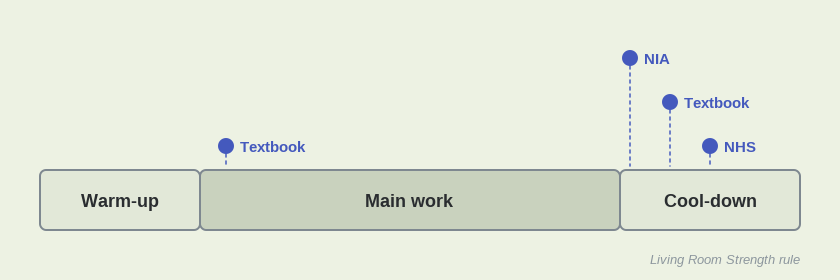
The college textbook. It says stretching has traditionally gone into the warm-up or the cool-down [2]. It then says recent studies suggest that stretching before a workout lowers the force muscles can produce, and it recommends stretching after the warm-up or after the workout [2].
The National Institute on Aging. Stretch once your muscles are warm, after strength or endurance work (adapted from the National Institute on Aging, NIH) [3].
The NHS. Its page of after-exercise stretches opens with "Use this routine to cool down after a workout". Information from the NHS website, as at 261126 (https://www.nhs.uk/live-well/exercise/how-to-stretch-after-exercising/) [6].
The U.S. activity guidelines. They say stretching, warming up and cooling down are often part of exercise programs, though their health benefits are not yet proven (p. 25) [4]. They call stretching an appropriate part of a plan even though its health benefits are unknown (p. 61) [4]. Their warm-up is usually the same activity at a slower speed or lower effort (p. 62) [4].
The Army manual. Its moving drill and its holding drill are separate drills with different names, Preparation and Recovery [7].
One review. A 2016 review of stretching studies found that changes in performance measured right after stretching were small to moderate, and that drops were larger after static holds of 60 seconds or more per muscle group than after shorter ones [5].
How long do the sources hold a static stretch?
- The NHS lists its after-exercise stretches as "hold for 15 to 20 seconds". Information from the NHS website, as at 261126 (https://www.nhs.uk/live-well/exercise/how-to-stretch-after-exercising/) [6].
- ATP 7-22.02 holds its Recovery Drill stretches for 20 to 30 seconds [7].
- The college textbook gives at least 10 seconds for very tight muscles, working toward 30 to 90 seconds, two to four times each [2].
The NHS and ATP times belong to their own stretches; the textbook's advice is general. This site's stretch pages list all three. Their Floor Cards use 20 seconds, a value inside the ranges each page lists (a Living Room Strength rule).
For a held stretch, the textbook says to go to the point of tightness or mild discomfort [2]. Don't stretch so far that it hurts (adapted from the National Institute on Aging, NIH) [3].
So what does this site do?
Its stretch pages don't choose a place in the workout for you. They give the sources' placements and let you pick.
About this illustration
Illustration by Living Room Strength: a generated marker drawing of a room, not a photograph and not a guide to any move. It shows no people. Reuse it with credit to Living Room Strength; this site claims rights in it only as far as the law grants them.For the start of a strength session, this site's warm-up page follows the guidelines' idea of the same activity at a slower speed or lower effort [4]. Moving warm-up ideas with no jumping are on Low-Impact Cardio at Home With No Jumping. To see where stretching sits next to strength work in a week, start at Strength Training at Home: Where a Beginner Starts.
Next session: pick one of the placements above for your stretches, and time one held stretch on each side.
Source trail
- Static stretching defined: slow and controlled to mild discomfort, then held; dynamic stretching defined: exaggerated movements done slower and controlled, without bouncing [1]
- Stretching traditionally in the warm-up or cool-down; recent studies on stretching before exercise; stretching after the warm-up or workout; at least 10 seconds toward 30 to 90 [2]
- Stretch when warmed up, after strength or endurance work [3]
- Stretching and warm-up health benefits not yet proven; stretching an appropriate part of a program; warm-up and cool-down at a slower speed [4]
- One sentence on performance changes measured right after stretching [5]
- Stretches as a cool-down after a workout; holds of 15 to 20 seconds (quoted) [6]
- A slow-cadence moving drill of 5 to 10 reps; held stretches of 20 to 30 seconds [7]
Living Room Strength rule
- No bouncing stretches on this site; this site's stretch pages list the sources instead of picking a placement
Living Room Strength set these itself. No source gives them, so read them as this site’s choice, not a finding.
Sources
Numbers in brackets point here. Anything marked Living Room Strength rule is this site’s own choice and has no source.
- Markell, Peterson and Johnson (Centralia College). Exercise and Nutrition, 5.4: Improving Flexibility. Medicine LibreTexts Open the source Read: Section 5.4 (static stretching). License: CC BY 4.0.
- Markell, Peterson and Johnson (Centralia College). Exercise and Nutrition, 5.5: Creating an Effective Stretching Program. Medicine LibreTexts Open the source Read: Section 5.5. License: CC BY 4.0.
- National Institute on Aging, NIH. Three Types of Exercise Can Improve Your Health and Physical Ability (content reviewed 2025) Open the source Read: Full article; general principles only.
- U.S. Department of Health and Human Services. Physical Activity Guidelines for Americans, 2nd edition (2018) Open the source Read: Full guidelines; Chapter 4 (pages 56-62) and Chapter 7 (pages 88-93) used.
- Behm DG et al. (2016). Acute effects of muscle stretching on physical performance, range of motion, and injury incidence in healthy active individuals: a systematic review. Applied Physiology, Nutrition, and Metabolism 41(1):1-11 Open the source Read: Abstract.
- NHS. How to stretch after exercising Open the source Read: Full page (page last reviewed 16 March 2026).
- Headquarters, Department of the Army. ATP 7-22.02, Holistic Health and Fitness Drills and Exercises, Oct 2020 (incl. C1, Sept 2025) Open the source Read: Chapters 2, 3, 6, 13, 14, 16 and 17 (exercise descriptions only; photographs not used).
Elsewhere in the room
Corrections
No corrections on this page yet. If a line, a number or a drawing here is wrong, tell this site.