Push & PullReference
Chin-Up vs Pull-Up Grip and Which Way the Palms Face
Living Room Strength ·
About this illustration
Illustration by Living Room Strength: a generated marker drawing of a room, not a photograph and not a guide to any move. It shows no people. Reuse it with credit to Living Room Strength; this site claims rights in it only as far as the law grants them.Answer first
Hanging from a bar, a pull-up grip turns your palms away from you; a chin-up grip turns them toward you. This site's bar pages use the pull-up grip, because both sources they rely on describe their bar work that way. The grip words in the U.S. Army's training manual are written for a bar you first take hold of, so they can look reversed on a bar over your head.
Which way do your palms face on each grip?
The Army manual ATP 7-22.02 names the grips by which way the palms face "when initially gripping a bar," using the body as the reference:
- "With the underhand or supinated grip, Soldiers turn their forearms and hands out so that their palms face away from the body when initially gripping a bar" (para 2-16, p. 2-5).
- "With the overhand or pronated grip, Soldiers turn their forearms and hands in so that the palms face toward the body when initially gripping a bar" (para 2-17, p. 2-5).
Now hang from a bar overhead. ATP's pull-up starts from a "Straight-Arm Hang using the closed overhand grip" (paras 6-5 and 13-7, pp. 6-3 and 13-6). HPRC, the Uniformed Services University's fitness resource, writes the grip for the same move as "palms facing away from you" in its pull-up sheet, Train Above the Bar.
Put those two together. On a bar overhead, the overhand grip points your palms away from you. The underhand grip is the opposite turn. As you hang, it points your palms toward you.
Why do the manual's words look backwards on a bar overhead?
ATP's definitions say "face toward the body" for overhand. Read on a bar over your head, that sounds like the palms should face you. They don't, as ATP's own pull-up and HPRC's sheet show.
This site reads the manual's words as if you were picking up a bar held in front of your thighs, the way a weight is first lifted from the floor. There, an overhand grip does turn the palms toward your thighs. Raise the same hands over your head without turning them, and the palms now face away from you. That reading, and the drawing below, are a Living Room Strength rule: the manual doesn't draw this out.
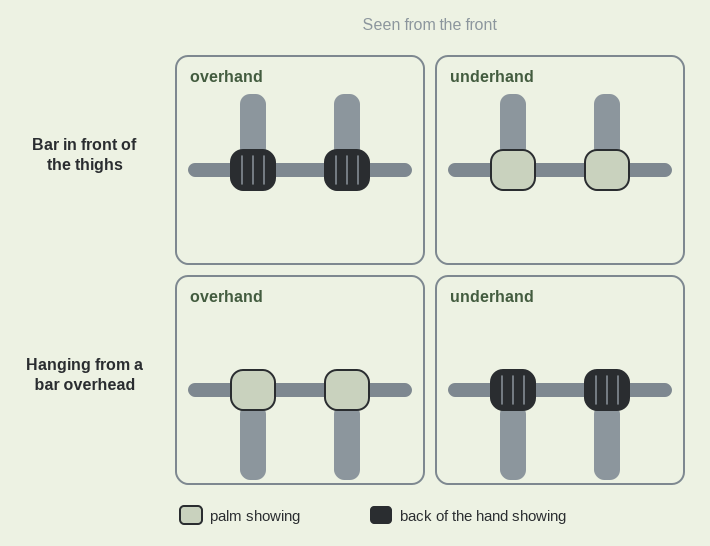
The same two grips, held low and held overhead. The forearms don't turn between the rows; raising the bar overhead is what makes the palms face the other way.
What counts as a chin-up, and what counts as a pull-up?
Neither source uses the word chin-up. ATP calls its bar exercise the Pull-Up and starts it from the closed overhand grip. HPRC's pull-up sheet keeps the palms facing away from you in every hang and pull on the bar.
On this site, a chin-up means the same pull from a straight-arm hang, but with the underhand grip, so your palms face you. That naming is a Living Room Strength rule, because the sources read for this page don't define the word.
About this illustration
Illustration by Living Room Strength: a generated marker drawing of a room, not a photograph and not a guide to any move. It shows no people. Reuse it with credit to Living Room Strength; this site claims rights in it only as far as the law grants them.This page doesn't say which one is harder or what each one works. The sources it uses don't compare the two, and this site doesn't write about muscles.
What is a neutral grip?
A neutral grip turns the hands so the thumbs point up. HPRC uses those words for one of its rows: "Hold with a palms-down or neutral (thumbs pointed up) grip."
In some moves with a weight in each hand, ATP uses a neutral grip. Its squat with dumbbells starts with "one weight at each side using a neutral grip" (para 14-6, p. 14-3). Its two-handed bent-over row holds the weights with a closed neutral grip too (para 13-10, p. 13-8).
The doorway pages on this site hang from the bar itself with the overhand grip, so they don't use a neutral grip.
Where does your thumb go?
Wrap it around the bar. In ATP's closed grip, Soldiers "wrap their thumb around the bar in the opposite direction to their fingers. The thumb normally overlaps with the fingers" (para 2-14, p. 2-5).
The same paragraph adds a second way to close the hand: "Occasionally they tuck the thumb beneath the fingers to form a hook grip." Either one keeps the thumb wrapped.
ATP also names an open grip and says, "It is not a safe grip for use on Climbing Drill or Free Weight Training exercises" (para 2-15, p. 2-5). Every bar page on this site keeps the thumb wrapped.
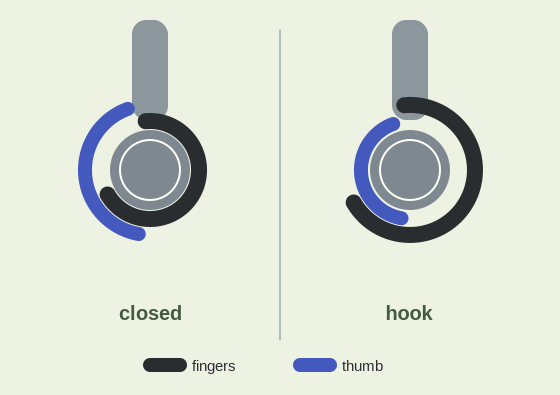
Two ways to close the hand. In both, the thumb goes all the way around the bar.
Which grip does each page on this site use?
- Dead Hang on a Doorway Bar: Check the Bar Before You Hang and Pull-Up Progression When You Can't Do One Yet: the closed overhand grip, palms facing away from you as you hang, from ATP and HPRC.
- Dumbbell Row at Home With One Hand on a Chair: one dumbbell held with the palm facing in, toward your body. That is a neutral grip, adapted from ATP's two-handed bent-over row (para 13-10, p. 13-8).
- Romanian Deadlift With Dumbbells, Hip Hinge First: a dumbbell in each hand in front of your thighs, palms facing your body. ATP's straight-leg deadlift calls this a pronated grip (para 13-4, p. 13-2), which is its overhand grip in its own, standing sense.
- Seated Resistance Band Rows on the Floor: you hold the two ends of a band. The source for that row doesn't name a grip, so the page doesn't set one.
The Romanian deadlift entry is a good check on the reading above. Standing, ATP's overhand grip faces your palms toward your body, just as its definition says. Its sumo squat holds a kettlebell with the "palms pronated to face the body" (para 13-3, p. 13-1).
Does this site have a chin-up page?
Not yet. This site has no version table for the chin-up, because the sources read so far describe the pull-up only with the overhand grip. If you hang with the underhand grip anyway, the bar checks on Pull-Up Progression When You Can't Do One Yet come first, the same as for any hang.
To see how a pull fits into a full session, start at Strength Training at Home: Where a Beginner Starts. Every bar version on this site, with the space and kit it needs, is listed in the Exercise Names: A Home Exercise Library by Movement.
Next session: before you hang, look at your hands on the bar and check that your palms face away from you and your thumbs wrap all the way around.
Source trail
- Overhand and underhand defined by where the palms face when you first take hold of a bar; closed, hook and open grips [1]
- The pull-up starts from a straight-arm hang with the closed overhand grip; some rows and squats with a weight in each hand use a neutral grip; standing, the pronated grip faces the palms toward the body [1]
- Hanging for a pull-up with the palms facing away from you; a neutral grip has the thumbs pointed up [2]
Living Room Strength rule
- Chin-up as the name for a pull from a hang with the palms facing you; reading the manual's grip words with a bar held in front of the thighs, and the four-panel drawing
Living Room Strength set these itself. No source gives them, so read them as this site’s choice, not a finding.
Sources
Numbers in brackets point here. Anything marked Living Room Strength rule is this site’s own choice and has no source.
- Headquarters, Department of the Army. ATP 7-22.02, Holistic Health and Fitness Drills and Exercises, Oct 2020 (incl. C1, Sept 2025) Open the source Read: Chapters 2, 3, 6, 13, 14, 16 and 17 (exercise descriptions only; photographs not used).
- Human Performance Resources by CHAMP (HPRC), Uniformed Services University. Train Above the Bar: Achieving Your First Pull-up (2020) Open the source Read: Full 4-page program sheet (photographs not used).
Elsewhere in the room
Corrections
No corrections on this page yet. If a line, a number or a drawing here is wrong, tell this site.