Cardio IndoorsReference
HIIT, Tabata, EMOM and AMRAP: Four Ways to Time a Workout
Living Room Strength ·
About this illustration
Illustration by Living Room Strength: a generated marker drawing of a room, not a photograph and not a guide to any move. It shows no people. Reuse it with credit to Living Room Strength; this site claims rights in it only as far as the law grants them.Answer first
HIIT, Tabata, EMOM and AMRAP are four ways to set the clock for a workout; none of them picks the moves. Choose a format, choose moves from this site's pages, and set how hard to go with the talk test. HIIT as the guidelines describe it also asks for maximal effort in the work periods. The table below sets the four side by side.
What is HIIT?
The U.S. Physical Activity Guidelines describe high-intensity interval training (HIIT) as short periods of maximal effort that alternate with less intense recovery periods (p. 60) [1]. They add that there are no agreed lengths for either period, no agreed ratio between them, no agreed number of rounds or total time, and no exact effort level for the hard part (p. 60) [1].
The NHS puts it this way: "Very vigorous activities are exercises performed in short bursts of maximum effort broken up with rest." "This type of exercise is also known as High Intensity Interval Training (HIIT)." Information from the NHS website, as at 261126 (https://www.nhs.uk/live-well/exercise/physical-activity-guidelines-for-adults-aged-19-to-64/) [2].
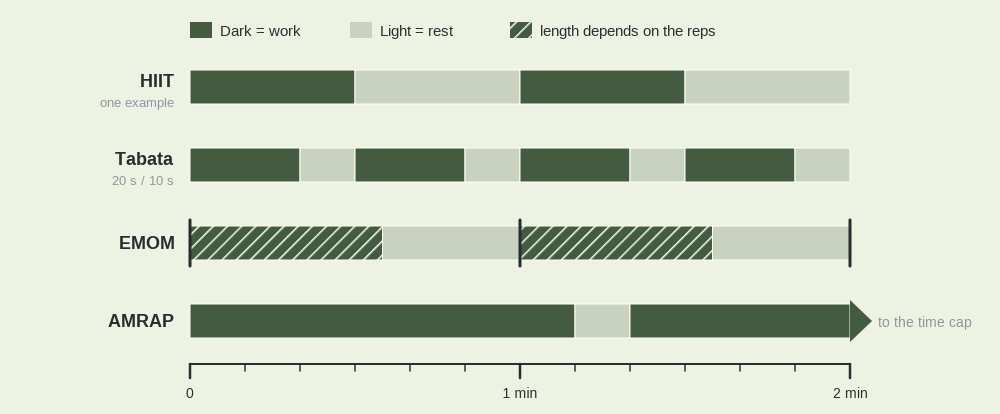
So HIIT is a family, not one fixed plan. This site's workout timer has a HIIT example of 30 seconds of work and 30 seconds of rest, eight times. That is one example, chosen by this site, not a standard.
What is Tabata?
On this site, Tabata means just the clock: 20 seconds on, 10 seconds off, eight rounds. The pattern is commonly called Tabata; that wording, and using the name for the clock alone, are Living Room Strength rules.
The same 20 and 10 appear in a 1996 study in which riders on a lab exercise bike did seven to eight 20-second bouts at about 170% of VO2max, a lab measure of aerobic fitness, with 10 seconds of rest between bouts [3].
This site uses eight rounds, the top of the study's seven to eight; that choice is also a Living Room Strength rule. The study's effort level, and its results, are not part of the format on this page. Nothing here asks you to match them.
What is EMOM?
EMOM stands for "every minute on the minute." On this site it means: at the start of each minute, you do a set number of reps of a move, and whatever is left of that minute is your rest. You count the minutes. This wording is a Living Room Strength rule, since no source on this site defines it.
Take the number of reps from the range on that move's page; How Many Sets and Reps? Ranges, Goals and Moving Up explains ranges. If the reps start to take most of the minute, there is little rest left. Use fewer reps next time, staying inside that move's range; if even the bottom of the range fills the minute, pick an easier version (also a Living Room Strength rule).
What is AMRAP?
AMRAP stands for "as many rounds as possible" (some plans use it for reps instead). On this site it means: you repeat a short list of moves, in order, until a time cap runs out. You rest only when you choose to, and you count the rounds you finish. This wording is also a Living Room Strength rule.
Every rep still follows that move's page. Each move's Floor Card says when a set ends, even inside a round. Going for more rounds does not change that.
The four formats side by side
| Format | Work | Rest | Rounds or time cap | How you count | Basis |
|---|---|---|---|---|---|
| HIIT | Short, hard work bouts; no one fixed length | Easier recovery between bouts | No fixed number | Count the work bouts | Physical Activity Guidelines for Americans, 2nd edition |
| Tabata | 20 seconds | 10 seconds | 8 rounds | The timer counts the rounds | Tabata et al. 1996, Medicine and Science in Sports and Exercise 28:1327 |
| EMOM | A set number of reps, started at the top of every minute | Whatever is left of that minute | A set number of minutes | Count the minutes | Living Room Strength rule |
| AMRAP | A short list of moves, repeated | Only when you choose to | A time cap | Count the rounds you finish | Living Room Strength rule |
The same table is free to download as a CSV file (What is in this file) (CC BY 4.0). The Basis column names the main source for each row, or says the row is this site's own wording.
On the Interval Workout Timer for Work, Rest and Rounds at Home page, each format has a preset button. The buttons are labeled with numbers, such as 20 s work / 10 s rest × 8, not with the format names.
How hard should a work bout feel?
You choose how hard to go. The formats only set the clock (a Living Room Strength rule).
HIIT is the exception, but only in its name. The guidelines describe its work periods as maximal effort, so an easier pace on a HIIT clock is still interval training, just not HIIT as they describe it.
Use the talk test to judge it. The guidelines say that at moderate effort you can talk, but not sing. At vigorous effort you cannot say more than a few words without stopping for a breath (p. 60) [1]. The National Institute on Aging says much the same: breathing hard but still able to hold a conversation is moderate, and only a few words between breaths is vigorous (adapted from the National Institute on Aging, NIH) [4].
In HIIT's hard bouts, breathing hard is expected; on a Tabata clock, how hard you breathe depends on the pace you choose. The guidelines list HIIT among vigorous activities (p. 59) [1]. They also give a 0 to 10 scale where moderate is a 5 or 6 and vigorous starts at 7 or 8 (p. 58) [1]. RPE Scale and Reps in Reserve for Home Sets explains ratings like this one.
If you are new to all of this, start with Low-Impact Cardio at Home With No Jumping, where the talk test sets the pace and nothing is timed.
Which moves work indoors without jumping?
None of the four formats needs jumping. The guidelines list jumping rope next to HIIT as vigorous (p. 59) [1], but the format and the move are separate choices.
For a quiet floor, pick moves by their noise label. Small-Space Workout Finder: Match Space, Noise and Equipment lists them by space and noise. The marching and knee lifts in Low-Impact Cardio at Home With No Jumping, or a strength move such as How to Squat at Home, From a Chair to a Goblet Squat, can fill a work bout. Choosing moves without jumping is a Living Room Strength rule, not a source's.
About this illustration
Illustration by Living Room Strength: a generated marker drawing of a room, not a photograph and not a guide to any move. It shows no people. Reuse it with credit to Living Room Strength; this site claims rights in it only as far as the law grants them.How do the minutes count toward your week?
The guidelines suggest 150 to 300 minutes of moderate aerobic activity a week, or 75 to 150 minutes of vigorous activity (p. 56) [1]. They count muscle-strengthening work separately (p. 56) [1]. For the strength side, start with Strength Training at Home: Where a Beginner Starts.
Next session: pick one format, set the timer to it before you start, and check the talk test at the end of the first work bout.
Source trail
- HIIT as short maximal-effort periods alternating with less intense recovery, with no agreed lengths, ratio, rounds, total time or intensity; HIIT and jumping rope listed as vigorous; the talk test; the 0 to 10 effort scale; weekly aerobic amounts [1]
- Very vigorous activity in short bursts of maximum effort broken up with rest, also known as HIIT (quoted) [2]
- Where the 20-second and 10-second numbers appear: seven to eight 20-second bouts with 10 seconds of rest, on a lab cycle at about 170% of VO2max (one sentence) [3]
- Talk test: breathing hard but able to hold a conversation is moderate; only a few words between breaths is vigorous [4]
Living Room Strength rule
- EMOM and AMRAP definitions in this site's words; Tabata as the common name for the 20-and-10 clock, used for the clock alone; eight rounds for Tabata; the 30-second example timer settings; effort left to you, except that HIIT by the guidelines' description is maximal effort; EMOM reps taken from each move page's range, with an easier version when even the bottom of the range fills the minute; choosing moves without jumping
Living Room Strength set these itself. No source gives them, so read them as this site’s choice, not a finding.
Sources
Numbers in brackets point here. Anything marked Living Room Strength rule is this site’s own choice and has no source.
- U.S. Department of Health and Human Services. Physical Activity Guidelines for Americans, 2nd edition (2018) Open the source Read: Full guidelines; Chapter 4 (pages 56-62) and Chapter 7 (pages 88-93) used.
- NHS. Physical activity guidelines for adults aged 19 to 64 Open the source Read: Full page (page last reviewed 22 May 2024).
- Tabata I et al. (1996). Effects of moderate-intensity endurance and high-intensity intermittent training on anaerobic capacity and VO2max. Medicine and Science in Sports and Exercise 28(10):1327-1330 Open the source Read: Abstract.
- National Institute on Aging, NIH. Three Types of Exercise Can Improve Your Health and Physical Ability (content reviewed 2025) Open the source Read: Full article; general principles only.
Elsewhere in the room
Corrections
No corrections on this page yet. If a line, a number or a drawing here is wrong, tell this site.