Stretch & MobilityHow-to
Shoulder Stretches Across the Chest, Overhead or With a Band
Living Room Strength ·

About this illustration
Illustration by Living Room Strength: a generated marker drawing of a room, not a photograph and not a guide to any move. It shows no people. Reuse it with credit to Living Room Strength; this site claims rights in it only as far as the law grants them.Answer first
Pick one of three shoulder stretches and hold it on each side. They are an arm across the chest, an arm pulled overhead, or a band behind your back. Move in slowly until the shoulder and upper arm feel tight, keep the Position lines below, and hold. The sources time these stretches differently; this page shows each one.
Floor Card
- Space
- Mat + reach
- Noise
- Quiet
- Kit
- resistance band
- Version today
- Across-the-chest, overhead or banded shoulder stretch
- Sets × seconds
- 1 × 20 per side
- Rest
- No clear source
- Spare-Two Check
- Not used here
- Easier
- Not used here
- Harder
- Not used here
- Stop for today if
- “Stop the exercise immediately if you feel any pain or become unwell.” If the pain does not go away, see a doctor.The quoted sentence: Information from the NHS website, as at 261126 (NHS). Seeing a doctor if the pain stays: Living Room Strength rule.
- End the set if
- The equipment moves or gives: the doorway bar shifts or creaks, the band has a nick, a cut or loose stitching, the chair or couch slides, or the step wobbles. End the set and check it against its instructions before the next one.What to look for on a band comes from the instructions that come with bands. Ending the set and checking: Living Room Strength rule.
- You can no longer keep one of the position lines. That rep or hold ends there.Going on only while the move meets its standard: Adapted from ATP 7-22.02, p. 13-7 (ATP 7-22.02).
Position lines
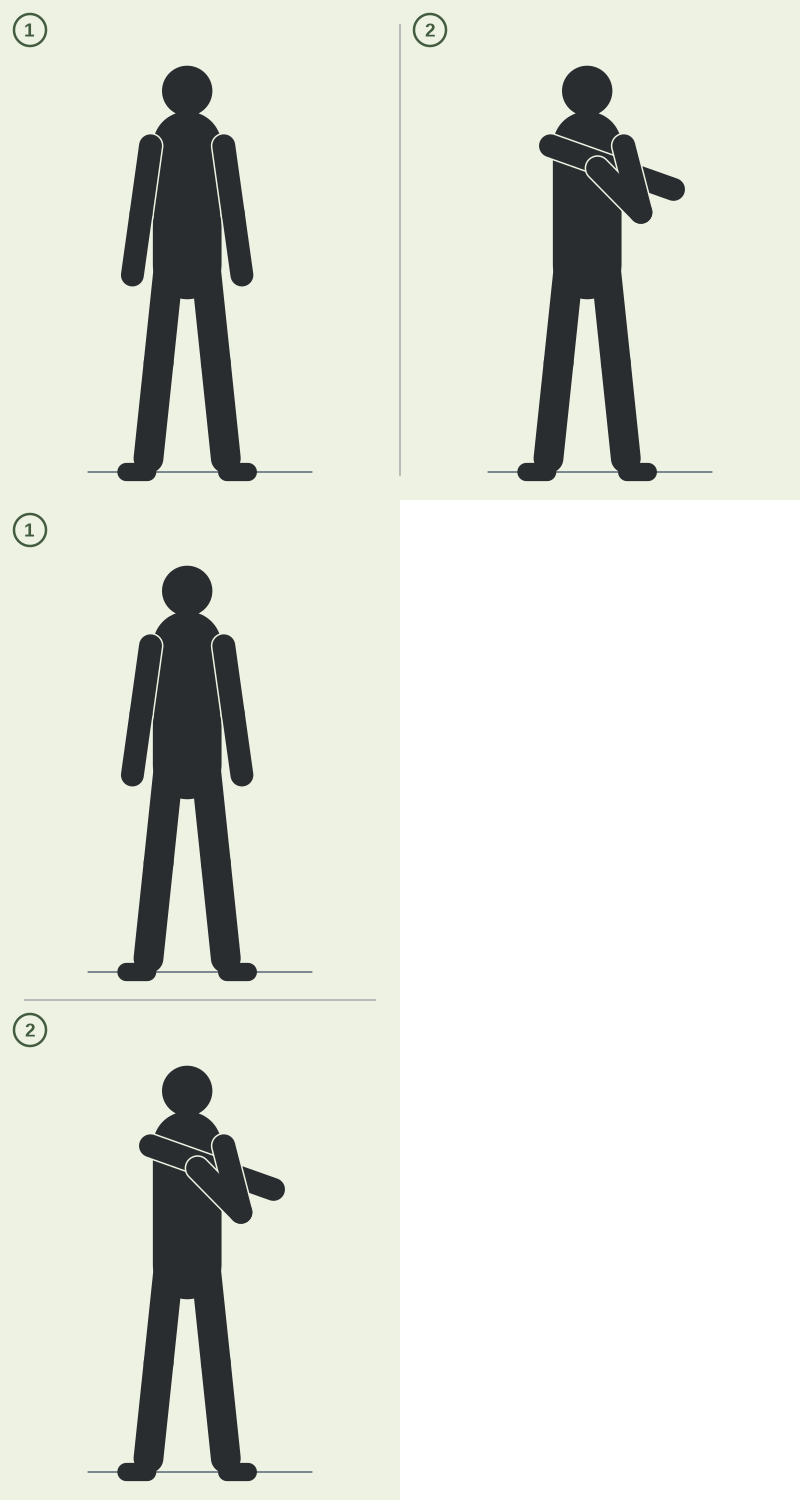
- Across the chest: one arm crosses the front of your chest, and the other hand holds it just above the elbow [1].
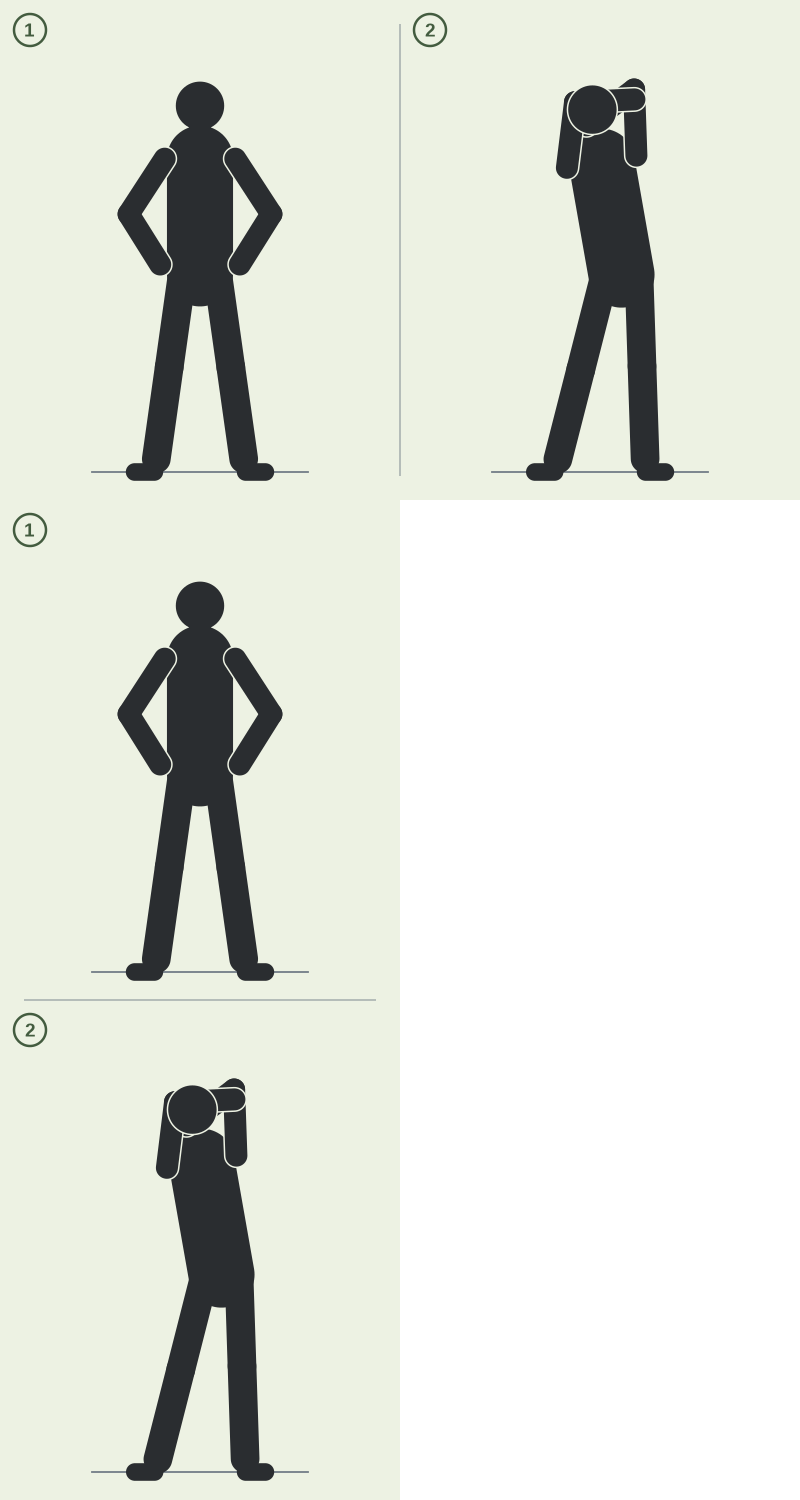
- Overhead: you start standing, feet shoulder-width apart and pointing ahead, hands on your hips [1].
- Overhead: one arm is raised overhead, the other hand holds just above that elbow and pulls it toward the other side, and your body leans the same way [1].
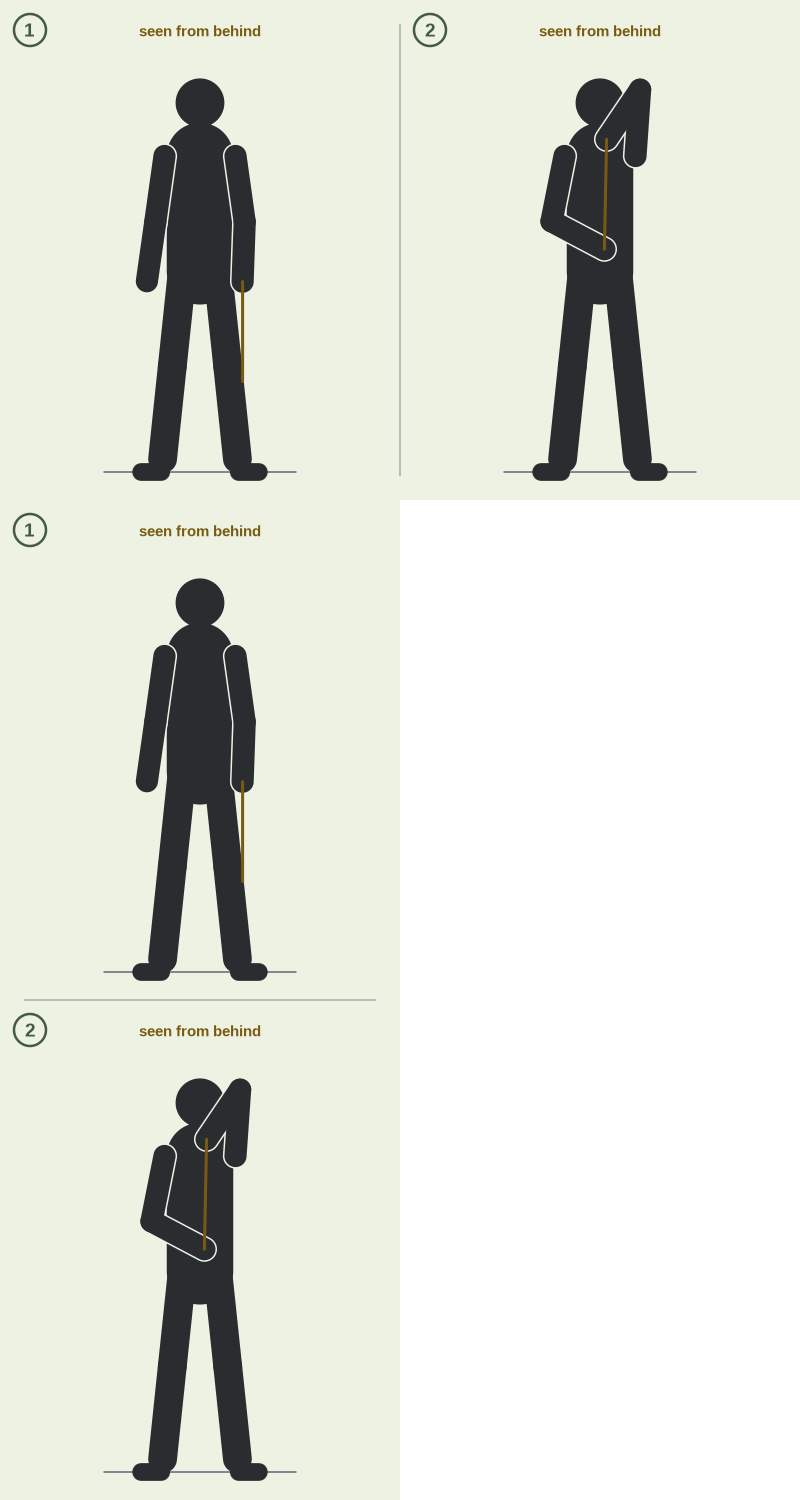
- Banded: one hand holds the band over your shoulder, and the other holds it behind your lower back [2].
- All three: you stop going deeper at the point of tightness or mild discomfort [3], and you never stretch so far that it hurts [4].
You can film one set from the side on your phone and check each line. The video stays on your phone; this site never sees it.
These are three separate stretches, not easier and harder versions of one stretch. Only the banded one needs a band; the other two need nothing.
The Army's fitness manual, ATP 7-22.02, describes the first two [1]. The banded stretch comes from a University of Illinois Extension exercise page [2]. The last line applies to all three and comes from two more sources [3][4].
How do you do the across-the-chest stretch?
Bring one arm across the front of your chest, then hold it just above the elbow with your other hand (panel 2). Pull it gently across. ATP 7-22.02 gives this as the modified form of its Overhead Arm Pull (para 16-12, p. 16-6) [1].
Hold, let go, and switch arms. The manual holds it for 20 to 30 seconds [1].
How do you do the overhead stretch?
ATP 7-22.02 calls this the Overhead Arm Pull (para 16-3, p. 16-1) [1]. Paraphrased:
- Stand with your feet shoulder-width apart and your hands on your hips (panel 1).
- Raise your left arm overhead.
- Hold just above your left elbow with your right hand.
- Pull the elbow to the right and lean your body to the right (panel 2).
- Hold, come back to the start, then do the other side.
The manual says you should feel the stretch at the back of the upper arm and down the side of your body [1].
Before the first hold, raise your arm once to check that it clears a ceiling fan or a hanging light. Switch a fan off and wait for it to stop. That check is a Living Room Strength rule.
How do you do the banded shoulder stretch?
The University of Illinois Extension describes this one on its exercise page [2]. In short: hold a band behind your back, with one hand reaching over your shoulder and the other behind your lower back (panel 2). With the band held short enough to be snug between your hands, give it a gentle pull until the shoulder and arm feel the stretch. Then swap hands so the other one is on top.
Don't stretch it past the length its instructions allow (a Living Room Strength rule, from band instructions in general).
Check the band before each use, the way band instructions say: look for nicks, cuts or loose stitching. If you have no band, the first two stretches on this page need nothing.
How long do you hold each stretch?
The sources time these differently:
- ATP 7-22.02 holds both of its arm stretches for 20 to 30 seconds (paras 16-3 and 16-12) [1].
- The Illinois Extension page does the banded stretch for five to eight counts, rests 30 seconds, and goes through it three times [2].
- An open college textbook says to stretch for at least 10 seconds for very tight muscles, work toward 30 to 90 seconds, and do each stretch two to four times [3].
The textbook's advice is general; the other two belong to their own stretches. The Floor Card's one 20-second hold on each side is a Living Room Strength rule. It falls inside the manual's and the textbook's ranges.
About this illustration
Illustration by Living Room Strength: a generated marker drawing of a room, not a photograph and not a guide to any move. It shows no people. Reuse it with credit to Living Room Strength; this site claims rights in it only as far as the law grants them.For the banded stretch, you can follow the Illinois counts instead. A workout timer can count either.
How far into the stretch do you go?
Go slowly and stay in control [3]. Move in until the shoulder and upper arm feel tight, or mildly uncomfortable, and hold still there [3]. Don't stretch so far that it hurts (adapted from the National Institute on Aging, NIH) [4].
Keep breathing while you hold (adapted from the National Institute on Aging, NIH) [4]. If a Position line slips, such as your hand sliding down to the wrist in the first stretch, end that hold.
When do these fit into a workout?
The textbook suggests stretching at least 2 to 3 days a week, and 5 to 7 if you can [3]. The National Institute on Aging suggests stretching once your muscles are warm, after strength or endurance work (adapted from the National Institute on Aging, NIH) [4]. Sources differ on stretching before a workout, and Static vs Dynamic Stretching: Where Each Fits sets them side by side.
The U.S. Physical Activity Guidelines call stretching an appropriate part of an exercise plan, even though its health benefits are unknown (p. 61) [5]. Time spent stretching does not count toward the guidelines for aerobic or strength work (p. 61) [5].
If you already own a band, Seated Resistance Band Rows on the Floor uses it for a pulling move, and a warm-up comes before that. To stretch the hips too, see Hip Flexor Stretch: Kneeling, Standing or Lying Down. To put these stretches into a longer set, see Full-Body Stretching Routine: Five Standing, Five on the Mat.
Next session: try the stretch you skipped today, read its Position line first, and time one hold on each side.
Source trail
- Overhead arm pull from a shoulder-width stance: arm up, the other hand above the elbow pulling toward the other side while the body leans; arm across the front of the chest held above the elbow; holds of 20 to 30 seconds [1]
- Band held behind the back, one hand over the shoulder and one behind the lower back, pulled gently; counts of five to eight, 30 seconds' break, three rounds (paraphrased) [2]
- Stretch to tightness or mild discomfort; at least 10 seconds, toward 30 to 90; two to four times; 2 to 3 days a week, ideally 5 to 7; slow and controlled [3]
- Never stretch so far that it hurts; keep breathing; stretch when warmed up [4]
- Health benefits of stretching unknown; stretching time does not count toward the aerobic or muscle-strengthening guidelines [5]
Living Room Strength rule
- Checking that a raised arm clears a ceiling fan or light; the band check before each use as band instructions describe; the Floor Card's one 20-second hold per side; holding the band short enough to be snug
Living Room Strength set these itself. No source gives them, so read them as this site’s choice, not a finding.
Sources
Numbers in brackets point here. Anything marked Living Room Strength rule is this site’s own choice and has no source.
- Headquarters, Department of the Army. ATP 7-22.02, Holistic Health and Fitness Drills and Exercises, Oct 2020 (incl. C1, Sept 2025) Open the source Read: Chapters 2, 3, 6, 13, 14, 16 and 17 (exercise descriptions only; photographs not used).
- University of Illinois Extension, Eat.Move.Save. Movement Library: Banded Shoulder Stretch Open the source Read: Full exercise page (steps).
- Markell, Peterson and Johnson (Centralia College). Exercise and Nutrition, 5.5: Creating an Effective Stretching Program. Medicine LibreTexts Open the source Read: Section 5.5. License: CC BY 4.0.
- National Institute on Aging, NIH. Three Types of Exercise Can Improve Your Health and Physical Ability (content reviewed 2025) Open the source Read: Full article; general principles only.
- U.S. Department of Health and Human Services. Physical Activity Guidelines for Americans, 2nd edition (2018) Open the source Read: Full guidelines; Chapter 4 (pages 56-62) and Chapter 7 (pages 88-93) used.
Elsewhere in the room
Corrections
No corrections on this page yet. If a line, a number or a drawing here is wrong, tell this site.